🎣 Gaff Length Calculator
Calculate the ideal gaff length based on boat freeboard, target species, and fishing scenario
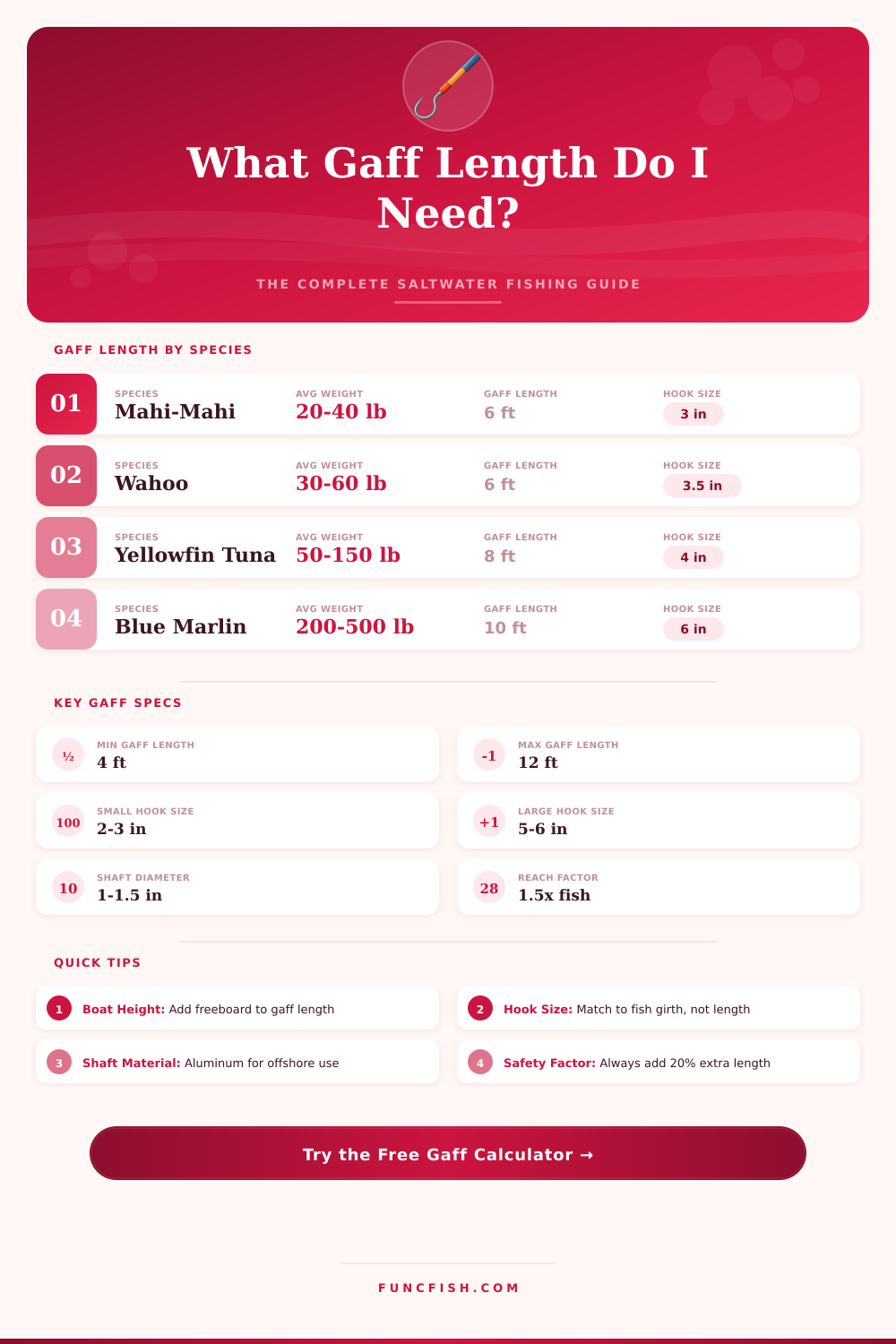
| Species | Typical Weight | Rec. Gaff Length | Hook Size | Min Hook Gap |
|---|---|---|---|---|
| Mahi-Mahi | 10–45 lb (4.5–20 kg) | 6–8 ft (1.8–2.4 m) | 3 in (7.6 cm) | 2.5 in (6.4 cm) |
| Yellowfin Tuna | 30–200 lb (14–91 kg) | 8–10 ft (2.4–3 m) | 4 in (10 cm) | 3.5 in (8.9 cm) |
| Bigeye Tuna | 80–300 lb (36–136 kg) | 8–10 ft (2.4–3 m) | 4.5 in (11.4 cm) | 4 in (10 cm) |
| Blue Marlin | 200–1000 lb (91–454 kg) | 10–12 ft (3–3.7 m) | 6 in (15 cm) | 5 in (12.7 cm) |
| Wahoo | 20–80 lb (9–36 kg) | 6–8 ft (1.8–2.4 m) | 3.5 in (8.9 cm) | 3 in (7.6 cm) |
| Swordfish | 100–600 lb (45–272 kg) | 8–12 ft (2.4–3.7 m) | 5 in (12.7 cm) | 4.5 in (11.4 cm) |
| Cobia | 20–100 lb (9–45 kg) | 6–8 ft (1.8–2.4 m) | 3 in (7.6 cm) | 2.5 in (6.4 cm) |
| Tarpon | 60–200 lb (27–91 kg) | 6–8 ft (1.8–2.4 m) | 4 in (10 cm) | 3 in (7.6 cm) |
| Grouper | 10–100 lb (4.5–45 kg) | 6–8 ft (1.8–2.4 m) | 3 in (7.6 cm) | 2.5 in (6.4 cm) |
| Shark (small) | 50–200 lb (23–91 kg) | 8–10 ft (2.4–3 m) | 5 in (12.7 cm) | 4 in (10 cm) |
| Boat Type | Typical Freeboard | Base Gaff Length | Rough Seas Add |
|---|---|---|---|
| Kayak / SUP | 0.5–1 ft (15–30 cm) | 4–5 ft (1.2–1.5 m) | +0.5 ft (15 cm) |
| Flats Boat / Skiff | 1–2 ft (30–60 cm) | 5–6 ft (1.5–1.8 m) | +1 ft (30 cm) |
| Center Console (20–25 ft) | 2.5–3.5 ft (76–107 cm) | 6–8 ft (1.8–2.4 m) | +1 ft (30 cm) |
| Center Console (26–35 ft) | 3–4 ft (91–122 cm) | 7–9 ft (2.1–2.7 m) | +1.5 ft (46 cm) |
| Sport Fisher / Yacht | 4–6 ft (1.2–1.8 m) | 8–12 ft (2.4–3.7 m) | +2 ft (60 cm) |
| Charter / Party Boat | 4–7 ft (1.2–2.1 m) | 8–12 ft (2.4–3.7 m) | +2 ft (60 cm) |
| Pier (low) | 3–5 ft (91–152 cm) | 6–8 ft (1.8–2.4 m) | +1 ft (30 cm) |
| Pier (high bridge) | 10–30 ft (3–9 m) | 12+ ft with rope gaff | N/A |
| Fish Girth | Rec. Hook Gap | Hook Gap (metric) | Typical Species |
|---|---|---|---|
| 6–9 in (15–23 cm) | 2 in (5 cm) | 5 cm | Snook, Small Mahi |
| 9–12 in (23–30 cm) | 2.5 in (6.4 cm) | 6.4 cm | Cobia, Mahi, Wahoo |
| 12–16 in (30–41 cm) | 3 in (7.6 cm) | 7.6 cm | Yellowfin, King Mack. |
| 16–22 in (41–56 cm) | 4 in (10 cm) | 10 cm | Large Tuna, Tarpon |
| 22–30 in (56–76 cm) | 5 in (12.7 cm) | 12.7 cm | Marlin, Swordfish |
| 30+ in (76+ cm) | 6+ in (15+ cm) | 15+ cm | Giant Marlin, Bluefin |
A gaff are a tool that is used to secure a fish. The lengths of the handle of a gaff is one of the factor that dictates whether or not an individual is able to successfully land there caught fish. If the handle of a gaff is too short for the type of fish that is being target, for instance, then the individual may not be able to effectively reach the fish that is present in the water.
Should the individual not be able to effectively reach the fish that is being caught in the water, the fish may shake the hook of the gaff and escape. Thus, an individual must select the more proper length for the handle of a gaff based off the environment in which they are catch the fish. The environment from which an individual is fishing will dictate the length of the handle necessary for the gaff.
How to Choose the Right Gaff Length
For instance, an individual that is fishing from a kayak may require a gaff with a shorter handle then an individual that is fishing from a center console boat; the boat’s hull push the fish further away from an individual fishing from a center console boat. Similarly, the individual that is fishing from a pier may require the most long handle for their gaff; the pier create a high drop between the individual and the water. The type of fish that is being target will also dictate the specification of the gaff that an individual should utilize.
Factors to consider include the shape of the body of the fish and the strength of the fish. For instance, an individual that is targeting a species of fish with a compact body, like a redfish, may require a gaff with a smaller gap in which the hook extend; a larger gap in the gaff would be required for a large fish, like a halibut or a cobia. Additionally, if an individual is planning to use the gaff to perform a head shot with the fish with the hook, the individual will need to select the gaff with enough length to clear the bow of the boat.
The conditions of the water in which the individual is fishing are another factor to consider when selecting a gaff. If the water is calm, an individual can utilize a gaff with shorter handle. However, if the water have swells or chop, the individual should utilize a gaff with a longer handle; the swells will cause the individual’s platform to move in the water, reducing their time to properly strike the fish with the gaff.
An individual may make mistake when selecting a gaff. For instance, an individual may select a gaff according to how the gaff may look in a photography shoot rather than according to the highest rail of the boat. Another mistake may be ignore the material from which the gaff is made; aluminum will flex when used to remove a fish from a pier, but a carbon fiber gaff will remain stiff.
Additionally, an individual must ensure the weight of the fish will not exceed the capacity of the gaff handle. In order to ensure success with the gaff, an individual should perform proper maintenance of the gaff. The hooks on the gaff should be sharp, and the grips on the handle should be secure.
If the hooks is not sharp, they may not be able to effectively secure the fish; if the grips are not secure, the individual may not be able to control the gaff. Thus, by ensuring the gaffs length is matched to the environment, species of fish, and conditions of the water in which they are fishing, the individual will increase their likelihood of successfully securing of the caught fish.