⚖️ Permit Weight Calculator
Calculate gross vehicle weight, axle loads & legal weight limits for oversize/overweight permits
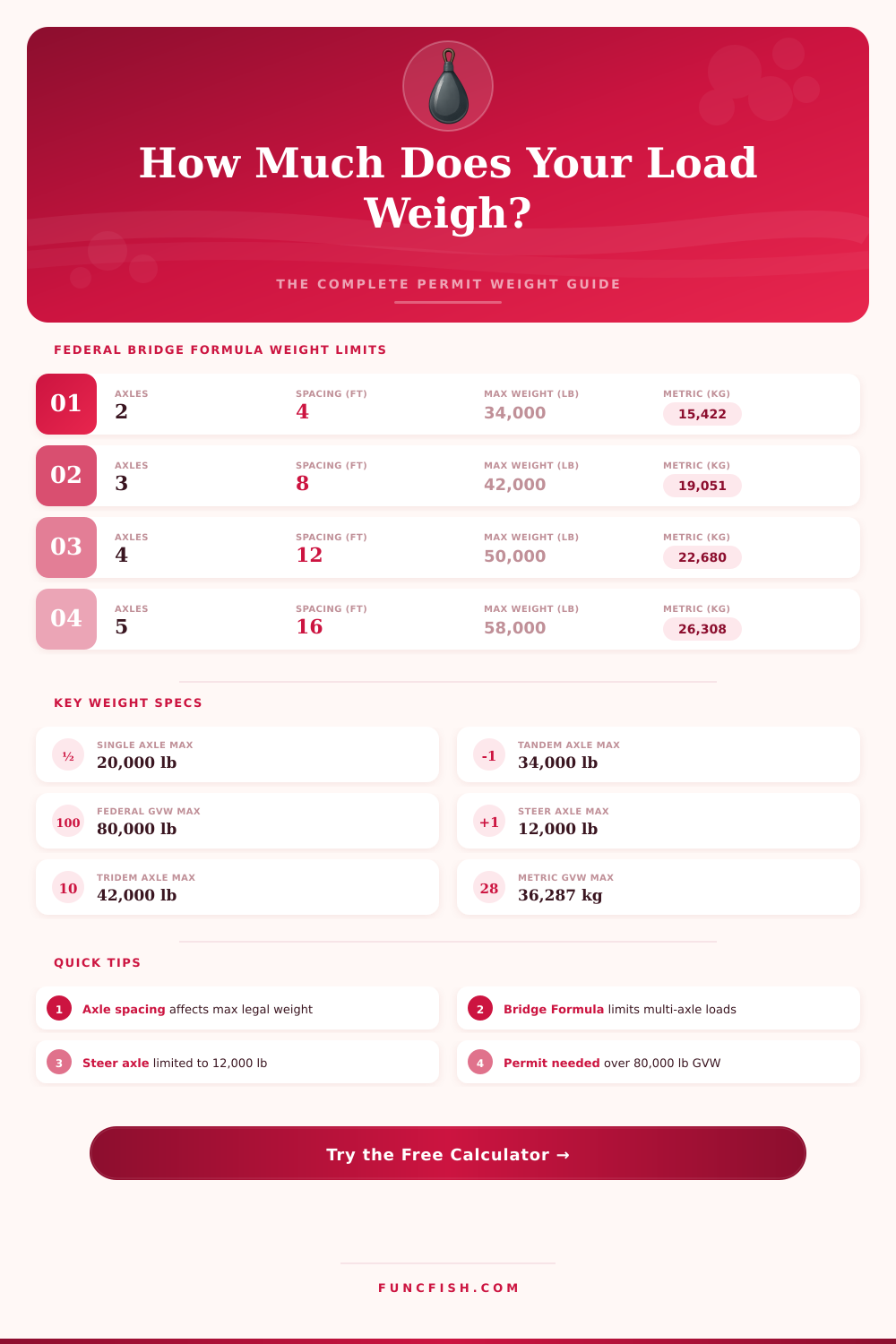
| Axle Group | Min Spacing (ft) | Max Weight (lb) | Max Weight (kg) | Notes |
|---|---|---|---|---|
| Single Axle | — | 20,000 | 9,072 | Federal limit |
| Tandem Axle (2) | 4 | 34,000 | 15,422 | Standard drive/trailer |
| Tridem Axle (3) | 8 | 42,000 | 19,051 | Some states allow |
| Quad Axle (4) | 12 | 50,000 | 22,680 | Permit may be needed |
| 5-Axle Group | 16 | 58,000 | 26,308 | Permit required |
| Steer Axle | — | 12,000 | 5,443 | Front axle limit |
| Gross Vehicle | — | 80,000 | 36,287 | Federal GVW max |
| Vehicle Type | Typical Tare (lb) | Max Payload (lb) | Typical GVW (lb) | Axles |
|---|---|---|---|---|
| Standard 5-Axle Semi | 35,000–38,000 | 42,000–45,000 | 80,000 | 5 |
| Flatbed Truck | 33,000–36,000 | 44,000–48,000 | 80,000 | 5 |
| Tanker (Liquid) | 36,000–40,000 | 40,000–44,000 | 80,000 | 5 |
| Dump Truck (Single) | 26,000–30,000 | 16,000–22,000 | 46,000–52,000 | 2–3 |
| Lowboy (Heavy Haul) | 40,000–50,000 | 40,000–80,000+ | 80,000–160,000 | 5–13 |
| Concrete Mixer | 28,000–34,000 | 18,000–28,000 | 60,000–66,000 | 3–4 |
| Double Trailer | 40,000–44,000 | 36,000–40,000 | 80,000 | 6–7 |
| Auto Hauler | 32,000–36,000 | 25,000–30,000 | 65,000–80,000 | 4–5 |
| State / Region | Single Axle (lb) | Tandem Axle (lb) | GVW (lb) | Permit Type |
|---|---|---|---|---|
| Federal Standard | 20,000 | 34,000 | 80,000 | N/A (baseline) |
| Texas | 20,000 | 34,000 | 80,000 | Routine / Superload |
| California | 20,000 | 34,000 | 80,000 | Single Trip / Annual |
| Florida | 22,000 | 44,000 | 80,000 | FL SB 1096 permit |
| Michigan | 18,000 | 32,000 | 164,000 (11-axle) | Special Permit |
| Colorado | 20,000 | 36,000 | 85,000 | O/W Permit |
| Illinois | 20,000 | 34,000 | 80,000 | OSOW Permit |
In order to estimate the weight of an permit, you need to take measurements of both the length and the girth of the fish. These two measurement is necessary to account for the fact that permits dont grow in a uniform manner, and that most of the permit’s weight come from its shoulders. A permit with a long body but thin shoulders will weigh less than a permit that has short length but thick shoulder.
Thus, it is necessary to measure the girth of the fish in order to arrive at an accurate weight estimate for the permit. Fork length is one of the main measurements that are used to estimate the weight of the permit. Pinching the tail forks together when measuring the length of the permit is important to provide accurate measurements; if the tail is not pinched together, the length of the permit will be overstated by around 5 or 6 percent of the total length of the permit.
How to Measure a Permit Fish to Estimate Its Weight
Additionally, you should avoid curved measuring tapes when measuring the length of the permit; if the permit is arched along the curve of the tape, the length will be inaccurate measured. Finally, total length is generally not used to estimate weight; total length is usually 5 to 6 percent longer than fork length, and if curved tapes are used to measure total length, errors in measurement could again occur due to the arched shape of the permit. The girth of the permit is the measurement of the width of the permit; this is one of the measurement that must be taken in order to determine the weight of the permit.
The girth should be measured at the widest point of the permit’s body. The widest point is typically located direct behind the pectoral fin. Additionally, another important measurement of the permit is the ratio of its depth to its fork length.
If the depth of the permit is 33 to 34 percent of the length of the permit, it is considered to be a standard permit. If the depth of the permit is 31 percent of its fork length, it is a lean permit. If the depth of the permit is 36 percent of its length, it is a thick permit.
Because the girth of the permit can significantly alter its weight, it is important to measure the girth at the widest point of the body. Depending off the region in which the permit was caught, permit weights may differ. For instance, permit in the Florida Keys are usually sturdier than permit from the remainder of the species’ range; thus, different formulas can be used for permit from the Keys region than those used for the remainder of the species range.
Additionally, the Gulf region has thinner permits due to the pass currents; thus, different formulas exists for permits from the gulf region. Finally, the permit species in the Yucatan may have different weights due to the bulk of the spawning permits in that region; thus, permit weights in that region should also be considered in relation to regional permit profiles. In addition to the region from which the permit originated, there are additional factors that can contribute to the weight of the permit.
For instance, permits in the pre-spawn season can weigh 4 percent more than permits that are not in the pre-spawn period. Additionally, the condition of the permit also indicates its weight; permits in peak physical condition will weigh more than permits in lean condition. Thus, if you measure the length of the permit, but the girth of the permit and the condition of the permit are not considered, it is likely that the weight of the permit will be underestimated.
When using the weight estimates of the permit, there are three different measurement that can be used to describe the weight of the permit: the primary weight, the confidence band, and the relative condition. The primary weight is the weight of the permit in metric or imperial units. The confidence band is the range of potential weights that can be expected from the permit based on the imprecision of the measuring tools that may be used.
Finally, the relative condition of the permit is a measurement of the weight of the permit in comparison to the standard permit of the same length; this makes it possible to determine if the permit is lean or thick. Finally, the weight of the permit can be used to determine the type of fishing gear that should be used when trying to catch a permit of this size. For instance, if the permit weighs between 5 and 14 pounds, a 20-pound fluorocarbon fishing line leader should be used.
Additionally, if fishing near bridges where permit are likely to hide in shadows, a 30-pound leader should be used to ensure that the permit can be properly control if it weighs between 12 and 30 pounds. Using the correct leader and drag settings will make it easier to catch and control the permit while reeling in the line. You should of used more careful measurements to recieve a better result.
It’s a lot of work to find the exact weight of these fish and the moddern tools dont always help.