🐟 Cutthroat Trout Weight Calculator
Estimate weight from length & girth measurements using proven fish weight formulas
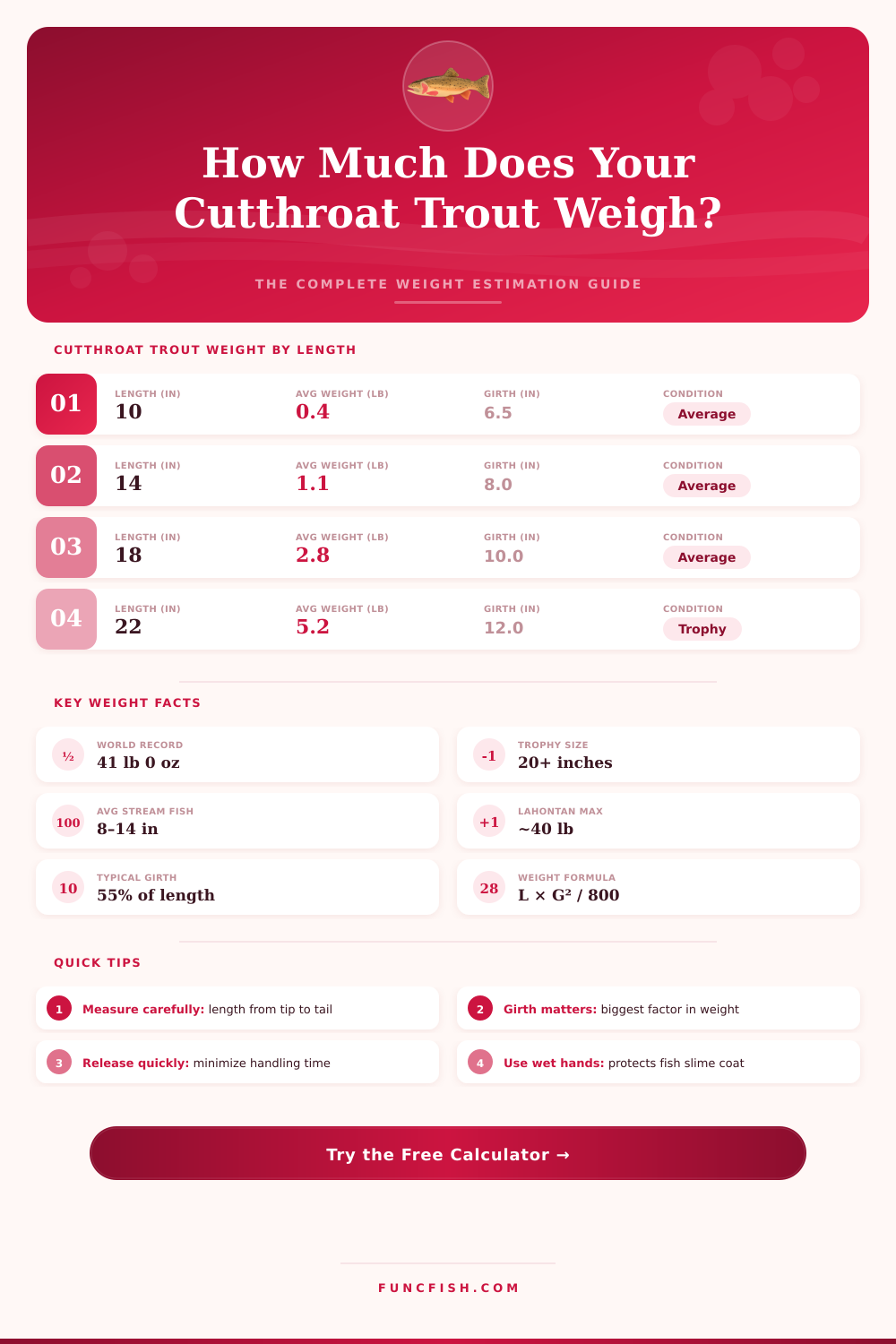
| Length (in) | Length (cm) | Est. Weight (lb) | Est. Weight (kg) | Typical Girth (in) | Classification |
|---|---|---|---|---|---|
| 8 | 20.3 | 0.2 | 0.09 | 5.0 | Fingerling |
| 10 | 25.4 | 0.4 | 0.18 | 6.0 | Small |
| 12 | 30.5 | 0.7 | 0.32 | 7.0 | Small |
| 14 | 35.6 | 1.2 | 0.54 | 8.2 | Average |
| 16 | 40.6 | 1.8 | 0.82 | 9.3 | Average |
| 18 | 45.7 | 2.8 | 1.27 | 10.5 | Good |
| 20 | 50.8 | 3.9 | 1.77 | 11.5 | Good |
| 22 | 55.9 | 5.3 | 2.40 | 12.5 | Trophy |
| 24 | 61.0 | 7.0 | 3.18 | 13.5 | Trophy |
| 26 | 66.0 | 9.0 | 4.08 | 14.5 | Trophy+ |
| 28 | 71.1 | 11.3 | 5.13 | 15.5 | Exceptional |
| 30 | 76.2 | 14.0 | 6.35 | 16.5 | Exceptional |
| Subspecies | Typical Length Range | Typical Weight Range | Record Weight | Habitat |
|---|---|---|---|---|
| Yellowstone | 10–24 in (25–61 cm) | 0.5–6 lb (0.2–2.7 kg) | ~11 lb (5 kg) | Mountain lakes & rivers |
| Coastal | 10–28 in (25–71 cm) | 0.5–10 lb (0.2–4.5 kg) | ~14 lb (6.4 kg) | Pacific coast streams |
| Lahontan | 12–36 in (30–91 cm) | 1–20 lb (0.5–9 kg) | 41 lb (18.6 kg) | Great Basin lakes |
| Rio Grande | 8–16 in (20–41 cm) | 0.2–2 lb (0.1–0.9 kg) | ~3 lb (1.4 kg) | Rocky Mtn headwaters |
| Bonneville | 10–24 in (25–61 cm) | 0.5–7 lb (0.2–3.2 kg) | ~14 lb (6.4 kg) | Bear River drainage |
| Westslope | 8–20 in (20–51 cm) | 0.3–4 lb (0.1–1.8 kg) | ~9 lb (4.1 kg) | Columbia River basin |
| Fish Size | Est. Weight | Rod Power | Line Weight | Leader / Tippet |
|---|---|---|---|---|
| Under 12 in (30 cm) | Under 0.7 lb (0.3 kg) | Ultralight | 2–4 lb (1–2 kg) | 6X–7X (2–3 lb) |
| 12–16 in (30–41 cm) | 0.7–1.8 lb (0.3–0.8 kg) | Light | 4–6 lb (2–3 kg) | 5X–6X (3–4 lb) |
| 16–20 in (41–51 cm) | 1.8–3.9 lb (0.8–1.8 kg) | Light–Med | 6–8 lb (3–4 kg) | 4X–5X (4–6 lb) |
| 20–24 in (51–61 cm) | 3.9–7 lb (1.8–3.2 kg) | Medium | 8–12 lb (4–5 kg) | 3X–4X (6–8 lb) |
| Over 24 in (61 cm+) | 7 lb+ (3.2 kg+) | Med–Heavy | 12–17 lb (5–8 kg) | 2X–3X (8–10 lb) |
Estimating the weights of a cutthroat trout is difficult due to the fact that cutthroat trout of the same length may have different weight. The reason that cutthroat trout of the same species may have different weights is due to the fact that cutthroat trout has different feeding habits. Cutthroat trout that eats more often and have more available food will be heavier than those that eat less frequent.
Therefore, it is not possible to rely on the length of the trout alone to determine the weight of that particular trout. However, the girth of the trout is a more accurate measurement of the weight of the trout. Because the weight of the trout is calculated according to the girth of the trout square, any increase in the girth of the trout will lead to a much more larger increase in the measured weight of the trout.
How to Estimate a Cutthroat Trout’s Weight
Moreover, even the smallest error in the measurement of the girth will lead to inaccuracies in the weight measurement of the trout. The weight calculator use the girth of the trout and different biological coefficient to arrive at the weight of the trout. The different subspecies of cutthroat trout have different body shapes.
For instance, the Lahontan cutthroat trout lives in deep lakes, and has a deep body profile. In contrast, the Rio Grande cutthroat trout lives in small creeks, and has a thinner body profile then other cutthroat trout. Therefore, you must select the subspecies of cutthroat trout in the calculator so that the weight estimate reflect the body structure of that specific subspecies of cutthroat trout.
The environment in which the cutthroat trout lives may also affect the weight of the trout. For instance, cutthroat trout that live in fast, freestone streams must fight against the currents with there bodies. The act of fighting against the current causes the trout to develop a lean body structure.
In contrast, cutthroat trout that live in reservoirs or terminal lakes do not have to fight against the current in their waters. Therefore, cutthroat trout that live in these environments may develops deep bellies and heavy shoulder. Therefore, the weight calculator must account for the water type in which the cutthroat trout lives.
The different seasons of the year may affect the weight of a cutthroat trout. For instance, the weight of cutthroat trout fluctuate according to the weather outside of the trout’s habitat, as well as according to the spawning cycle of the female cutthroat trout. During the spring and fall seasons, female cutthroat trout store large amount of egg mass while laying eggs.
This egg mass adds to the weight of the female trout without adding to its length. Additionally, cutthroat trout that have spawned may be thin due to the use of their energy reserve during the spawning process. Therefore, the calculator must account for the season during which the cutthroat trout was weighed in order to provide the most accurate estimate of the weight of the trout.
Another factor to consider when estimating the weight of a cutthroat trout is the confidence in the measurements of the trout. For instance, using a calibrated tape rule to measure the girth of the trout will produce more accurate results than attempt to estimate the length of the trout from a photograph. Additionally, providing a range of weights calculated for the trout will be more accurate than providing a single estimate of the weight of the trout.
Moreover, if a person is only performing an estimation of the weight of the trout from a photograph, a wider confidence band would be used to protect the person calculating the weight from providing an inaccurate estimate of the weight of the trout. These different estimates of the weight of cutthroat trout can be used to monitor the growth of the cutthroat trout over time. While a digital scale can provide the exact weight of the cutthroat trout, these mathematical models allows for the categorization of the weight of the trout without the need for heavy equipment.
Additionally, by understanding the relationship between the length, girth, and subspecies of cutthroat trout, that relationship can be used to understand the weight of that specific type of cutthroat trout.