🐟 Yellow Bass Weight Calculator
Estimate yellow bass weight from length & girth using proven angler formulas
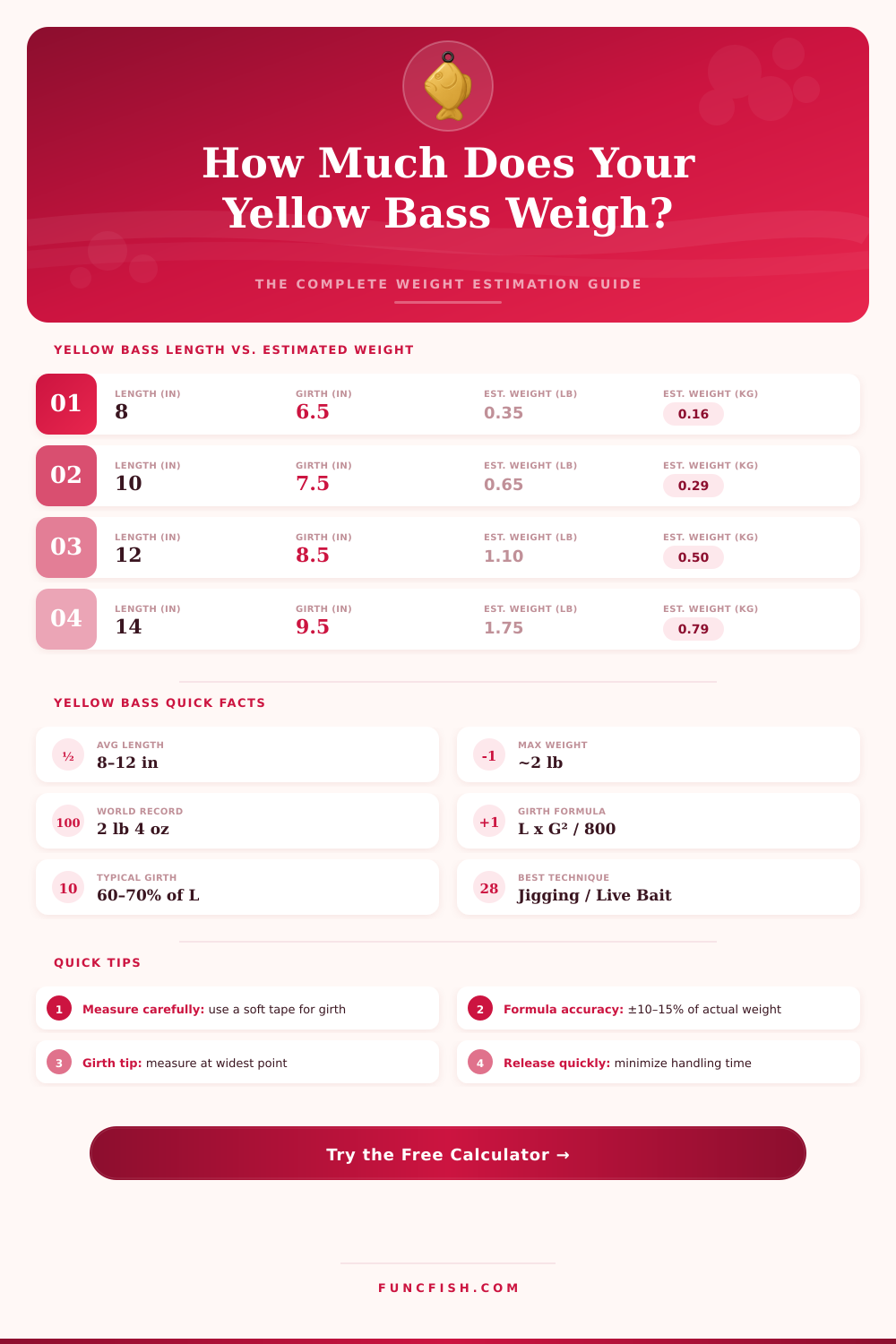
| Length (in) | Length (cm) | Est. Weight (lb) | Est. Weight (kg) | Typical Girth (in) | Category |
|---|---|---|---|---|---|
| 6 | 15.2 | 0.14 | 0.06 | 4.0 | Juvenile |
| 7 | 17.8 | 0.21 | 0.10 | 4.7 | Sub-legal |
| 8 | 20.3 | 0.32 | 0.15 | 5.4 | Sub-legal |
| 9 | 22.9 | 0.46 | 0.21 | 6.0 | Keeper |
| 10 | 25.4 | 0.63 | 0.28 | 6.7 | Keeper |
| 11 | 27.9 | 0.83 | 0.38 | 7.4 | Good |
| 12 | 30.5 | 1.08 | 0.49 | 8.0 | Good |
| 13 | 33.0 | 1.37 | 0.62 | 8.7 | Above Avg |
| 14 | 35.6 | 1.72 | 0.78 | 9.4 | Trophy |
| 15 | 38.1 | 2.11 | 0.96 | 10.0 | Trophy |
| Formula Method | Formula Used | 12" Result (lb) | Best Use Case |
|---|---|---|---|
| Standard (L³/1600) | 12³ / 1600 | 1.08 | No girth available |
| Girth (L x G²/800) | 12 x 8² / 800 | 0.96 | Girth measured |
| Bass-Specific (L x G²/900) | 12 x 8² / 900 | 0.85 | Stocky bass body type |
| Condition Factor Low | CF 0.55 applied | 0.83 | Lean fish / poor habitat |
| Condition Factor Avg | CF 0.65 applied | 0.98 | Average seasonal fish |
| Condition Factor High | CF 0.75 applied | 1.13 | Well-fed trophy specimen |
| Linear Regression | Regression estimate | 1.05 | Field survey data |
| Fulton K Factor | K = 1.0 baseline | 1.08 | Population studies |
| Species | Avg Weight Range | Typical Length | Weight Formula Divisor |
|---|---|---|---|
| Yellow Bass | 0.3 – 2.0 lb | 8–14 in | 1600 (standard) |
| White Bass | 0.5 – 3.0 lb | 10–17 in | 1400 |
| Striped Bass | 5 – 30 lb | 18–36 in | 1200 |
| Largemouth Bass | 1 – 8 lb | 12–22 in | 1600 |
| Smallmouth Bass | 0.5 – 5 lb | 10–20 in | 1600 |
| Rock Bass | 0.2 – 1.5 lb | 7–13 in | 1800 |
In order to determine the weights of a yellow bass, an individual must consider several factor regarding the physical make-up of the fish. Length alone will not provide an accurately indication of the weight of a yellow bass. For instance, two yellow bass fish may have the same length, but the weight of each fish may differs due to the body condition of each fish.
A yellow bass that consume shad will have more weight in they body than a yellow bass that consumes insects due to the yellow bass having a larger belly. Therefore, an individual will need to consider the girth of the fish in addition for the length of the fish in order to determine its weight. The time of year that a yellow bass is caught can also impact the weight of that fish.
What Affects the Weight of a Yellow Bass
For instance, female yellow bass gains weight during the pre-spawn phase of the year due to the fact that they are carrying eggs. Consequently, the female yellow bass will weigh more then a yellow bass of the same length that is caught during a different time of year. Additionally, yellow bass may weigh less during the post-spawn phase of the year due to the fact that they are thinly and exhausted after spawning.
Thus, the time of year that the yellow bass is caught can impact its body mass, thus impacting the weight calculation of that fish. Finally, the environment in which the yellow bass lives can have an impact on the weight and body density of the yellow bass. For instance, a yellow bass that lives in a high-oxygen spillway with a constant supply of food will contain more body fats and weigh more than a yellow bass that lives in a stagnant backwater basin.
For example, the muscular build of river yellow bass is a result of the fish struggle against the current in their habitat. Reservoir yellow bass, on the other hand, have a much more abundantly supply of food, causing them to develop a rounder and heavier build. As such, the environment has a great deal of influence over the physical build of yellow bass, which in turn influence the way that yellow bass feel when you are fishing for them.
In addition to the physical characteristics of yellow bass, the social behavior of these fish is another means of determine the size of the bass that you may encounter. Yellow bass are known to exhibit social behavior and form school of fish. However, depending on the density of the school of yellow bass that you encounter, the size of the yellow bass may change.
Schools of yellow bass may contains fish of all sizes. However, if you are fishing in edge pods, where larger yellow bass live, you are more likely to encounter larger yellow bass. This is due to the fact that large yellow bass tend to push smaller yellow bass away from there location.
Since you must match the weight of the yellow bass with the fishing gear that you use to catch them, gear failure is avoided. If you use a heavy fishing rod to catch a school of small yellow bass, the yellow bass will struggle to move the heavy fishing rod. Alternatively, using an ultralight fishing rod to catch a large school of yellow bass may snap the fishing line due to the weight of the yellow bass.
Selecting fishing gear that match the mass of the yellow bass will allow you to maintain control over the bass that you catch. Additionally, reference table exist that compare the size of yellow bass to other fish species in the same habitat, such as white bass or striped bass. However, yellow bass tend to have a more narrower size range as compared to other mentioned species.