🐟 White Bass Weight Calculator
Estimate white bass weight from length & girth — imperial & metric, instant results
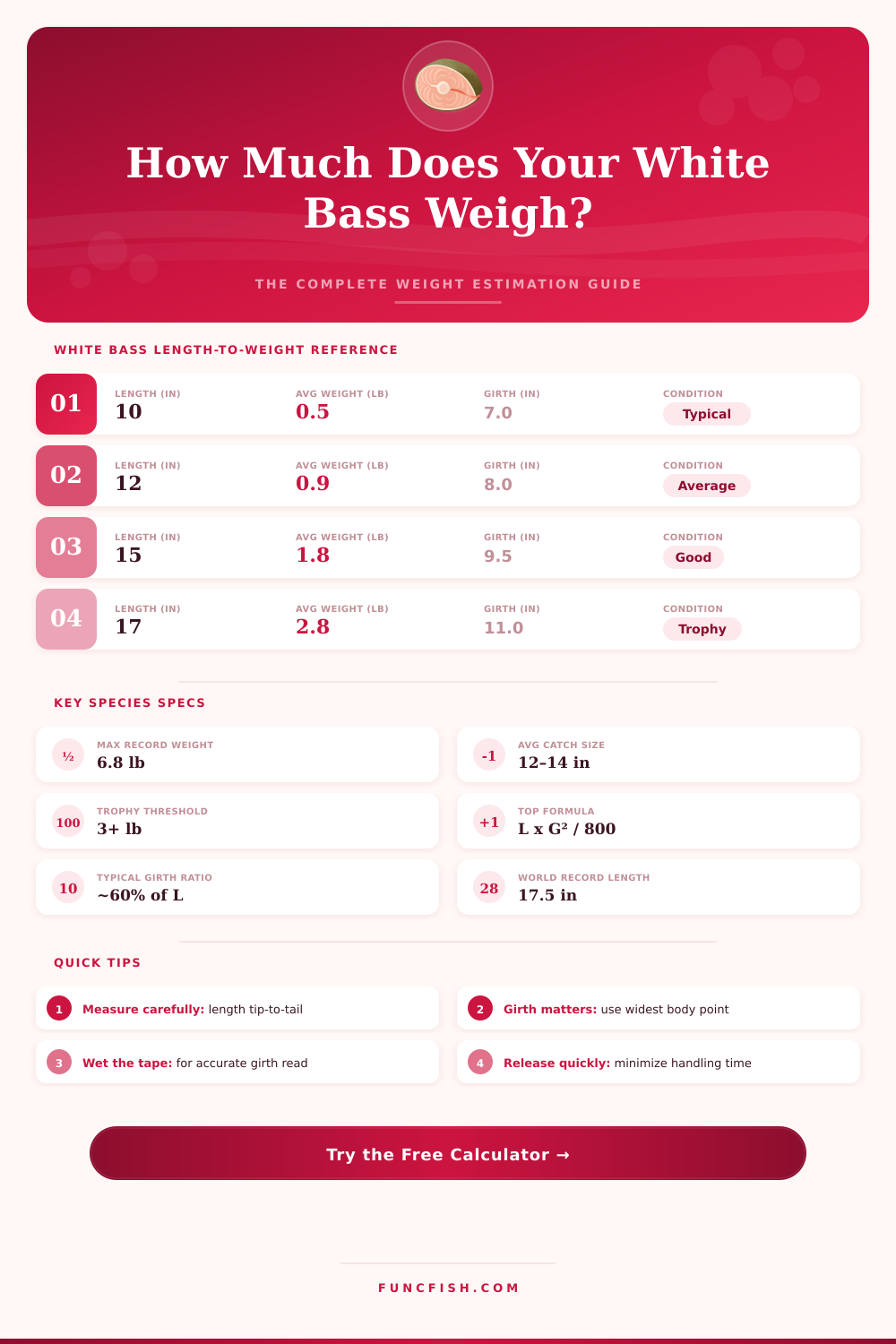
| Length (in) | Length (cm) | Est. Weight (lb) | Est. Weight (kg) | Avg Girth (in) | Classification |
|---|---|---|---|---|---|
| 8 | 20.3 | 0.30 | 0.14 | 5.5 | Sub-Legal |
| 10 | 25.4 | 0.55 | 0.25 | 7.0 | Small |
| 11 | 27.9 | 0.75 | 0.34 | 7.5 | Small |
| 12 | 30.5 | 0.95 | 0.43 | 8.0 | Average |
| 13 | 33.0 | 1.30 | 0.59 | 8.8 | Average |
| 14 | 35.6 | 1.65 | 0.75 | 9.5 | Good |
| 15 | 38.1 | 2.10 | 0.95 | 10.0 | Good |
| 16 | 40.6 | 2.65 | 1.20 | 10.7 | Quality |
| 17 | 43.2 | 3.20 | 1.45 | 11.2 | Trophy |
| 17.5 | 44.5 | 3.60 | 1.63 | 11.5 | World-Class |
| Formula | Best For | Est. Weight (lb) | Accuracy Notes |
|---|---|---|---|
| Standard (L x G² / 800) | All freshwater bass | 1.59 | ±5% typical |
| Girth-Adjusted (/ 750) | Heavier body fish | 1.69 | Better for chunky fish |
| Length-Only Estimate | No girth measurement | 1.50 | ±15% wider margin |
| Preston Curve | Panfish & bass species | 1.62 | Good mid-season estimate |
| Anderson Species-Specific | White bass population data | 1.55 | Calibrated for Morone |
| Species | Typical Length | Typical Weight | Record Weight |
|---|---|---|---|
| White Bass (M. chrysops) | 10–17 in | 0.5–3 lb | 6.8 lb |
| Striped Bass (M. saxatilis) | 20–40 in | 5–30 lb | 81.9 lb |
| Yellow Bass (M. mississippiensis) | 8–14 in | 0.3–1.5 lb | 2.63 lb |
| Wiper / Hybrid Striped Bass | 14–28 in | 2–15 lb | 27.4 lb |
| White Perch (M. americana) | 8–12 in | 0.25–1 lb | 4.9 lb |
To measure a white bass fish, one must determine the weight of a white bass without using a scale to do so. One can estimate the weight of white bass by measuring the length of the white bass and the girth of the white bass. Length and girth are used to estimate the weight of a white bass because the body shape of a white bass change with the season in which the fish is found and the environment in which it live.
For instance, white bass will often be thinner in the postspawn season of the year when the fish are resting and recovering after spawning. In contrast, white bass will be thicker in the pre spawn season of the year when the white bass is populated with eggs. Thus, length alone is not a sufficient measure of the weight of a white bass; measuring the girth of the white bass is necessary.
How to Estimate the Weight of a White Bass
The girth of a white bass should be measured at its thickest portion, which is located behind the pectoral fin of the fish. Environmental factor will influence the weight of the white bass that is being measured. One must consider these environmental factors when estimating the weight of a white bass.
For instance, white bass that live in lakes that contain high populations of shad will be thicker than white bass that live in creek arm. Additionally, the season in which the white bass is located will impact its weight; white bass will lose weight after spawning and gain weight during fall feeding periods of the year. Based off the length and girth measurements of the white bass, one can create a confidence band for the weight of the white bass.
A confidence band indicates the range of weights that can exist for the white bass; it is a measure of the inaccuracies inherent in the estimation of the weight of the white bass through measurement of length and girth. The tools that are use to measure the length of the white bass will impact the accuracy of the estimation of the weight of that fish. A soft measuring tape should be used instead of a ruler to measure the length of the fish.
Using a ruler to measure the length of the tail of the white bass may cause the length of the fish to be estimated as more short than the actual length of the tail of the fish. Additionally, if the angler wraps a ruler too loosely around the thickest portion of the body of the fish, the girth may be underestimated for that fish. Thus, inaccurate measuring tools will result in inaccurate estimations of the weight of the white bass.
While it may be difficult to measure the length and girth of the white bass by eye, many anglers will use photo of the white bass to estimate its length and girth. However, using photos to estimate length and girth is inaccurate due to the potential for the human eye to be fool by the proportions of the white bass in that photo. The relationship between the length and girth of a white bass can reveal information regarding the condition of the white bass.
For instance, comparing the girth of that bass to its length calculates the relative condition score for a white bass. For an average white bass fish, its girth will be approximately 58% of the length of the fish. If the girth is more than 100% of the girth that is expected for the length of the fish, then the white bass is a thick fish.
If the girth of the fish is less than 100% of the expected girth for the length of that white bass, then it is a lean fish. By being able to determine whether a white bass is a thick or lean fish, anglers can make decisions regarding the type of fishing tackle that should be used for that species of fish. The type of tackle that should be used for a white bass will depend upon the size of that fish.
For instance, if the size of the bass is under 10 inches in length, then ultralight finesse fishing tackle should be used to catch the white bass. If the size of the white bass is between 10 and 15 inches in length, medium light fishing tackle with 1/8 ounce jig should be used. For white bass that are over 17 inches in length, medium fishing rods and 10 pound fishing line should be used.
By being able to estimate the weight and thickness of the white bass by measuring the length and girth of the fish, anglers can determine the type of fishing tackle that should be used for the white bass. Thus, measuring the length and girth of a white bass will ensure that the proper fishing equipment is select for that species of fish.