Line Stretch Calculator
Estimate fishing line elongation, stretch percent, hookset delay, and shock absorption from line material, length out, line test, diameter, drag load, water temperature, shock load, and knot or leader system.
📌 Named Line Presets
⚙ Line Stretch Inputs
The model estimates elastic stretch at the working load by combining material stretch curves, line length, load-to-test ratio, diameter, water temperature, and knot or leader efficiency. Real line varies by brand, age, water soak, abrasion, and spool memory.
Line Stretch Results
Calculation Breakdown
⚖ Line Material Comparison Grid
Nylon Mono
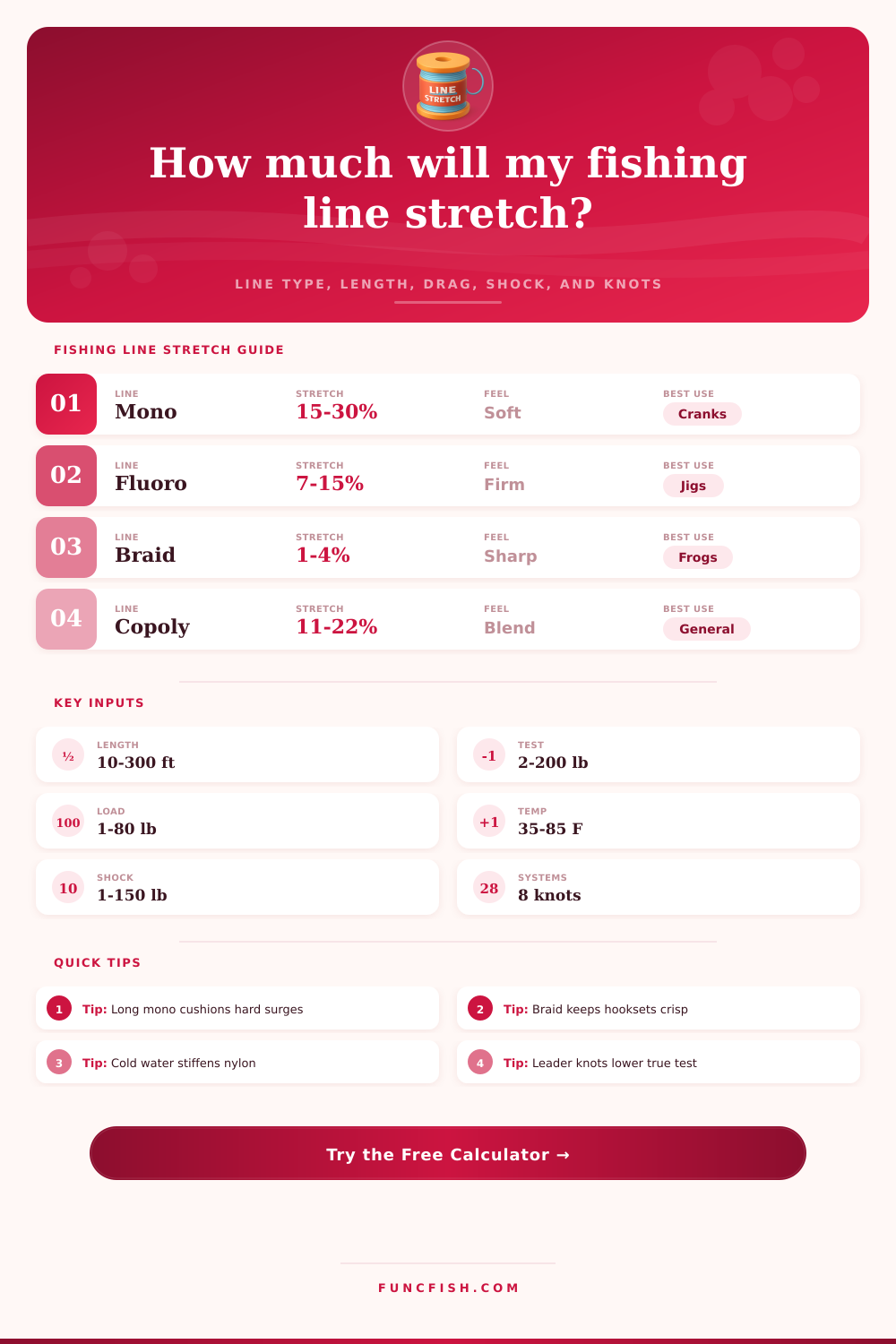
15-30% High stretchStrong cushion for trebles, trolling, and sudden boatside runs.
Fluorocarbon
7-15% Firm stretchLower elongation than mono with dense, crisp pressure transfer.
PE Braid
1-4% Low stretchFast hooksets and high sensitivity with little built-in cushion.
Copolymer
11-22% Moderate stretchA middle ground for general casting and moving baits.
Fused Braid
3-6% Firm superlineMore give than round braid, still much firmer than mono.
Dacron
5-10% Backing stretchCommon backing with some cushion over long runs.
Hollow Braid
2-5% Low stretchHeavy offshore connection line with strong direct pressure.
Wire Leader
<1% Nearly rigidBite protection with almost no shock cushion by itself.
📊 Reference Tables
| Line material | Typical stretch window | Hookset feel | Calculation note |
|---|---|---|---|
| Nylon monofilament | 15% to 30% near high working loads | Softest and most forgiving | Stretch rises quickly as load nears line test |
| Fluorocarbon | 7% to 15% near high working loads | Firm, dense pressure transfer | Cold water and thick diameters can make it feel stiffer |
| PE braid | 1% to 4% near high working loads | Very crisp and direct | Leader material and rod action provide most cushion |
| Copolymer mono | 11% to 22% near high working loads | Balanced and slightly springy | Often falls between mono and fluorocarbon behavior |
| Wire leader | Under 1% in normal fishing loads | Rigid and immediate | Main line and drag supply nearly all shock absorption |
| Line length out | Stretch effect | Hookset effect | Best watch point |
|---|---|---|---|
| Under 30 ft / 9 m | Short total elongation | Fast pressure transfer | Drag spikes arrive quickly |
| 30 to 90 ft / 9 to 27 m | Moderate working stretch | Typical casting range | Material choice is noticeable |
| 90 to 180 ft / 27 to 55 m | Large stretch distance on mono | Delayed hook pressure | Reel down before sweeping hard |
| Over 180 ft / 55 m | Very high total elongation | Long travel before full load | Braid or firmer leaders may help sensitivity |
| Knot or leader system | Efficiency range | Cushion effect | Use in calculator |
|---|---|---|---|
| Direct Palomar or San Diego jam | 90% to 96% | Minimal added cushion | Strong direct connection for braid or mono |
| Improved clinch | 78% to 88% | Minimal added cushion | Raises working load ratio sooner |
| FG braid to fluorocarbon leader | 85% to 95% | Leader adds measured give | Sharp main line with some front-end cushion |
| Swivel plus leader | 82% to 92% | Leader adds noticeable give | Good for trolling, bait rigs, and toothy fish |
| Bimini double line | 92% to 98% | Spreads shock across a double section | Best margin for heavy drag and shock spikes |
| Water temperature | Nylon mono | Fluorocarbon | Braid / wire |
|---|---|---|---|
| 35 to 45°F / 2 to 7°C | Stiffer, less stretch | Firm and crisp | Very small change |
| 46 to 60°F / 8 to 16°C | Slightly reduced stretch | Near baseline | Very small change |
| 61 to 75°F / 16 to 24°C | Baseline calculator zone | Baseline calculator zone | Baseline calculator zone |
| 76 to 90°F / 24 to 32°C | Softer, more stretch | Slightly more stretch | Very small change |
💡 Calculation Tips
Hookset check: Compare stretch distance to the rod sweep you actually have. Long casts with mono can use much of the sweep before the hook sees full pressure.
Shock check: The score rewards elastic cushion and remaining test margin. Low-stretch braid can still work well when drag, rod action, and leader choice supply cushion.
Line stretch is an elastic lengthening of fishing line when a fish pull on the line. The elastic nature of fishing line can cause a fish to be missed during a hookset if the line stretch are too high. If the pressure from the hookset dont reach the fish quickly, or if the line stretch is too high, the fish will shake the hook free from it’s mouth.
Differant type of fishing line have different amount of line stretch. Lines such as nylon monofilament has high amounts of line stretch and act as a shock absorber for the line due to the elastic nature of nylon monofilament. The elastic nature of the line is helpful in absorbing the sudden movement of the fish, but can delay the hookset because of the longer period of time it take for the line to tighten.
How Line Stretch Affects Fishing
Lines such as fluorocarbon and braided lines has less line stretch than nylon monofilament lines. Fluorocarbon and braided lines is firmer lines that provide the fishing pressure to the hook faster than nylon monofilament lines. Because these lines has less line stretch, they are at a higher risk of break if the drag isnt correctly set on the reel.
The length of the fishing line will also affect the line stretch of the fishing line. Using a short length of fishing line will result in minimal line stretch. Using a longer length of fishing line, such as 150 feet of line, will allow for more line stretch.
Additionally, the type of knots that you use in the line will also affect the line stretch. Some knots will increase the line stretch, but others will decrease the line stretch of the fishing line. Water temperature also affect the amount of line stretch that occurs with nylon monofilament fishing lines.
With cold water, nylon monofilament fishing lines will become stiff, resulting in less line stretch. With warm water, the nylon monofilament lines will become limp, resulting in more line stretch. Braided lines does not change with water temperature, so the amount of line stretch will be the same, whether the fishing line is in cold or warm water.
The force that a person applies to the fishing line will also change the amount of line stretch that occurs with the fishing line. If a person apply force that is steady to the line, the line stretch will be moderate. If the fishing line experience a sudden, sharp pull from the fish, the amount of line stretch will be high.
This sudden pull on the fishing line is referred to as a shock load. If the shock load is applied to the fishing line too quickly, the line may elongate rapid. Additionally, if the hookset delay with the fishing line is too long due to the line stretch, the fish will not remain hooked to the fishing line.
The type of fishing line that a person should use depend on the situation in which they is fishing. For instance, if a person is fishing with deep crankbaits, people use nylon monofilament lines because of the line stretch. If a person is fishing in thick vegetation, people use braided lines because of the very little line stretch of these lines.
The age of the fishing line also has to be considered. If the fishing line has been sitting in the sun for long periods, it may become old and brittle; it’s line stretch properties will be different than fresh fishing lines. Additionally, old fishing lines are more likely to snap unexpectedly when under heavy tension.
By understanding how to choose the proper amount of line stretch for the fishing situation a person is enacting, that person can increase the number of fish that remain hooked to there fishing line.