Hook Size for Saltwater Calculator
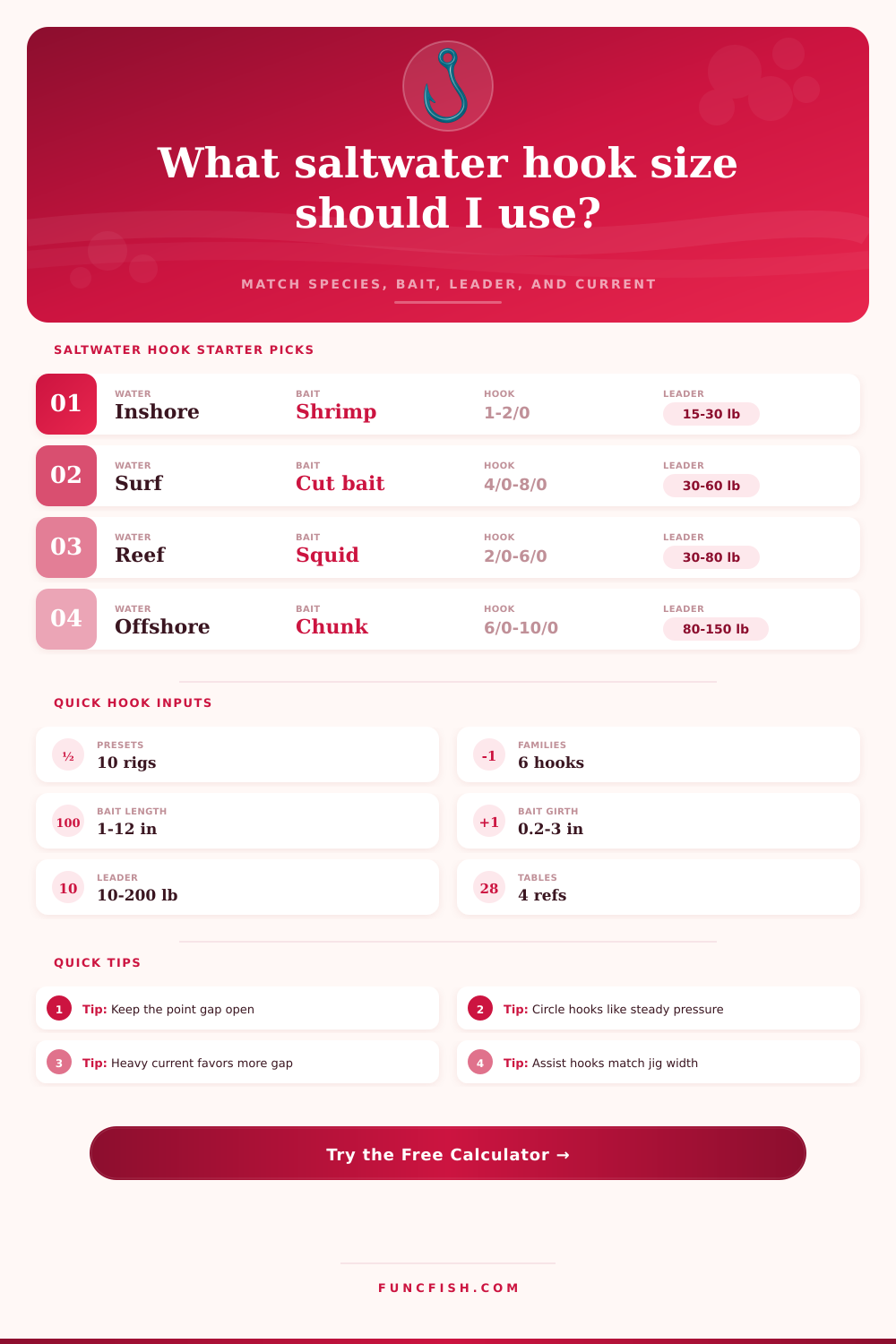
Match inshore, offshore, surf, reef, and jigging presentations to bait length, bait girth, hook family, leader test, current, and species group.
📌Saltwater hook presets
⚙Saltwater hook inputs
Saltwater hook match
Recommended hook size, gap, wire class, and rig fit will appear here.
Full breakdown
📋Saltwater species, bait, and hook comparison grid
Flats Shrimp
Surf Chunk
Reef Squid
Offshore Jig
📚Saltwater hook reference tables
| Species group | Typical bait profile | Common hook range | Leader match |
|---|---|---|---|
| Redfish, trout, bonefish | Shrimp, crab, small baitfish | #1 to 3/0 | 10 to 30 lb / 5 to 14 kg |
| Snook and juvenile tarpon | Live pilchard, mullet, pinfish | 2/0 to 6/0 | 25 to 60 lb / 11 to 27 kg |
| Pompano, whiting, croaker | Sand flea, shrimp, clam | #4 to 1/0 | 10 to 25 lb / 5 to 11 kg |
| Striped bass and bluefish | Chunk bait, plugs, live eel | 2/0 to 8/0 | 30 to 80 lb / 14 to 36 kg |
| Snapper, sheepshead, sea bass | Squid, shrimp, crab pieces | #1 to 6/0 | 20 to 80 lb / 9 to 36 kg |
| Grouper, cobia, amberjack | Live baitfish, big squid, jig | 5/0 to 12/0 | 50 to 150 lb / 23 to 68 kg |
| Mahi, kingfish, wahoo | Ballyhoo, strip bait, lures | 5/0 to 10/0 | 40 to 120 lb / 18 to 54 kg |
| Tuna and big pelagics | Chunk bait, sardine, jig | 6/0 to 14/0 | 80 to 200 lb / 36 to 91 kg |
| Bait type | Measured part | Gap factor | Best hook families |
|---|---|---|---|
| Shrimp or sand flea | Body curve and shell width | 1.45x girth | J, octopus, small circle |
| Crab or clam piece | Firmest hooked edge | 1.60x girth | Octopus, J, circle |
| Strip bait | Folded strip thickness | 1.55x girth | J, live bait, trolling J |
| Live baitfish | Shoulder depth near hook point | 1.70x girth | Live bait, circle, J |
| Cut bait chunk | Chunk thickness through point | 1.80x girth | Circle, J, octopus |
| Squid strip or mantle | Folded mantle thickness | 1.50x girth | Octopus, J, circle |
| Plug or hard bait | Factory treble hanger size | 1.25x body | Treble, inline single |
| Metal jig | Jig width at hook seat | 1.35x width | Assist hook |
| Hook family | Working range | Best use | Selection note |
|---|---|---|---|
| Circle hook | #1 to 14/0 | Cut bait, chunks, drifted live bait | Choose enough gap for the bait to roll clear. |
| J hook | #4 to 10/0 | Shrimp, squid, strip bait, trolling bait | Useful when quick point exposure matters. |
| Octopus hook | #6 to 6/0 | Small baits, reef bait, compact chunks | Short shank with a wide bite for smaller baits. |
| Live bait hook | #2 to 9/0 | Pinfish, pilchard, mullet, sardine | Match gap to shoulder depth so bait can swim. |
| Treble hook | #6 to 4/0 | Plugs, spoons, some stinger rigs | Treble sizes run smaller than single hooks. |
| Assist hook | 1/0 to 14/0 | Metal jigs and speed jigs | Hook gap should clear the jig width cleanly. |
| Presentation | Current effect | Hook adjustment | Leader cue |
|---|---|---|---|
| Freeline or drift | Low to moderate sweep | Neutral size with open gap | Leader stays near species range |
| Bottom rig | Bait spins or tumbles in flow | Add gap when current rises | Leader often steps heavier |
| Casting bait or lure | Hook must stay exposed on retrieve | Moderate shank and wire | Leader follows cover and teeth |
| Trolling spread | Constant pull loads hook | Strong wire and stable gap | Leader often above base range |
| Vertical jigging | Hooks swing around jig body | Assist gap clears jig width | Leader rises with jig weight |
| Topwater plug | Short strikes and surface slash | Treble or inline size balance | Leader depends on abrasion |
💡Hook sizing tips
For bait rigs, the hook point and barb area should remain clear after the bait is pinned. If the bait fills the bend, size up or change family.
Leader test does not choose hook size by itself, but heavy leader, hard current, and abrasion usually need a stronger wire class.
When choosing a hook size, there is a variety of factors that you must consider. Factors such as bait type, target species, and water conditions will all influence the size of the hook that you use when you are fishing. If the hook size is too small for the bait, the fishes may hide the hook.
If the hook size is too large for the bait, the hook may begin to tear away from the fish when the fish take the bait. If the hook size is correct for the bait, the fish will load the point of the hook when it take the bait. The calculator provided on this page considers these various factors to determine the best hook size for your fishing situation.
How to Choose the Right Hook Size
The dimensions of the bait that you are using will impact the size of the hook. For instance, live pinfish will require a different size gap in the hook than bait such as a sand flea, as the pinfish have a different shape to there bodies than the sand flea. Additionally, the speed at which the water is moving will impact the size of the hook; fast-moving water can roll the bait and bury the hook point.
The strength of the leader that attaches to the hook will impact the size of the hook; heavy leaders are often used to fish for big fish, or when fishing in heavy surf. Finally, the type of presentation that the bait will make will impact the size of the hook; live bait that is allowed to drift will require a different sized hook than bait that is rigged for the bottom of the water in moving water. The different species of fish will impact the size of the hook that is used to catch them.
For instance, species like redfish and bonefish is often caught in areas with calm water and small baits, and as such have a modest hook size. Conversely, fish like grouper and amberjack live near rocks, and using a light wire hook for these species may result in the hook getting caught on the rock when attempting to remove the caught fish. Species like tuna will have a larger circle hook with more wire than other species, since the tuna will strike quick at chunk baits.
It is tempting to use the size of the fish as a factor in the selection of hook size; however, this is a mistake. Regardless of the size of the fish, large fish may eat small bait and small fish may eat large bait. The hook should be compatible with the bait; if the point and barb of the hook are within the bait when the bait is rigged, the fish will have to crush the bait before feeling the steel hook.
You can avoid this loss of hookups by using a bait girth that takes into consideration the factor of the hook size in the tables provided. This factor will ensure that the fish will feel the hook before it eats the bait. The type of presentation of the bait will impact the size of the hook.
A circle hook works well for live bait that is allowed to drift, since the fish will turn when they eats the bait. However, a circle hook can be a problem when using topwater baits; the strike is much shorter with these baits, and the hook will be designed to set onto the bait on the initial impact with the fish. The wire class for the hook involves tradeoffs.
For instance, light wire will penetrate the mouth of the fish easily, but it may open if there is heavy drag on the line. Conversely, heavy wire can survive encounters with fish bones or rocky areas, but it may overpower small bait. The calculator considers these tradeoffs to recommend the best wire class for your fishing situation.
The tables that are provided on this page contain the same information as the calculator. They are simply presented in a different format. These tables show typical ranges for the factors listed above.
You can use these tables to compare the different factors for different species of fish, and to make your own decision regarding which hook size to use. While the calculator can take into consideration most of the factors that influence hook size, there is a variety of other variables that can impact fishing success. Factors like water clarity will impact how aggressively the fish attack at the bait.
The barometric pressure and tide can also impact fishing success. Additionally, your accuracy in casting your bait will impact success. There are no exact variables for these factors.
However, the calculator will give you a starting point for hook size and hook family. You will have to make adjustments according to what you see on the water; all professional anglors adjust their hook size and other parameters for their fishing rigs. Thus, while there are a variety of variables in fishing success that cannot be accounted for in the calculator, the calculator will give you a starting point so that you will not have to remember all of the information when you go to fish.
The value of the calculator is the ability to provide a consistency in the information provided. Thus, you can easily compare different types of rigs. For instance, you can easily compare the type of rig that you use for redfish to that which you use for striper fish.
Additionally, you can determine why a 4/0 circle hook is appropriate for cut bunker bait in moderate currents, yet why the same size hook may be too large for the same bait in calmer water with a lighter fishing leader. By presenting these types of relationships between the various factors in fishing, the calculator will allow you to fish your rigs rather than second guess them.