Hook Size for Trout Calculator
Pick a trout hook size from species, size class, bait or fly type, hook style, water clarity, tippet strength, bait length, and presentation finesse.
📌Trout hook presets
⚙Trout rig inputs
Trout hook recommendation
Calculator output appears here after choosing a trout scenario.
Calculation breakdown
🎣Trout bait, hook, and tippet comparison grid
Dry Fly
Nymph
Egg or Bead
Worm
Minnow
Dough Bait
Spinner Treble
Streamer
📊Hook style reference
Dry fly hook
Fine wire, lighter bend, and smaller sizes keep surface flies floating and look natural on clear trout water.
Nymph hook
Usually heavier wire with a wide enough gap to clear bead heads, dubbed bodies, and split-shot pressure.
Bait holder
Works for worm, salmon egg, corn, or dough bait when barb slices and a longer shank help hold soft bait.
Circle hook
Best when trout take bait deeply; size modestly and avoid striking hard so the point can rotate.
Treble hook
Use smaller numbered trebles than single hooks because three points increase visible hardware and weight.
📋Trout species and size reference
| Trout class | Common size | Typical bait size | Starting hook | Line or tippet |
|---|---|---|---|---|
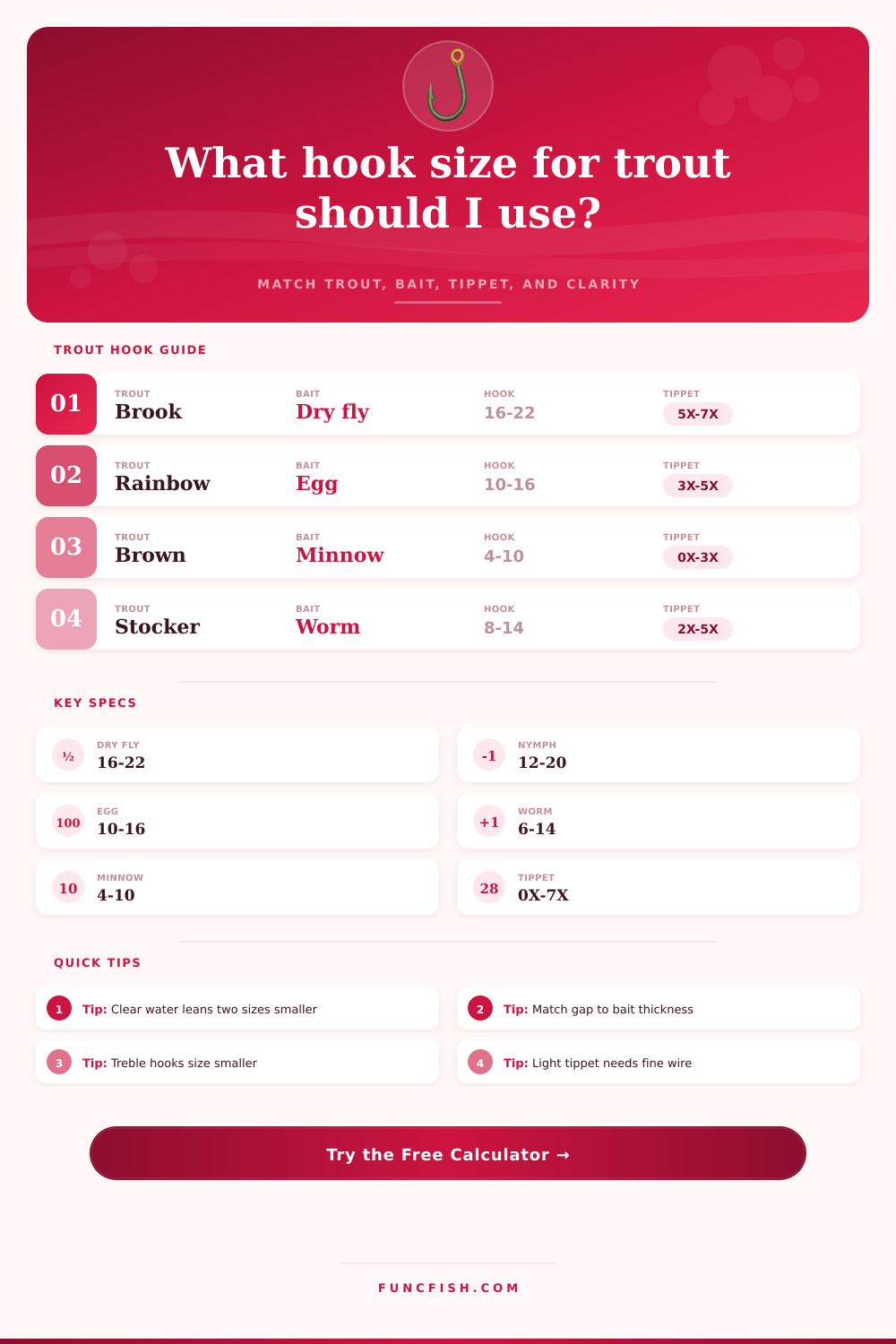
| Brook trout in small streams | 6-10 in / 15-25 cm | 0.2-0.8 in / 5-20 mm | 16-22 dry, 14-18 nymph | 5X-7X or 2-4 lb |
| Stocked rainbow trout | 10-16 in / 25-41 cm | 0.4-1.5 in / 10-38 mm | 10-16 bait, 12-18 fly | 3X-5X or 4-6 lb |
| Wild brown trout | 12-22 in / 30-56 cm | 0.5-3.0 in / 13-76 mm | 6-14 bait, 4-10 streamer | 0X-4X or 4-10 lb |
| Cutthroat trout | 8-18 in / 20-46 cm | 0.3-1.2 in / 8-30 mm | 12-20 dry or nymph | 4X-6X or 3-5 lb |
| Steelhead and lake trout | 20-30 in / 51-76 cm | 0.6-4.0 in / 15-102 mm | 4-10 egg, worm, minnow | 0X-2X or 8-12 lb |
📏Hook size geometry table
| Hook size | Approx gap | Shank range | Good trout uses | Common tippet |
|---|---|---|---|---|
| 22-20 | 2.0-3.2 mm / 0.08-0.13 in | 5-9 mm / 0.20-0.35 in | Midges, tiny dries, micro nymphs | 6X-7X |
| 18-16 | 3.0-4.8 mm / 0.12-0.19 in | 8-13 mm / 0.31-0.51 in | Small dries, nymphs, eggs | 5X-6X |
| 14-12 | 4.5-6.5 mm / 0.18-0.26 in | 12-18 mm / 0.47-0.71 in | General nymphs, worms, dough | 3X-5X |
| 10-8 | 6.0-9.0 mm / 0.24-0.35 in | 17-27 mm / 0.67-1.06 in | Worms, minnows, larger eggs | 1X-4X |
| 6-4 | 8.5-12.5 mm / 0.33-0.49 in | 24-38 mm / 0.94-1.50 in | Streamers, big bait, lake trout | 0X-2X |
🧵Tippet and leader matching table
| Tippet | Approx test | Best hook range | Best presentation | Notes |
|---|---|---|---|---|
| 7X | 2 lb / 0.9 kg | 20-24 | Ultra clear midge or dry fly | Use gentle hook sets and fine wire. |
| 6X | 3 lb / 1.4 kg | 18-22 | Small dry, emerger, light nymph | Good for small flies and spooky trout. |
| 5X | 4 lb / 1.8 kg | 14-20 | Everyday trout dries and nymphs | Balanced for most clear-water trout. |
| 4X | 5 lb / 2.3 kg | 12-18 | Nymphs, eggs, light bait rigs | Handles split shot and faster water. |
| 3X | 6 lb / 2.7 kg | 8-14 | Worms, wet flies, small streamers | Choose stronger wire if current is heavy. |
| 2X-0X | 8-12 lb / 3.6-5.4 kg | 4-10 | Streamers, minnows, steelhead eggs | More power, less stealth in clear water. |
🌊Water clarity adjustment table
| Clarity | Visibility | Hook adjustment | Tippet adjustment | Presentation target |
|---|---|---|---|---|
| Clear | 4 ft plus / 1.2 m plus | Go 1-2 sizes smaller | Drop 1 tippet size finer | Small profile, fine wire, clean drift |
| Light stain | 2-4 ft / 0.6-1.2 m | Use calculated size | Stay balanced | Natural size with reliable gap |
| Stained | 1-2 ft / 0.3-0.6 m | Go 1 size larger | One step stronger if needed | More visible bait or fly profile |
| Dirty / high water | Under 1 ft / 0.3 m | Go 1-2 sizes larger | Use stronger leader | Positive hookups and bigger silhouette |
Hook gap tip: Trout often reject bulky hardware in clear water, but the hook gap still needs to clear the thickest part of the bait or fly body. If the point is buried, go larger; if the hook dominates the pattern, go smaller.
Tippet tip: Fine tippet pairs best with fine-wire hooks and soft hook sets. When using worms, minnows, or fast current, size the tippet and wire together so the hook does not bend before the leader protects the fish.
The size of the hook a person select can have an impact on the success that they have on there fishing trip. A person must make certain to choose a correct hook size based off the conditions into which the trout are being encountered, the type of bait that will be used, and the type of trout that is present in those waters. If a person selects the wrong hook size for the trout and it’s habitat, the trout may either ignore the bait that is being used, or may altogether avoid the hook altogether.
In determining the correct size of the hook that should of be use when fishing for trout, there are a variety of different variables that must be considered. One of those variable is the clarity of the water into which the trout are to be caught. If the water is clear, the trout will be able to more easy view the hook that is attached to the bait.
How to Choose the Right Hook Size for Trout
In these cases, angler should use smaller hooks with fine wires. However, if the water is dirty or fast moving, the trout will have a more difficult time viewing the bait and hook. In these instances, larger hooks with large gaps are used to ensure that the hook can more easy clear the bait that is being used to catch the trout.
In addition to the type of water into which a person is fishing, another variable that can impact the necessary size of the hook is the length of the bait that is to be used. Smaller baits, such as midges, requires smaller hooks so that they will remain in the proper position in the water column. However, larger bait require larger gaps in the hook so that the point of the hook does not become caught on the bait.
An additional variable in the determination of hook size is the strength of the tippet that will be attached to the hook. A strong tippet may not be able to handle a hook that contain heavy wire. Alternatively, the trout may pull apart an ultra fine hook if it is attached to a tippet that is strength to handle the hooks strong bite.
A fourth variable in the determination of the proper hook size is the presentation style that will be used. For instance, in slow moving waters or when using a delicate presentation style, smaller hooks and wires should be used. In fast moving waters or in situations where an aggressive presentation style is use, larger hooks with a larger gap should be used.
One of the most common mistakes in hook size is thinking that hook size never change. For instance, a person may use a size 18 hook when the water is clear and the skies are bright, but those same condition may require the use of a size 16 hook if the skies are overcast. In addition to the aforementioned variables, another mistake is in the ignoring of the relationship between hook gap and bait thickness.
If the gap in the hook is too small in comparison than the thickness of the bait, the hook will not be able to properly catch the trout. To avoid this situation, the calculator estimate the proper gap in the hook according to the length and type of bait that will be used. The fifth variable is the species of trout that is to be caught.
Smaller trout in smaller streams require finer baits and smaller hooks. Larger trout in larger body of water can take the stronger hook sizes. Clear water, fine tippet, and small bait requires smaller hooks.
Stained water, heavy tippet, and large bait requires larger hooks. The angler can consider all these variables to ensure that the hook size that is selected for the trout is the correct one. By understanding the relationship between these variables, a person will be able to select the proper hook size for there environment, which will ensure better results in their fishing effort.