Tippet X To Pound Test Converter
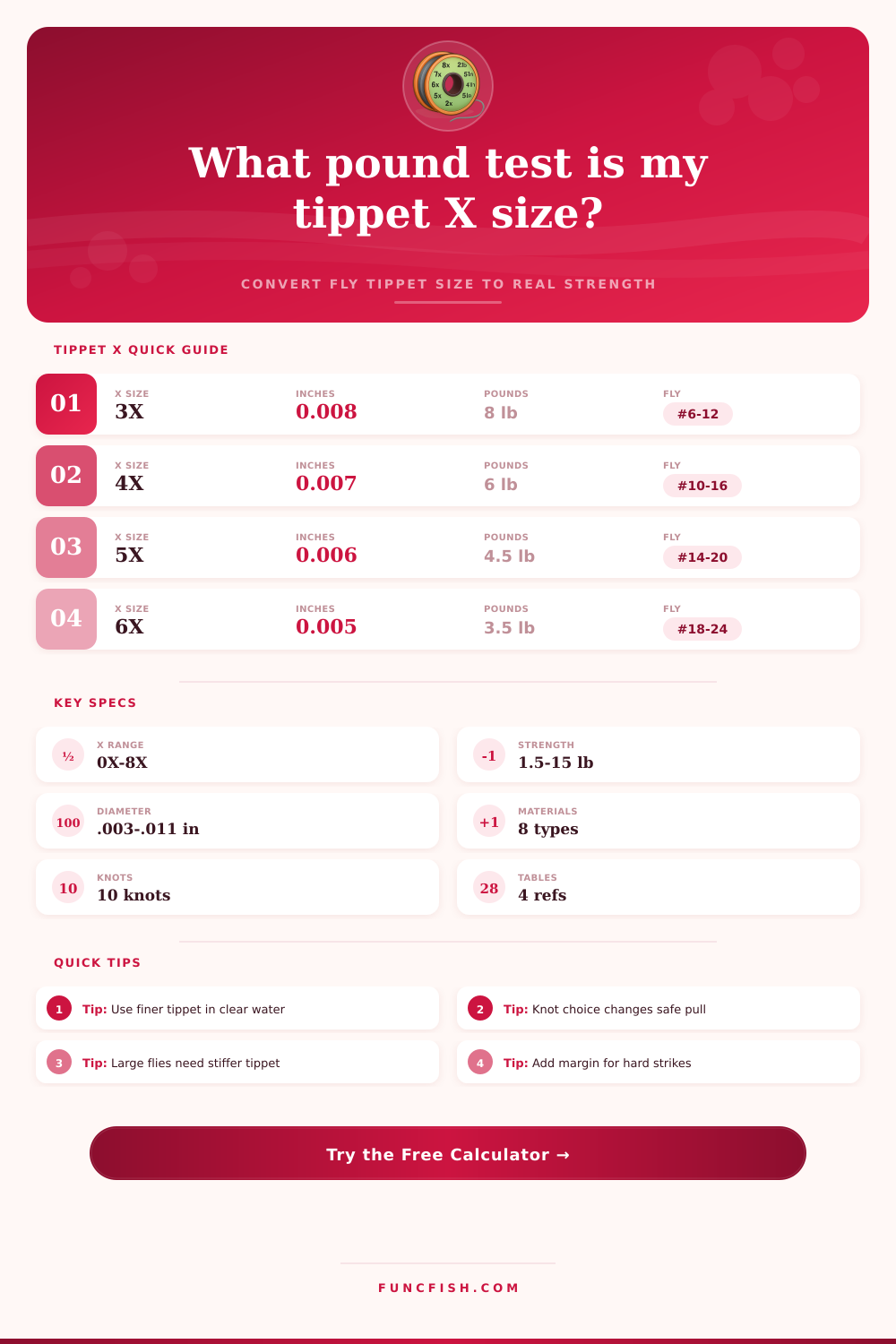
Convert fly tippet X size into pound test, kilogram test, diameter, retained knot strength, fly-size fit, and practical safety margin for the species and water in front of you.
📌Fly tippet presets
⚙Converter inputs
Converted tippet strength
Calculation breakdown
🧵Tippet material grid
Nylon Mono
Fluorocarbon
Soft Nylon
Stout Salt Mono
🎯Tippet, fly, and species grid
6X to 8X
Best for #18 to #28 flies, clear trout water, grayling, and light panfish where stealth matters more than turnover.
4X to 5X
The everyday trout band for #12 to #20 dries, nymphs, soft hackles, and modest streamers in average flow.
2X to 3X
Good for #6 to #12 nymphs, small streamers, hopper droppers, larger trout, smallmouth, and stained water.
0X to 1X
Use for bass bugs, steelhead wets, carp, light saltwater flies, wind, weeds, and faster hook-setting pressure.
Clear Water
One X size finer often helps presentation, but only when knot-retained strength still clears the species demand.
Large Flies
Bulky patterns need diameter and stiffness. The converter flags fine tippet when turnover becomes the weak link.
📊Reference tables
| X size | Typical diameter | Baseline test | Metric test | Usual fly sizes |
|---|---|---|---|---|
| 0X | 0.011 in / 0.279 mm | 15 lb | 6.80 kg | #2 to #6, bass bugs, salt flies |
| 1X | 0.010 in / 0.254 mm | 13 lb | 5.90 kg | #4 to #8, steelhead wets |
| 2X | 0.009 in / 0.229 mm | 10 lb | 4.54 kg | #6 to #10, streamers |
| 3X | 0.008 in / 0.203 mm | 8 lb | 3.63 kg | #8 to #12, hoppers, nymphs |
| 4X | 0.007 in / 0.178 mm | 6 lb | 2.72 kg | #10 to #16, standard trout |
| 5X | 0.006 in / 0.152 mm | 4.5 lb | 2.04 kg | #14 to #20, dries and nymphs |
| 6X | 0.005 in / 0.127 mm | 3.5 lb | 1.59 kg | #18 to #24, midges |
| 7X | 0.004 in / 0.102 mm | 2.5 lb | 1.13 kg | #22 to #28, technical dries |
| 8X | 0.003 in / 0.076 mm | 1.5 lb | 0.68 kg | #24 to #32, tiny flies |
| Material | Strength factor | Presentation feel | Diameter note | Common use |
|---|---|---|---|---|
| Nylon monofilament | 1.00 | Supple, floats better | Matches common X charts | Dry flies, general trout |
| Fluorocarbon | 1.08 | Stiffer, sinks faster | Often stronger at same X | Nymphs, clear subsurface rigs |
| Copolymer mono | 1.05 | Moderate stretch | Can test slightly above nylon | Mixed dry-dropper rigs |
| Soft dry-fly nylon | 0.92 | Very limp, delicate | May sacrifice break strength | Small dries, slow slicks |
| Hard mono leader | 1.10 | Firm turnover | Useful for bigger flies | Streamers, warmwater flies |
| Fluoro shock tippet | 1.12 | Dense, abrasion resistant | Better when cover is rough | Carp, bass, pocket water |
| Tenkara level line | 0.95 | Direct, controlled drift | Check spool rating closely | Fixed-line trout and panfish |
| Stout saltwater mono | 1.18 | Firm and springy | Built for wind and shock | Bonefish, bass, larger flies |
| Knot type | Retention used | Best with | Weakness to watch | Converter effect |
|---|---|---|---|---|
| Improved clinch | 86% | Most trout tippet | Slips if poorly seated | Balanced default retention |
| Standard clinch | 82% | Small dries | Lower margin on fluoro | Reduces safe pull more |
| Orvis knot | 90% | Fine tippet | Needs clean turns | Raises retained strength |
| Davy knot | 84% | Fast fly changes | Very small tying error window | Good but compact rating |
| Double Davy | 88% | Small flies and fluoro | Must dress neatly | Strong fine-tippet option |
| Trilene knot | 88% | Nymphs and streamers | Bulkier on tiny hooks | Stable strength retention |
| Non-slip loop | 80% | Streamers | Loop movement costs strength | Allows fly action, less pull |
| Palomar | 92% | Large eyes, stout tippet | Awkward on small flies | Highest retained pull here |
| Species target | Typical tippet band | Estimated pull demand | Clarity adjustment | Fly match note |
|---|---|---|---|---|
| Brook trout | 5X to 7X | 1.0 to 2.0 lb | Clear water favors 6X | Small dries and soft hackles |
| Rainbow trout | 4X to 6X | 1.8 to 3.0 lb | Normal rivers fit 5X | Nymphs, dries, emergers |
| Brown trout | 3X to 6X | 2.2 to 3.8 lb | Low light can go stronger | Terrestrials and streamers |
| Grayling | 5X to 7X | 1.0 to 2.2 lb | Often needs stealth | Fine dries and nymphs |
| Panfish | 4X to 6X | 1.0 to 2.5 lb | Stained ponds allow 4X | Small poppers and wets |
| Smallmouth bass | 0X to 3X | 4.0 to 6.0 lb | Clear rivers may use 3X | Streamers and poppers |
| Steelhead | 0X to 2X | 6.0 to 9.0 lb | Winter color allows 1X | Wet flies and small intruders |
| Bonefish | 0X to 2X | 6.0 to 10.0 lb | Flat calm favors longer leaders | Shrimp and crab flies |
💡Practical tippet notes
Diameter matters: X size is a diameter standard, while pound test varies by material and maker. When a spool lists a diameter, enter it so the converter can blend the printed size with the X-table estimate.
Safe pull is not spool rating: The useful number is retained strength after the knot and safety margin. A finer X size may cast beautifully but still be too close to the break point for hard runs, weeds, or rough rocks.
The strength of the line are not determined by an X rating of the line that is on the spool of the line. Many individuals may believe that the X measurement is the full measurement of the strength of the fishing line. However, the X rating of the fishing line is only one of the measurements of the strength of the line.
Other factors that play a role in the strength of the fishing line include the material of the line, the type of knot that are used on the line, the conditions of the water in which the fishing line is being used, and the amount of force that the fish apply to the line. Each of these factors can change the strength of the fishing line, which is why it is necessary to use a converter to determine the true strength of the fishing line. The converter will calculate the strength of the fishing line by using the X size of the fishing line and the diameter of the fishing line as it is on the spool.
How to Find the True Strength of a Fishing Line
Additionally, the converter will also adjust the strength according to the material of the fishing line. For instance, fluorocarbon lines are consider to be stronger than nylon lines of the same diameter. However, soft dry fly nylon lines are considered to be less strong than fluorocarbon lines because the nylon lines are softer to allow the flies to present itself more better to the fish.
Additionally, the type of knot that is used will also reduce the strength of the fishing line. For instance, an improved clinch knot will allow for 86% of the strength of the line to be transmitted through the knot, but an Orvis knot will allow for 90% of the strength of the line to be transmitted through the knot. Thus, the type of knot will impact the strength of the fishing line, and must be accounted for in the calculation of the lines true strength.
In order to calculate the true strength of the line, several different factors must be consider. For instance, the size of the fly that is to be used will impact the stiffness of the fishing line. For instance, a large hopper fly will require a thicker tippet than a size 22 midge fly.
Additionally, the species of the fish will also impact the strength of the fishing line. For instance, rainbow trout may apply more force to the fishing line than brook trout, so a different strength of fishing line will be required for each type of fish. Additionally, the clarity of the water will also impact the type of strength of fishing line that is required.
For instance, in clear water, finer X sizes of the fishing line are required to effectively present the bait to the fish. However, sufficient strength is required in the line to allow it to hold the fish. Another variable that must be considered is the safety margin.
For instance, while the safety margin will account for the fish that is being caught, it is actualy used to account for variables like weeds or changes in the direction of the fish. Thus, a moderate safety margin can be used to account for the possibility of encountering weeds, but a higher safety margin may be required for fishing near logs or in areas of heavy current. Additionally, the fishing line converter will display the amount of strength that will be taken from the fishing line due to the safety margin.
Many individuals make the mistake of believing the strength of the line is the rating of the line that is on the spool. For instance, if an individual uses a 5X line that has a strength of 4.5 pounds, and uses an improved clinch knot, many individuals will believe that the line will have a strength of 4.5 pounds. However, the use of the knot will reduce the strength of the line, the safety margin will reduce the strength of the line, and the strength of the line may not match the X rating of the line.
Thus, the fishing rig will have less strength then the individual believes. The reference tables will provide example line strengths for different types of fishing situations. However, the reference tables are not rules for the strength of the fishing line.
For instance, 4X to 5X lines are often used for fishing for trout. However, if an individual desires to use a line that is thinner than 4X or 5X lines, then they will have to use more care in tying there knots, and in the amount of pressure that is applied to the fish while fishing. In order to determine the strength of the fishing line that will be used in a specific instance, it is recommended for the angler to use the converter prior to beginning to fish.
For instance, it is difficult for an individual to remember the strength of a 6X fluorocarbon line after tying a blood knot to the line. The converter will calculate the strength of the line based off the diameter, the material, and the type of knot that will be used. Additionally, the converter can determine the strength of the line after the safety margin is applied.
Thus, if the strength of the fishing line after the safety margin is applied is stronger than the expected strength of the fish that will be caught, then the fishing line will be sufficient for the fishing situation. Finally, the strength that is calculated by the converter should be viewed as a range of strength for the fishing line. For instance, the conditions of the fishing spot may change while fishing, as well as the type of fish that may be in the water and the clarity of the water.
By understanding how each of the factors have an impact upon the strength of the fishing line, it is possible to adjust the strength of the line to the changing fishing conditions.