Fishing Weight Ounces To Grams Converter
Convert sinkers, lures, jig heads, and split shot between ounces and grams, then total the pack weight with count, tolerance, rig type, target species, and water condition.
📌Fishing weight presets
⚖Converter inputs
Converted fishing weight
Results update from your ounce or gram input, count, tolerance, rig, species, and water condition.
Conversion breakdown
🎣Weight, rig, and species comparison grid
Finesse trout
Bass jig
Surf pyramid
Deep bank
📏Common ounce to gram conversions
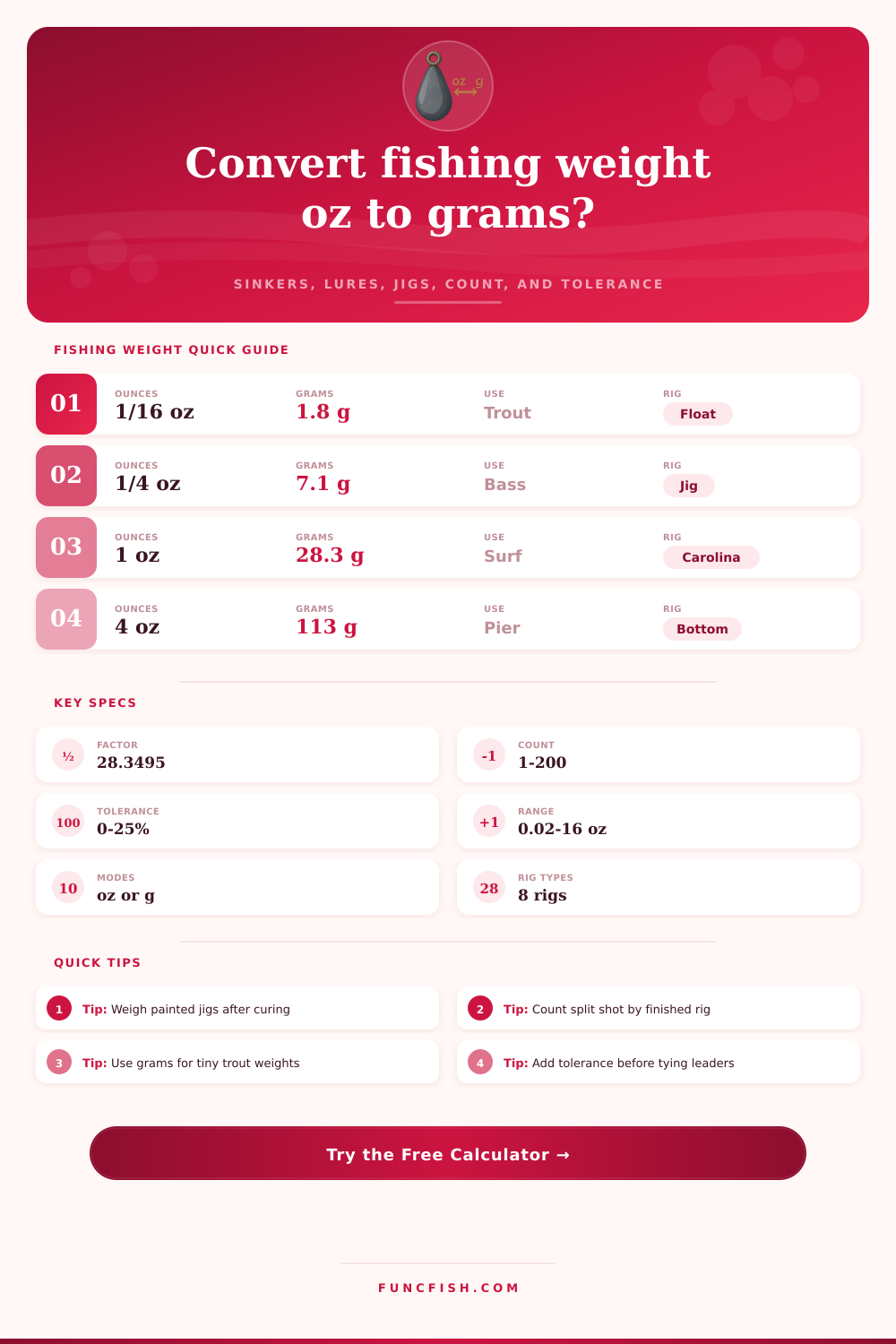
| Fishing weight | Decimal ounces | Grams | Typical category | Common use |
|---|---|---|---|---|
| 1/64 oz | 0.0156 oz | 0.44 g | Micro jig | Ice, trout, panfish |
| 1/32 oz | 0.0313 oz | 0.89 g | Tiny jig | Panfish or stream trout |
| 1/16 oz | 0.0625 oz | 1.77 g | Split shot or jig | Float rigs and finesse casts |
| 1/8 oz | 0.125 oz | 3.54 g | Jig head | Light bass, crappie, walleye |
| 1/4 oz | 0.25 oz | 7.09 g | Jig or sinker | Walleye, bass, inshore flats |
| 3/8 oz | 0.375 oz | 10.63 g | Bass jig | Cover, swim jigs, blades |
| 1/2 oz | 0.5 oz | 14.17 g | Lure or sinker | Spinnerbaits and shore casts |
| 1 oz | 1 oz | 28.35 g | Spoon or sinker | Pike, surf, pier, current |
| 3 oz | 3 oz | 85.05 g | Surf sinker | Beach sweep or pier rigs |
| 8 oz | 8 oz | 226.80 g | Bank sinker | Deep bottom fishing |
🧰Rig and water adjustment reference
| Rig or condition | Factor | Best matched category | Why it changes load | Watch point |
|---|---|---|---|---|
| Vertical jigging | 1.05 | Jig heads | Line angle adds small drag | Stay near bottom contact |
| Drop shot | 0.95 | Cylinder sinkers | Less casting stress | Use enough bottom feel |
| Carolina rig | 1.12 | Egg or bullet sinkers | Leader and bead add drag | Current lifts light rigs |
| Surf casting | 1.28 | Pyramid or storm sinkers | Wash and sweep demand grip | Do not overload rod rating |
| Bottom rig | 1.18 | Bank or no-roll sinkers | Bait and current pull hard | Thin braid lowers drag |
| Trolling rig | 1.35 | Inline weights | Speed magnifies resistance | Track actual depth |
| Calm water | 0.92 | Finesse weights | Less holding force needed | Natural fall matters |
| Surf wash | 1.35 | Surf sinkers | Breaking waves roll rigs | Use grippy shapes |
🐟Species weight reference
| Target species | Typical weight range | Metric range | Common rig | Line class |
|---|---|---|---|---|
| Trout | 1/64-1/8 oz | 0.4-3.5 g | Float, jig, nymph shot | 2-6 lb |
| Panfish | 1/64-1/16 oz | 0.4-1.8 g | Micro jig or split shot | 2-6 lb |
| Bass | 1/8-3/4 oz | 3.5-21.3 g | Texas, jig, Carolina | 8-20 lb |
| Walleye | 1/8-1 oz | 3.5-28.3 g | Jigging or trolling | 6-14 lb |
| Catfish | 1-6 oz | 28-170 g | Slip sinker bottom rig | 15-50 lb |
| Redfish | 1/4-2 oz | 7-57 g | Jig, popping cork, sinker | 10-30 lb |
| Pike | 1/2-2 oz | 14-57 g | Spoon or spinner | 20-50 lb |
| Grouper | 4-16 oz | 113-454 g | Bottom or knocker rig | 40-100 lb |
📋Pack count and tolerance examples
| Item | Count | Base total | With 5% tolerance | Good check |
|---|---|---|---|---|
| 1/32 oz panfish jigs | 12 | 10.63 g | 10.10-11.16 g | Tray sorting |
| 1/8 oz walleye jigs | 8 | 28.35 g | 26.93-29.76 g | Jig box balance |
| 3/8 oz bass jigs | 6 | 63.79 g | 60.60-66.98 g | Skirted jig batch |
| 1 oz spoons | 5 | 141.75 g | 134.66-148.84 g | Casting lure roll |
| 3 oz surf sinkers | 4 | 340.19 g | 323.18-357.20 g | Rig bag weight |
| 8 oz bank sinkers | 3 | 680.39 g | 646.37-714.41 g | Deep drop kit |
Rig tolerance: Add the tolerance after count multiplication when you are checking a whole leader pack, because small paint or swivel differences accumulate across repeated rigs.
Reverse conversion: For imported tackle marked in grams, switch to grams-to-ounces first, then compare the adjusted rig load to your rod lure rating before casting.
Fishing weights are available in various measurement systems. The weight of fishing weights are listed in two different units of measurement: ounces and grams. Some fishing weight companies uses ounces in the measurement of their products, while others use grams.
It is necesary for anglers to convert the ounce of fishing weights to grams because it will allow anglers to understand the exact mass of the fishing weights. If anglers dont convert the weights from ounces to grams, they may select fishing weights that do not provide the desired fishing experience. The weight of fishing weights is important in determining how the fishing weights will move in the water and how they will remain in place in a current.
Convert Fishing Weights from Ounces to Grams
The fishing weights calculator allow anglers to enter the weight of a single fishing weight in both ounces and grams. Anglers can also enter the number of fishing weights that they will use in their fishing rig. Anglers can enter a small allowance for the variations of the fishing weights.
Small variation in the weights of fishing weights may be caused by the paint or hardware used on the fishing weights. Using the calculator, anglers can determine the total weight of the fishing weights in ounces and grams. The fishing weight calculator will also calculate the low and high range of the total weight of the fishing weights to account for the possible variations in the weight of each fishing weight.
Anglers should use this fishing weights calculator because it allows anglers to avoid guesswork when creating there fishing rig. Knowing the weight of the fishing weights will allow anglers to better understand the total load that will be on the fishing line. The type of fishing weight that is selected will change the way that the fishing weight performs in the water.
For instance, bare lead sinkers have the same weights as skirted jig, but the skirted jigs will perform differently in the water due to the drag that the skirt and keeper on the jig create. Certain types of fishing rigs will also affect the performance of the fishing weights. For instance, Carolina rigs will catch more current than drop shot rigs due to the long leader and bead used in the Carolina rig.
Drop shot rigs will behave differently than Carolina rigs because the drop shot rigs will sit closer to the fishing rod tip. Lastly, the conditions in the water will change the performance of the fishing weights. For instance, calm ponds will allow for the use of lighter fishing weights than areas with heavy tides and surf.
Different species of fish requires different weights of fishing weights. Another factor to consider when using fishing weights is the tolerance of the weights. A five percent difference in the weights of fishing weights might seem small, but the five percent can be significent when using many quantities of fishing weights.
The paint on jig heads might not be uniformly coated, which could cause the weight of the jigs to vary. The fishing weights calculator allows for this five percent to be spread out over the batch of fishing weights that will be used. Anglers will be able to view the low and high weights in the batch using the calculator.
This information is helpful when fishing because it can tell the angler if the small differences in the weights will matter to the fish when they pull at the fishing line. Reference tables can be used to determine the weights of different types of fishing weights according to the line class that will be used with those weights. For instance, a one-quarter ounce jig is the weight that is commonly used when fishing for walleye with a ten-pound line.
However, using a one-quarter ounce jig with a two-pound line for trout can be a problem for the fishing line. The fishing weight may be too heavy for the trout line, causing the fishing line to fail when the fish pulls at the line. These reference tables offer recommendations for fishing weights for different conditions.
However, the fishing weights calculator is more useful than the reference tables because it allows anglers to make adjustments to specific factors to see the effect on the weights of the fishing weights. The conditions of the water may differ from the conditions stated in the reference tables. For instance, the wind may push the fishing float sideways in the water, even if the water’s surface appears to be calm.
The movement of the bait may create an extra pulling tension on the fishing weights, even if the fishing weights are set up to counteract the movement of the bait. Anglers should use the fishing weights calculator before fishing. By fishing weights calculator, anglers can start with a weight that is close to what they need for their fishing trip.
By starting with a close approximation of the correct fishing weights, anglers only have to make small adjustments in the field. This is beneficial for anglers who are on the move and whose local tackle shop uses a different system of measurements for fishing weights than the system that the anglers use when fishing. Anglers use a digital scale to weigh their fishing rigs when they are on the water.
Using a fishing weights calculator is helpful for this process. This is because the calculator allows anglers to determine the weights of their fishing weights before tying them to the fishing line. Using the fishing weights calculator will save anglers time on the water and will reduce the number of fishing rigs that they create with incorrect weight.
This is especially helpful when anglers are searching through their tackle tray for the correct fishing weights for a specific trip. Converting the weight of the fishing weights from ounces to grams is only the first step for anglers in the decision-making process. Besides the gram weight of the fishing weights, anglers must also determine if the weight of the fishing weights is appropriate for the cover and line class that will be used.
The fishing weights calculator brings these considerations together for anglers so that they dont have to perform the calculations in their heads. For instance, if the weight of the fishing weights is close to the upper range of the weight for the type of fish that is being targeted, the strength of the line will have to be checked or a lighter weight can be used for the fishing rig. If the weight that is determined by the calculator is towards the low end of the range of weights, a split shot or denser material can be used.
Using the fishing weights calculator can help anglers develop a habit of determining the weight of their fishing weights. This habit will help anglers make better decisions when they are on the water during every fishing trip.