
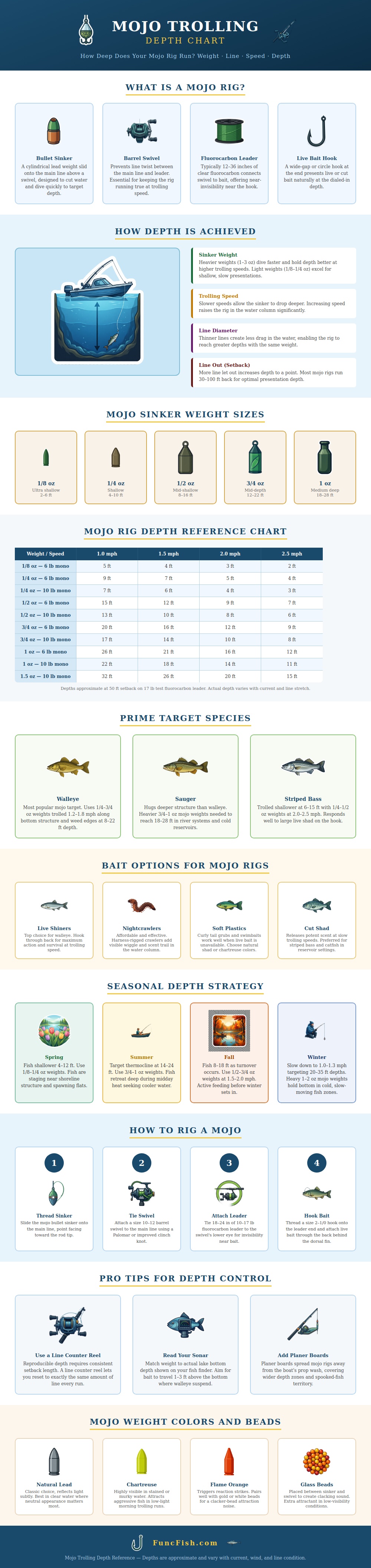
When fishing for walleye or saugerfish that reside near bottom of the water, the distance between the hook and the water’s surface is critical. A mojo rig allow anglers to control the distance between the bait and the water’s surface. A mojo rig uses a bullet sinker that slide on the main fishing line.
The bullet sinker allows the bait to reach the desire depth. However, the angler will only reach those depths with a bullet sinker if they understand the depth chart for mojo rig. The depth chart for mojo rigs will allow anglers to place their bait at correct depth.
How to Use a Mojo Rig Depth Chart
A mojo rig has a few different part, each having a specific use. The bullet sinker will allow the bait to dive towards bottom of the water column. A barrel swivel will prevent the leader from twisting as the fishing line move.
Lastly, the fluorocarbon fishing line will allow the bait to look as natural in the water as possible. The depth at which the bait will reach will depend on the speed of the fishing boat. If the angler decreases boat speed, the bullet sinker will drop to the deepest part of the water column.
If the angler increases boat speed, the bullet sinker will remain higher in the water. A depth chart will help anglers to understand how to vary the weight of the sinker to achieve desired depth. Mojo rigs use half-ounce or three-quarter ounce sinker to target walleye and saugerfish.
These weights work best in depths ranging from 8 to 12 foot of water. In the summer, however, walleye will have moved to deeper waters. For these situation, angler will use a heavier sinker instead of let out more line with the fishing rig.
Letting out too much line will create drag on the fishing line that will cause the bait to wander from the bottom where the walleye live. Using a heavier sinker will allow the bait to remain in close proximity to the bottom. The diameter of the fishing line will also affect the depth at which the sinker will reach.
Using thinner monofilament or braided fishing line will allow the sinker to travel to more greater depth in the water column. A depth chart will have separate column for both six-pound and ten-pound test line because the thickness of the line will impact the depth to which the sinker can travel. Using a heavier test line than recommend will cause anglers to lose some of the depth achieved by using thinner line.
Anglers must account for this when selecting sinker weight. Walleye and saugerfish will move to different depth throughout the year depending on the season. During the spring, the fish will be in shallow waters.
Anglers should use a quarter ounce sinker and use a slow boat speed. In the midsummer, walleye will begin to move to deeper waters near the thermocline. Therefore, using heavier sinker will allow the bait to reach these depths.
In the fall, walleye will return to shallower waters as the baitfish begin to move. During the winter, walleye will require the heaviest sinkers and the slowest boat speeds to find the fish. While the depth chart does not change, anglers will have to read a different row on the depth chart to match current season.
Depending on the bait being used, a mojo rig can use live shiners or nightcrawler bait. These type of bait will work best for angling for walleye and saugerfish. If using live bait is impossible, using soft plastic or cut bait will work, but slower boat speed will be required.
The mojo rig will not change with the bait being used. However, the weight of the sinker will have to be matched with the depth at which the bait will travel. One of the most common mistake made when fishing for walleye or saugerfish with a mojo rig is letting out too much line to increase the depth at which the bait will travel.
When letting out too much line, the fishing line will create a belly in the line. A belly in the fishing line will cause the bait to move away from the bottom of the water. The depth chart illustrates the limit for each type of sinker weight with the fishing boat at various speed.
When reaching the limit for a given line, angler can add more weight to the bait instead of add more line length. Using planer boards and line counter reels will allow anglers to maintain more consistency in their fishing effort. A planer board will pull the fishing line to the side of the boat, but it will not affect the depth at which the bait will travel.
A line counter reel will allow anglers to set the line to the same offset as used previously to find the fish. These tool will allow anglers to effectively use the depth chart to increase the chance of success. Another benefit of using a depth chart when fishing for walleye and saugerfish is that it allows anglers to use their sonar to determine the position of the bait in the water.
By using sonar, anglers can find the fish. By looking at the speed and the weight of the sinker, anglers can determine whether the bait is above, below, or in the same zone as the fish. By knowing the position of the bait, the variable will be removed from the fishing effort.
By removing the variable, anglers will have a more succesful day of fishing for walleye and saugerfish.