
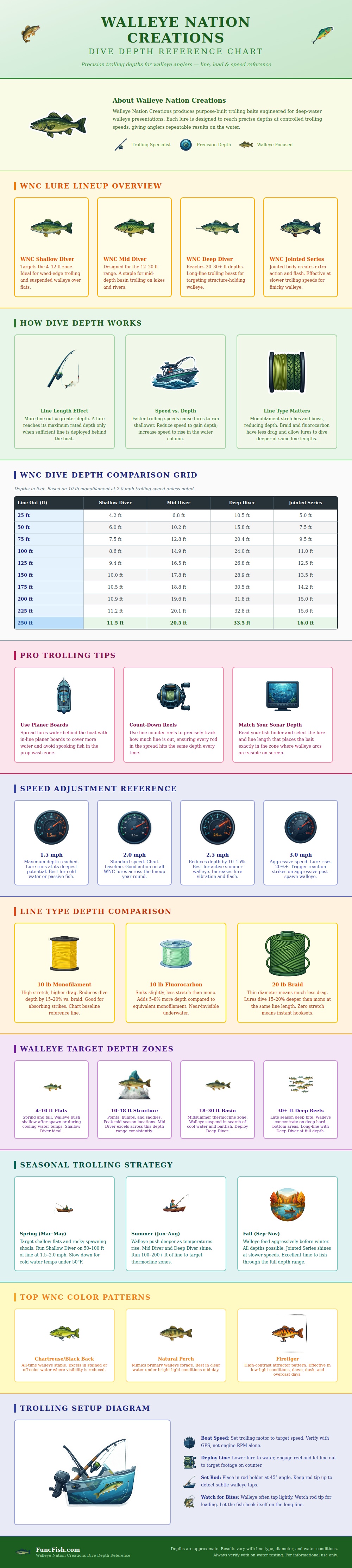
When trolling for walleye, the depth at which you troll will determine how often the walleye strike your lure. If your trolling depth are incorrect, the rod will remain quiet as the walleye wont be exposed to your lure. However, if the depth is correct, the rod will load up with fish that is striking your lure.
The company Walleye Nation Creations has created a series of lures that are effective at specific depth in the water. The Shallow Diver is a lure that is designed to travel between the surface of the water and twelve feet. This lure is most effective when use in the spring and fall along the edges of weeds or flats in the water.
How to Keep Your Lure at the Right Depth
The Mid Diver lure is designed to go deeper than the Shallow Diver lure but shallower than the Deep Diver lure. This lure will travel between twelve and twenty feet into the water. The Deep Diver lure is designed to go deeper than the Mid Diver lure.
With the Deep Diver lure, you can set it to travel past thirty feet into the water if you provide it with enough line. The Jointed Series lure is designed to work at a different depth than the other lure design but has extra action at slower speeds when the walleye is more difficult to catch. The depth of the lure can change based off three different variable.
First, the amount of line you have on the reel will change the depth at which the lure goes into the water. Second, the speed at which the boat move will change the depth at which the lure travels. Third, the type of line you use on the reel will change the depth at which the lure travels.
If you add more line to the reel, the depth at which the lure travels will increase. However, it will eventually plateau once the line reaches a certain length. When you move the boat faster, the lure will rise in the water.
However, if you move the boat at a slower speed, the lure will go to a deeper part of the water. If you use monofilament line, the line will stretch out, and this will add drag on the lure so it will travel highly in the water. Fluorocarbon line will travel to a medium depth in the water.
It will add some sink to the lure, but it wont create the memory on the line that other lines can. Braided line will cut through the water very cleanly so it will allow you to go to the deepest depth in the water with your lure. The depth that the walleye travel in the water will change with the season.
During the spring and fall, walleye will be in the same spot in the water. However, during the summer, the walleye will move to deep reefs or the thermocline in the water. During the winter, the walleye will return to the same spots they were in the fall.
However, they dont always go to the same spots they used to in the spring. Therefore, it is helpful to have a full set of lures in each category. If you move the boat at one and a half miles per hour, the lure will remain at its maximum depth.
If you travel at two miles per hour, the lure will go to a middle depth but remain steady in the water. However, if you move the boat faster than two and a half miles per hour, the lure will rise higher in the water but travel at a faster rate than when you were traveling at a slower speed. Planer boards and line counters will allow you to have more control over the depth of the lures.
Planer boards will spread out the lines on the water so that they dont get caught in the propwash of the boat. Line counters will allow you to have the same amount of line on the reel each time you go into the water to troll for walleye. With this, you can control the depth of the lure.
Additionally, sonar device will tell you the depth in which the fish are in the water. The depth chart will tell you the type of lure you should use and the amount of line you should have on the reel for that lure to reach the depth of the walleye. Once you understand each lure and how it works, you can make change to the depth at which the lure travels.