Fishing Line Ratio to Backing Calculator
Estimate how much backing sits under a top-shot using reel capacity, spool arbor and full diameter, line diameters, reel type, line material, and target fill.
📌Backing and top-shot presets
⚙Reel, spool, and line inputs
Backing and top-shot forecast
Full breakdown
🧵Line material reference grid
Braided PE
Mono
Fluoro
Dacron
📊Reel and line comparison grid
Spinning
Baitcaster
Conventional
Fly
📋Reference tables
| Reel type | Typical fill target | Backing choice | Top-shot role |
|---|---|---|---|
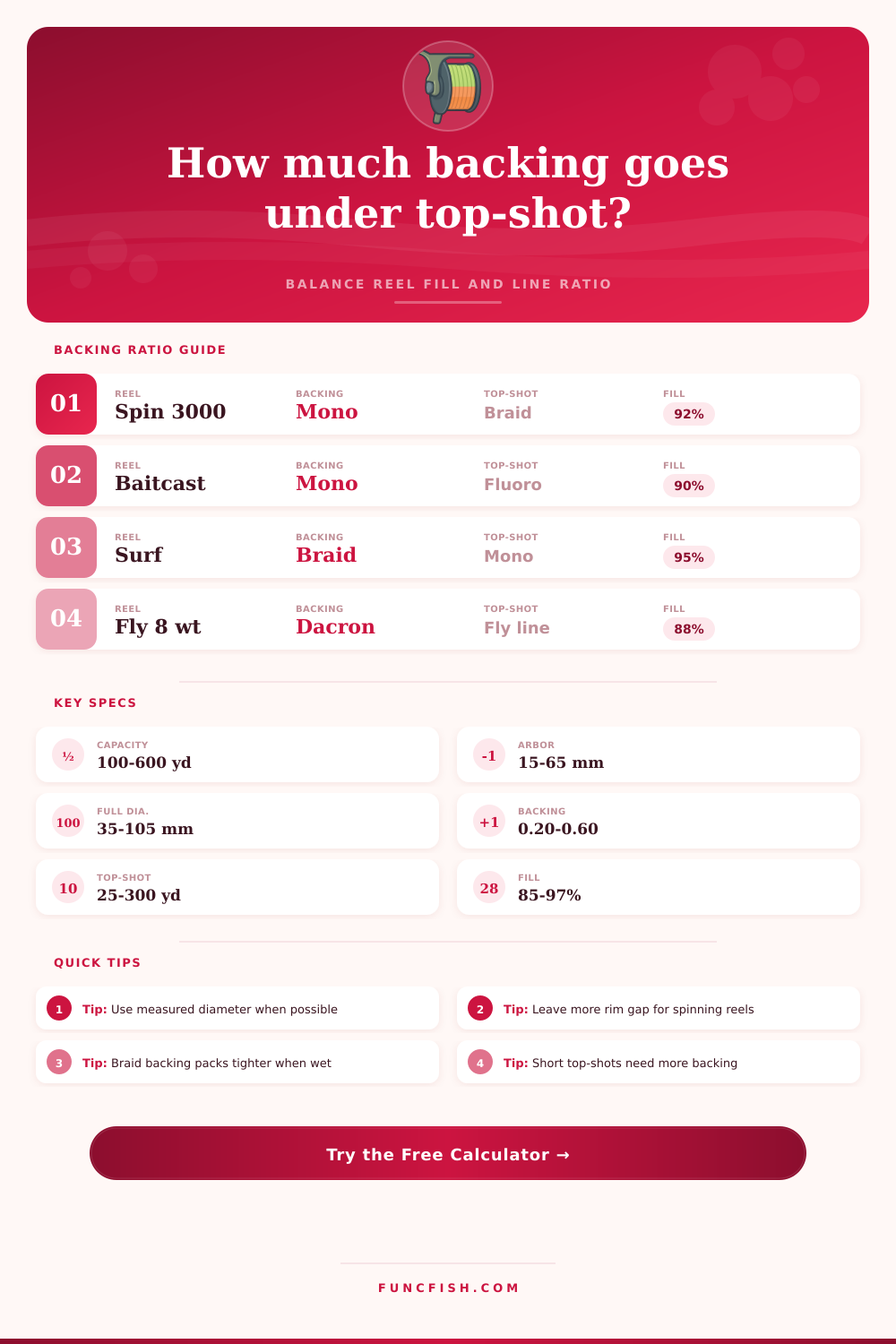
| Spinning | 88-94% | Mono grip layer | Long casts, less twist |
| Baitcaster | 85-92% | Mono or old braid | Control and spool speed |
| Conventional | 90-97% | Braid capacity base | Stretch and abrasion window |
| Fly | 82-90% | Dacron or gel-spun | Fly line plus leader clearance |
| Diameter change | Capacity effect | Backing effect | Use case |
|---|---|---|---|
| Same diameter | Near rating | Direct volume split | Mono to mono fills |
| Top-shot thinner | More total length | Needs more backing | Braid on spin reels |
| Top-shot thicker | Less total length | Needs less backing | Fluoro or shock leader |
| Backing thinner | More backing length | Higher base ratio | Deep conventional reels |
| Top-shot length | Common reel | Backing ratio | Practical read |
|---|---|---|---|
| 25-35 yd | Fly reel | High backing | Running fish reserve |
| 75-120 yd | Baitcaster | Medium backing | Fresh working line |
| 150-250 yd | Spinning | Low backing | Cast and drift length |
| 300+ yd | Trolling | Variable | Spread or leadcore work |
| Material | Packing factor | Diameter behavior | Ratio note |
|---|---|---|---|
| Braided PE | 0.92 | Flat, tight | Longer at same diameter |
| Mono | 0.89 | Round, soft | Good backing grip |
| Fluoro | 0.86 | Stiff, springy | Needs more rim margin |
| Dacron | 0.84 | Soft, bulky | Fly backing baseline |
💡Practical checks
Tip: If the factory capacity is printed for mono but you are loading braid, enter the printed mono diameter as the factory capacity diameter and braid diameter as the top-shot diameter.
Tip: Arbor and full-spool diameter make the fill estimate more realistic because the first yards near the arbor use less volume than yards near the rim.
To properly spool a fishing reel, a fisherman must determine the amount of backings to place under the working line and the amount of the spool to fill with the working line. The amount of backing and the amount of working line that should be placed on the spool are dependent upon the type of fishing reel that is used, the material of the fishing line, and the geometry of the spool itself. If these two amounts is not correctly calculated, the fisherman may experience issues with the casting distance of the line or the line may feel loose on the spool.
Furthermore, the fish may begin to run, and the working line may be fully utilized before the fisherman can reel in the caught fish. Because fishing reels are not perfect cylinders in three-dimensional space, the volume of line that is placed on the spool will change according to the location of that line on the spool. Line that is placed in closer proximity to the arbor will take up less of the total volume of the spool than line that is placed in closer proximity to the rim of the spool.
How Much Line to Put on a Fishing Reel
Thus, both the diameter of the arbor of the reel and the full diameter of the spool are necessary measurements in calculating how much line will fit on the spool. Without incorporating these two measurements into any calculations, the amount of line that will fit on the spool will be inaccurate. In addition to the diameter of the arbor and the full diameter of the spool, the material of the fishing line will affect the amount of volume that the line takes up on the reel.
Braid lines pack more closely to the spool than lines made from monofilament materials. Fluorocarbon lines leave gaps between the individual strands of the line due to the spring characteristics of fluorocarbon material. Additionally, lines made from Dacron material take up more of the volume of the spool than braided lines or lines made from monofilament material.
A line capacity calculator accounts for these different materials. Another factor that will impact the amount of the spool that should be filled with the working line is the type of fishing reel that is being used. For example, spinning reels often require a gap in the line closest to the spool to avoid the formation of wind knots in the line.
In contrast, conventional fishing reels can become filled to the maximum extent of their volume because the conventional reels have level-wind systems. Baitcaster reels will have a different fill percentage than conventional or spinning reels. Thus, the type of reel that is used will impact the amount of the spool that should be filled with working line.
The length of the top-shot on the fishing line will also impact the amount of backing that should be placed in the reel. For example, if a shock leader is used with a jigging reel, there is more room for placing backing on the spool. The use of a long 150-yard top-shot, however, on a surf fishing reel will reduce the amount of backing line that should be placed on the spool.
The length of the top-shot will impact the amount of backing line that is required for that fishing setup. Another consideration for fishing lines is the diameter of the top-shot on the fishing reel. If the diameter of the top-shot is thinner than the capacity of the line that the manufacturer created for that model of fishing reel, more length of fishing line can be placed on the spool.
In this case, however, the amount of backing line will need to account for a smaller portion of the total volume of the spool. If the top-shot is of a larger diameter than the capacity line of the manufacturer, the relationship between the backing line and the working line shifts accordingly. A line capacity calculator can display these shifts in the relationship of the various line components.
One of the mistakes that many beginning anglers make is the ignoring of the factory capacity line that is printed on the models of fishing lines that may be purchased. The factory capacity line of the manufacturer is merely an estimate of the amount of line that will fit on the spool. The actual diameter of the line and the material of the line will change that capacity number.
Thus, without measuring the actual diameter of the arbor of the reel and the full diameter of the spool, a fisherman will not be able to accurately add the correct amount of line to the reel. Another issue that should be considered before beginning to wind the line onto the spool is the fact that wet braid will pack more closely to the spool than dry braid. Thus, if a fisherman calculates the amount of line that should be on the reel based off the capacity of the reel, there is the potential that the line will appear to be low on the reel after the braid has become wet and packed more closely to the spool.
In this case, a slight increase in the percentage of line that is calculated for the reel will ensure that the line does not appear to be low on the spool after it has become wet. Depending upon the type of fishing reel that is used in the fishing operation, the amount of backing and fill percentage of the working line will differ. Surf reels that have braided line placed into the reel and a mono top-shot require the line to be filled to the full capacity of the reel to ensure that the fisherman is able to cast the line as far as possible.
Fly reels, in contrast, require the working line to have clearance to avoid the line becoming caught on the frame of the fishing reel. Though these percentages are not absolute percentages for each type of fishing reel, these percentages are those that are common in various fisheries. The fisherman should make another decision: if the calculated amounts of line and backing will work in the way in which the fisherman plans to fish.
If the calculated amount of backing for the line is too long, the length of the top-shot can be increased to allow for the line to be filled to a less percentage of the capacity of the spool. Alternatively, the fisherman can increase the length of the backing line to ensure that the line is not too short in comparison to the length of the working line. Making these types of small adjustments to the length of the top-shot and the amount of backing line will allow the fisherman to avoid the realization that the length of the top-shot is too short to adequately fish those areas.
The use of any line capacity calculator prior to beginning to wind the line onto the spool will allow the fisherman to catch any mistakes that may be made. Thus, by catching any mistakes in winding the line, the fisherman will not have to deal with those winding mistakes once the line has been cut and tie to the fishing rod. Thus, measuring the length, diameter, and material of the fishing line prior to casting will eliminate the need to constantly and random experiment with different amounts of line during the fishing efforts.