Fishing Weight To Line Test Calculator
Choose line test, leader strength, safe casting load, and reel drag from sinker or lure weight, cast style, rod power, line material, target species, current, wind, and safety factor.
📌Weight-line presets
⚙Gear matching inputs
Weight to line test match
Enter a cast weight and gear profile to estimate line, leader, rod load, and drag.
Full breakdown
📊Weight, line, and rod comparison grid
Finesse
All-purpose
Heavy cover
Surf load
📑Reference tables
| Line material | Best role | Model factor | Fishing note |
|---|---|---|---|
| Monofilament | General casting | 0.95 shock demand | Stretch helps absorb hard casts and surging fish. |
| Fluorocarbon | Clear water leader | 1.05 shock demand | Less stretch than mono and good abrasion resistance. |
| Braid | Thin main line | 1.18 shock demand | Low stretch raises cast shock but cuts wind and current belly. |
| Copolymer | Balanced main line | 1.00 shock demand | Middle ground for stretch, handling, and knot strength. |
| Wire | Teeth and traces | 1.30 shock demand | Use mainly as a short leader for pike, bluefish, or sharp teeth. |
| Lead-core | Trolling | 1.12 shock demand | Best treated as trolling line, not a hard-cast main line. |
| Rod power | Typical lure range | Line range | Best match |
|---|---|---|---|
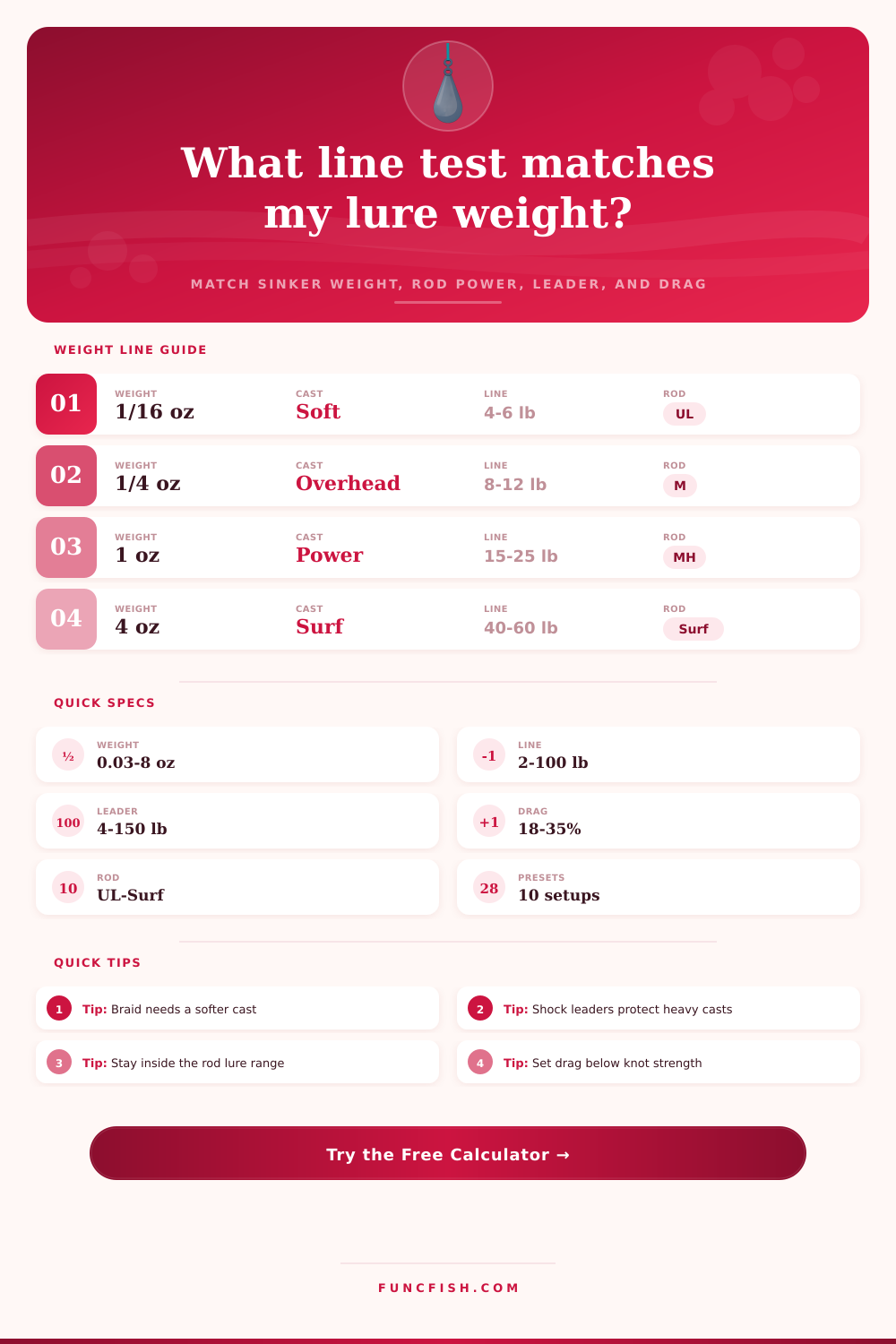
| Ultralight | 1/32-1/8 oz (1-4 g) | 2-6 lb | Panfish, trout jigs, tiny spoons. |
| Light | 1/16-1/4 oz (2-7 g) | 4-8 lb | Stream spinners and finesse rigs. |
| Medium light | 1/8-1/2 oz (4-14 g) | 6-12 lb | Walleye jigs and small inshore lures. |
| Medium | 1/4-3/4 oz (7-21 g) | 8-17 lb | Bass, walleye, poppers, and spinnerbaits. |
| Medium heavy | 3/8-1 oz (11-28 g) | 12-25 lb | Jigs, Texas rigs, spoons, and light catfish. |
| Heavy | 1/2-2 oz (14-57 g) | 17-40 lb | Cover, pike lures, bottom sinkers, and live bait. |
| Extra heavy | 1-6 oz (28-170 g) | 30-80 lb | Big swimbaits, muskie, and heavy bait rigs. |
| Surf | 2-8 oz (57-227 g) | 20-60 lb | Surf sinkers, bait rigs, and shock leaders. |
| Species target | Main line floor | Leader habit | Drag starting point |
|---|---|---|---|
| Panfish / crappie | 4 lb | 2-6 lb fluoro | 0.8-1.5 lb |
| Trout | 6 lb | 4-8 lb fluoro | 1-2 lb |
| Bass | 10 lb | 8-20 lb mono or fluoro | 2.5-5 lb |
| Walleye | 8 lb | 6-12 lb fluoro | 2-4 lb |
| Pike / muskie | 25 lb | 30-80 lb wire | 6-12 lb |
| Catfish | 20 lb | 25-60 lb abrasion leader | 5-10 lb |
| Inshore redfish / snook | 15 lb | 20-40 lb fluoro | 4-8 lb |
| Surf drum / bluefish | 25 lb | 40-80 lb shock or bite leader | 6-12 lb |
| Adjustment | Multiplier | When it matters | Calculator effect |
|---|---|---|---|
| Soft lob cast | 0.80 | Short range and flexible rods | Lowers cast shock demand. |
| Power cast | 1.28 | Hard overhead casts with heavy lures | Raises line and leader recommendation. |
| Surf cast | 1.55 | Long rods, bait rigs, headwind, big sinkers | Strongly favors shock leaders. |
| Moderate current | 1.14 | Line belly and sinker drag | Adds margin to main line and drag. |
| Surf sweep | 1.36 | Waves, side sweep, and bait drag | Raises safe-load caution. |
| Good knots | 0.85 | Normal terminal tackle | Reduces usable strength after rating. |
💡Tips
Tip: When the lure is near the top of the rod range, choose a smoother cast or step up leader strength before increasing distance.
Tip: For braid main line, set drag by measured pull and leader knots. Low stretch makes heavy sinkers feel harsher during sudden stops.
Choosing the correct fishing lines for the type of cast weight that will be used is another important task to perform. Choosing the correct fishing line for you situation will ensure that you dont damage your gear or lose any fish that you have hooked. If the weight of the bait or sinker is too heavy for the fishing rod and line that you are using, then the line will create a situation in which the knot is the weakest part of the fishing equipment.
This situation can lead to snapped fishing leaders or even lost fish when the fish pulls on the line during a run. It is important to understand the relationship between the cast weight and the fishing tackle. The cast weight will determine the physical demand that are to be placed upon the fishing line.
Choose the Right Fishing Line for Your Cast Weight
The calculator will provide mathematical results based off the cast weight and the fishing equipment that is to be used. Each of the variables that is entered will affect the mathematical calculation that the calculator performs. Cast style is one of the variables that must be considered in the calculation.
Different type of casts will place different loads upon the fishing gear. For instance, a soft pitch or lob will place less load upon the line than a hard overhead or surf pendulum cast. Another of the variables that the calculator will use is the power of the fishing rod.
The power of the rod indicates the amount of weight that the fishing rod can handle before it breaks. The material of the fishing line is another of the variables that the calculator considers. Braid lines do not stretch much, meaning that the impacts or jolts will be transmitted to the knot of the fishing line.
Therefore, braid lines require a more higher test than other lines. Lines that stretch more, like monofilament or copolymer lines will allow for a lower test line for the fishing line. Another of the variables that is important to consider is the type of species that will be targeted with this fishing line.
For instance, an four pound test line may be sufficient for a light jig in calm waters, but would not be able to handle a pike or surf drum. Environmental conditions, such as crosswind or current will create additional drag upon the line. These variables can be adjusted with the safety factor and knot efficiency adjustments on the calculator.
These adjustments allow for additional safety in the event that the fishing line is of older manufacture, or if the environment is particularly rough. The role of the leader in fishing line is different than the role of the main fishing line. For instance, a finesse fluorocarbon line is used to remain invisible to the fish, and therefore must have the same strength as the main fishing line.
However, a surf shock leader or wire trace is used to provide abrasion resistance or to protect the line from fish teeth, meaning that it must have a higher strength than the main fishing line. Finally, the drag setting for the fishing reel is the last step in the calculation process. Most fishing reels are manufactured to allow the drag to be set below the test of the fishing line.
Therefore, any drag that this fishing line calculator recommends will be within the range of the species that is to be targeted. One of the most common mistake with fishing lines is to ignore the fact that the line test is just one part of a system that includes the fishing rod, the line, and the knot. Another of the most common mistakes is to ignore how the cast place upon the fishing gear can impact the type of line that is to be used.
For instance, a three ounce sinker may be manageable on a medium-heavy fishing rod during a soft lob of the rod, but may be too much for that same fishing rod when performing a hard overhead cast with that same sinker. The calculator consider these different types of requirements for fishing gear by performing a multiplier function of the power of the fishing rod and the shock factor of the line. In addition to the variables that are to be entered into the fishing line calculator, there are other variables of the actual fishing environment that can continue to impact the outcome of the fishing line test.
For instance, water temperature can impact the feel of the line, and the strength of the line can degrade over time if it was stored in a hot environment. Similarly, a knot that was tied in poor lighting may not be as efficient as a knot that was tied in good lighting. Therefore, a knot that was tied in poor lighting could be a potential point of failure.
In this case, an additional safety factor would of been wise in incorporating into the fishing line calculation. The tables provided on this page provide information about the strength of lines according to the species of fish and the power of the fishing rod. The tables indicate the impact of the material of the fishing line, and provide information about how switching from monofilament lines to braided lines will require an increased test strength for the fishing line.
These tables provide a starting point for the strength of the fishing line according to the type of fish and the strength of the fishing rod. However, the calculator can be used to adjust for the cast weight and the fishing conditions. The goal is to find the balance in the system that allows for sufficient drag pressure when a fish is being reeled in.
Through using this fishing line calculator, the relationship between the cast weight, the fishing rod, and the fishing line will become clear to the anglers that use this fishing line calculator.