Tiger Trout Weight Calculator
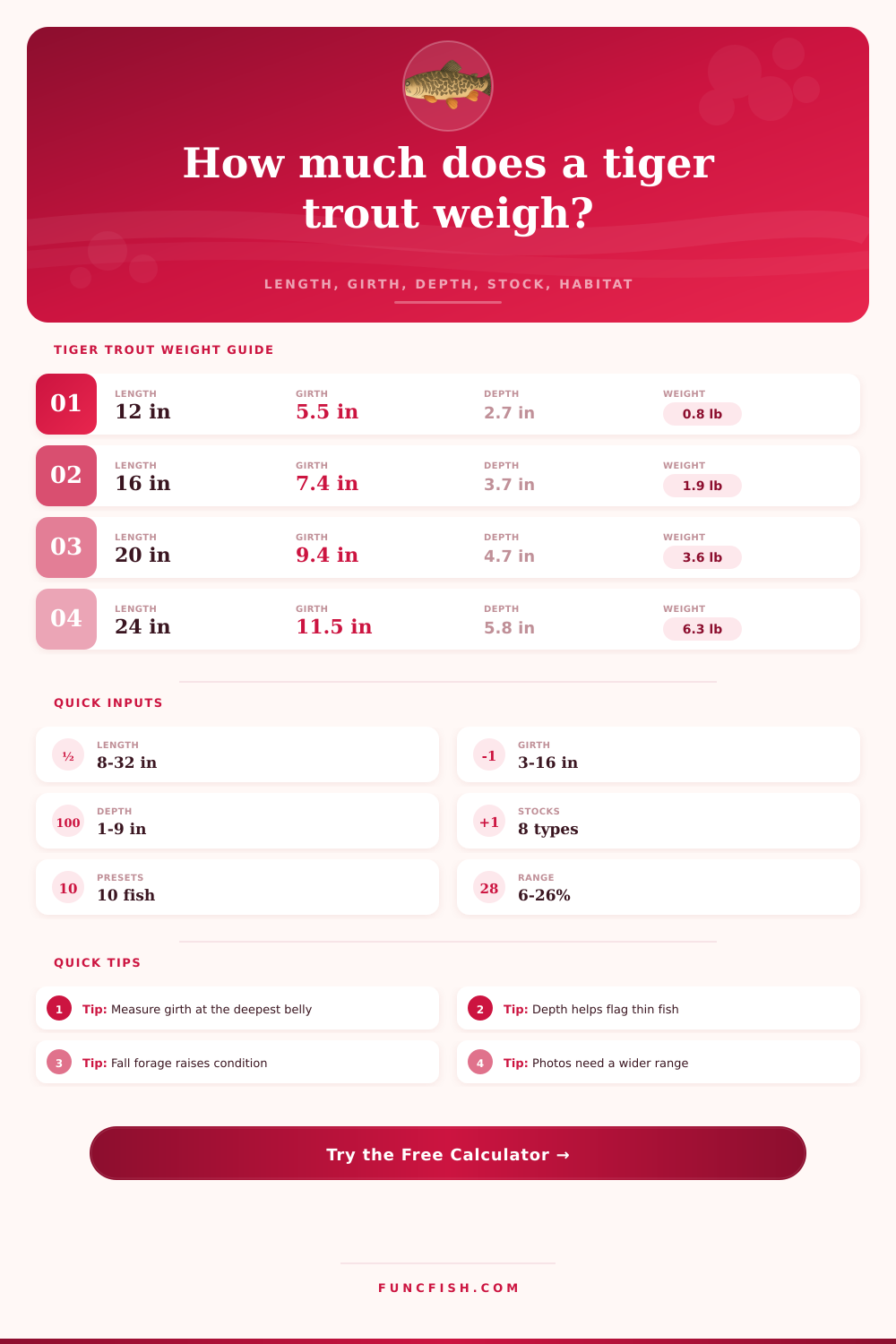
Estimate tiger trout weight from length, girth, body depth, hybrid stock class, lake or stream habitat, season and forage index, condition factor, and measurement confidence.
📌Tiger trout presets
⚙Hybrid measurements and condition
Model: the calculator blends the classic trout length-girth estimate with body-depth and relative-weight checks, then adjusts for hybrid stock class, lake or stream habitat, forage, season, condition factor, and confidence.
Tiger trout weight estimate
Calculator output appears here after entering measurements.
Calculation breakdown
📊Stock class data grid
Put-grow stock
Wild stream tiger
Reservoir trophy
Tailwater frame
🔎Tiger trout comparison grid
Stocked juvenile
Shorter hatchery fish with compact girth and fast early growth.
Quality stream fish
Longer frame, moderate girth, and strong shape in cold flow.
Lake trophy tiger
Heavy shoulders and deeper belly from minnows or rich forage.
Exceptional hybrid
Rare large tiger trout with high girth and measured depth.
📘Reference tables
| Length | Lean girth | Heavy girth | Typical weight |
|---|---|---|---|
| 10 in / 25 cm | 4.1 in / 10 cm | 4.8 in / 12 cm | 0.4 to 0.6 lb / 0.18 to 0.27 kg |
| 14 in / 36 cm | 5.8 in / 15 cm | 6.8 in / 17 cm | 1.0 to 1.5 lb / 0.45 to 0.68 kg |
| 18 in / 46 cm | 7.5 in / 19 cm | 8.8 in / 22 cm | 2.1 to 3.2 lb / 0.95 to 1.45 kg |
| 22 in / 56 cm | 9.4 in / 24 cm | 11.0 in / 28 cm | 4.0 to 5.6 lb / 1.81 to 2.54 kg |
| 26 in / 66 cm | 11.1 in / 28 cm | 13.0 in / 33 cm | 6.8 to 9.3 lb / 3.08 to 4.22 kg |
| Hybrid stock class | Body clue | Calculator effect | Best use |
|---|---|---|---|
| Standard brook x brown hybrid | Balanced girth and depth | Neutral coefficient | General tiger trout estimate |
| Put-grow hatchery tiger | Rounded but variable | Slightly fuller profile | Stocked lakes and ponds |
| Wild stream tiger | Longer, leaner frame | Lowers mass modestly | Creeks and cold tributaries |
| Reservoir trophy-strain tiger | Deep body, high girth | Raises profile and range | Minnow-rich reservoirs |
| Tailwater long-frame hybrid | Strong length, moderate girth | Leaner body coefficient | Cold release runs |
| Habitat | Forage clue | Condition tendency | Measurement priority |
|---|---|---|---|
| Small stream pocket water | Insects, sculpin, small minnows | Lean to balanced | Length and girth |
| Spring creek meadow reach | Insects, snails, small forage | Balanced | Depth and girth |
| High-country lake or pond | Insects, leeches, seasonal minnows | Variable | Girth confidence |
| Productive lake weed edge | Minnows and young perch | Fuller body | Maximum girth |
| Reservoir basin or inlet | Open-water forage and minnows | Heavy when forage is strong | Girth plus depth |
| Confidence setting | Base range | Use when | Bias to watch |
|---|---|---|---|
| High: board, wet tape, measured girth | 6% | Fish was calm and fully measured | Very small tape angle errors |
| Standard: quick field tape | 11% | Length and girth were taken quickly | Girth may be off by half an inch |
| Rough: curved tape or moving fish | 18% | Fish moved or tape was not square | Girth usually reads high |
| Photo-only or memory estimate | 26% | Only a photo, net, or hand scale clue exists | Perspective changes belly size |
💡Measurement tips
Girth tip: Tiger trout weight changes quickly when girth changes because the length-girth formula squares girth. A careful widest-point girth reading is more useful than adding extra decimal places to length.
Depth tip: Body depth is a shape check. If depth is low for the selected stock class, the calculator trims the estimate even when the entered girth looks strong.
Tiger trout are the result of a female brown trout mating with a male brook trout. Because tiger trout are the result of a crossbreeding between two different types of trout, tiger trout can have various physical characteristics, weights, and behaviors. One of the uses of a tiger trout weight calculator is to allow anglers to determine whether there catch of tiger trout is growing well or struggling to reach it’s full growth potential.
Similarly, biologists use these calculators to determine how the weights of tiger trout that are stocked into a body of water compare to that of wild tiger trout populations. Though the weight of a tiger trout cannot be truly measured without placing the fish on a scale, the weight estimate for that particular fish does allow for the comparison of the weight of that fish to other tiger trout caught or weighed, and to the average weight of tiger trout in that body of water. Because tiger trout do not all have the same physical characteristics, it is important to consider the growth patterns of those fish.
How to Use a Tiger Trout Weight Calculator
For instance, tiger trout that were raised in a hatchery that used pellets as food will have more girth than those tiger trout that live in a fastly stream with access only to insects. Additionally, tiger trout that live in a lake with minnows as there main food source will have a different body shape than those that live in a tailwater with a constant current. The tiger trout calculator accounts for these different physical characteristics by permitting the user to select the stock class, habitat type, and forage condition of the tiger trout to be measured.
Each of these attributes of the tiger trout will adjust the weight estimation to reflect the physical characteristics of that specific fish. The length and girth of the tiger trout are used as the primary measurements for the calculator. While length will only provide a measurement of the length of the fish, the girth is measured at the widest point of the belly of the fish to account for the thickness of the trout.
Additionally, body depth is also collected to provide another measurement of the thickness of the fish. Finally, the individual uses the condition factor to provide their own judgment of the weight of the tiger trout. Standard tiger trout typically have a condition factor near 100.
If the condition of the fish feels heavy for its length, the user will increase the condition factor. However, if the fish feels thin after it has spawned or spent the winter months, the user will decrease the condition factor. This condition factor is calculated as a multiplier of the weight of the tiger trout to determine the change in that weight with the addition of heaviness or lightness of the trout.
This factor changes according to the season in which the fish is measured. For instance, in late fall, the factor will be higher than 100, yet in spring it may be less than 100. The calculator provides the user with the estimated weight of the tiger trout, a confidence range for the weight estimate, and a relative condition score.
The confidence range reflects the range of the weight estimate should the weight calculations be slightly inaccurate. For example, if the length and girth are measured using a tape measure and a board, the confidence range will be narrow. However, if the weight is estimated from a photograph of the tiger trout, that confidence range will be much larger.
Additionally, the relative condition score can indicate the health of the trout. A relative score near 100 reflects that the fish is healthy. However, if the score is significantly higher or lower than 100, the quality of the water and the availability of food fish within the body of water is affecting the health of the tiger trout.
The stock class and habitat type determine the baseline values for the weight calculator. For instance, a tiger trout of the reservoir trophy strain will have greater girth measurements than a wild stream stock class of tiger trout. By adjusting for these different baseline values, the calculator will produce different estimates of the weight of the tiger trout if different stock classes and habitats are selected.
Thus, the adjustment for these different variables is essential to reflect the biological differences between tiger trout that were caught in a hatchery as opposed to those that live in the wild. The reference tables provide the typical girth and depth ratios for the different stock classes of tiger trout. These tables are helpful in that they provide information regarding the effect of the habitat and forage availability upon the condition of the tiger trout.
Should the tiger trout have a condition score outside of those typical ranges, the owner of the calculator and the owner of the fish can decide whether that difference in the weight of the tiger trout is the result of inaccuracies in the measurement of the fish, or if it is the result of differences in the availability of food in the body of water in which the fish lives. To measure a live tiger trout, measure its length, girth, and depth. The length of the fish is measured from the tip of its nose to the end of its tail.
The girth is measured at the widest point of the belly of the fish, approximately where the dorsal fin begins. The depth is measured from the back of the fish to its belly at the same location as the girth measurement. These three measurements provide the information necessary for the calculator to differentiate between a long, thin tiger trout and one that is short and deep.
The weight estimate will not provide the exact weight of the tiger trout. However, the weight estimate will provide an informed guess as to the weight of the fish. The accuracy of the weight estimate will be improved with more accurate measurements of the tiger trout.
Additionally, the condition and forage setting will be adjusted to reflect the true spawning cycle of the fish. For instance, a twenty-inch tiger trout in a lake may weigh more than one of the same length in a stream due to the increased availability of food in the lake. Thus, the calculator allows for the identification of these differences in weight.
The weight of the tiger trout varies according to the availability of food in its body of water and the specific water in which it lives. Thus, a twenty inch tiger trout in a lake will have a different weight than a twenty inch tiger trout that lives in a stream. The calculator permits anglers and fish owners to identify these differences in the weight of their tiger trout without measuring the weight of the fish.
Thus, the calculator utilizes length, girth, depth, and condition factors in the determination of the weight of the tiger trout.