🐟 Saugeye Weight Calculator
Estimate saugeye weight from length & girth — imperial & metric supported
| Species | Typical Length Range | Typical Weight | Weight Formula Divisor |
|---|---|---|---|
| Saugeye (hybrid) | 12–28 in (30–71 cm) | 0.5–12 lb (0.2–5.4 kg) | ~2,750 |
| Walleye | 12–30 in (30–76 cm) | 0.5–14 lb (0.2–6.4 kg) | 2,700 |
| Sauger | 10–22 in (25–56 cm) | 0.3–6 lb (0.1–2.7 kg) | 2,800 |
| Yellow Perch | 6–15 in (15–38 cm) | 0.1–2 lb (0.05–0.9 kg) | 3,500 |
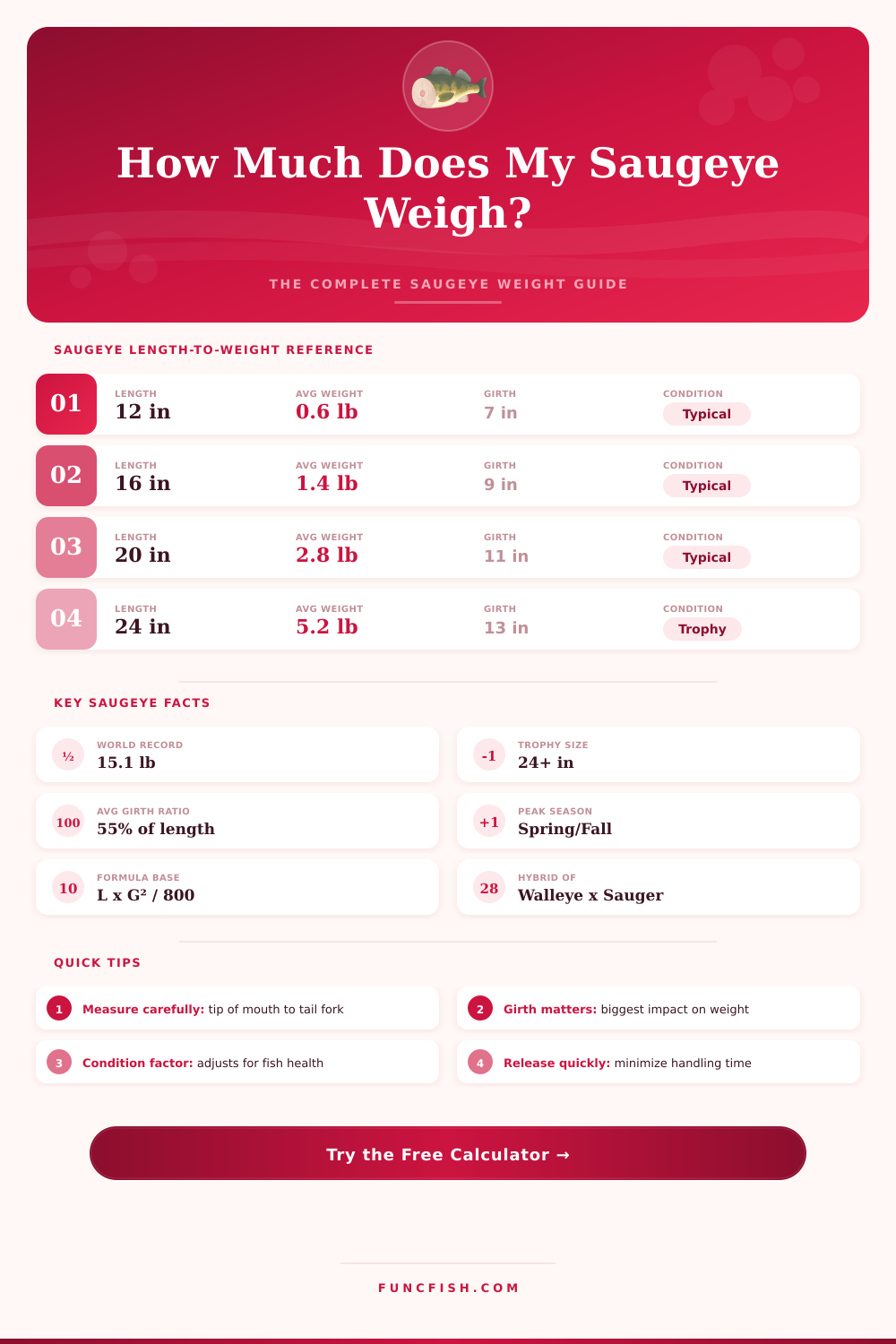
| Length (in) | Length (cm) | Avg Girth (in) | Est. Weight (lb) | Est. Weight (kg) | Classification |
|---|---|---|---|---|---|
| 10 | 25.4 | 6.0 | 0.4 | 0.18 | Juvenile |
| 12 | 30.5 | 7.0 | 0.6 | 0.27 | Juvenile |
| 14 | 35.6 | 7.8 | 1.0 | 0.45 | Sub-legal |
| 15 | 38.1 | 8.3 | 1.3 | 0.59 | Keeper (some states) |
| 16 | 40.6 | 8.8 | 1.6 | 0.73 | Keeper |
| 18 | 45.7 | 9.8 | 2.4 | 1.09 | Good |
| 20 | 50.8 | 10.8 | 3.1 | 1.41 | Good |
| 22 | 55.9 | 11.8 | 4.1 | 1.86 | Quality |
| 24 | 61.0 | 12.8 | 5.5 | 2.49 | Trophy |
| 26 | 66.0 | 13.6 | 7.0 | 3.18 | Trophy |
| 28 | 71.1 | 14.5 | 9.0 | 4.08 | Master Angler |
| Saugeye Size | Line Weight | Hook / Jig Size | Rod Power |
|---|---|---|---|
| Under 14 in | 6–8 lb mono | #4–#6 hook, 1/8 oz jig | Light |
| 14–18 in | 8–10 lb mono / 10 lb braid | #2–#4 hook, 1/4 oz jig | Med-Light |
| 18–22 in | 10–12 lb mono / 15 lb braid | #1–#2 hook, 3/8 oz jig | Medium |
| 22–26 in | 12–17 lb mono / 20 lb braid | #1/0 hook, 1/2 oz jig | Med-Heavy |
| Trophy 26+ in | 17–20 lb mono / 30 lb braid | #2/0 hook, 3/4 oz jig | Heavy |
Saugeye is a type of fish that is created through the cross-breeding of a walleye and a sauger. Due to the fact that the length of a saugeye dont always accurately indicate its weight, it may be difficult to determine the weight of a saugeye based off its length alone. For instance, the saugeye may have the body shape of a sauger yet contain the mass of a large saugeye; or, it may have the body shape of a walleye yet contain few mass within its body.
Thus, an individual cannot rely upon the length of the saugeye to indicate the weight of the fish. The body shape of the saugeye is one of the primary factor that can be used to estimate its weight. Saugeye fish that possess a body shape that is more dominate by walleyes will possess a deeper flank and broader back than sauger fish, which will contribute to the increase of the weight of the fish without increasing its length.
How to Estimate the Weight of a Saugeye
Sauger fish, in contrast, will have a more slenderly body shape as they are adapted to move through the currents within rivers. Therefore, an individual should measure the girth of the fish at its deepest point; the girth of the saugeye will change the estimated weight of the fish more quick than the length of the saugeye will change the estimated weight of the fish. In addition to the body shape of the saugeye, there is other biological factors that can contribute to the weight of the fish.
For instance, female saugeye fish may contain a mass of egg that is yet to be spawned, which would increase the weight of the fish in comparison to a male saugeye fish of the same length. Additionally, the oils in the food will increase the weight of the fishs shoulders and overall profile as the fish may consume oily types of food during the fall months. An online calculator can be used to adjust for these biological factor to account for the expected weight of the fish without guessing as to if its body is lean or plump.
The environment in which a saugeye live will also have an effect upon the weight of the fish. For instance, a saugeye that lives in a reservoir that contains abundant food will be heavier than a saugeye that lives in an environment that contains very little food. Saugyr fish that live in rivers are typically built for speed and endurance, while those that live in reservoirs has bulkier body shapes.
The condition of the saugeye can be determined by measuring the depth of its body from its back to its belly. This measurement of depth will allow an individual to calculate the relative weight (Wr) of the fish; this relative weight will allow an individual to determine if the fish is thin, balanced, or exceptional compared to other saugeye fish in the same range of weights. Based upon the weight of the saugeye, an angler can determine the type of gear that they should use to catch these fish.
The size of the saugeye fish will dictate the type of gear that people use to catch them; different gear will be needed for a trophy fish then for a small saugeye. For instance, if fishing for saugeye fish in a river, the jig used to catch these fish should be heavy enough to ensure that it maintain contact with the riverbed. The weight of the saugeye will dictate the type of jig and line that should be used when fishing for these fish; using the wrong type of fishing gear may result in the loss of a large saugeye.
It is common for individuals to attempt to use a photograph of the saugeye to determine its weight. These type of photographs, however, can be inaccurate; the fish may appear to be very large in a photograph if the camera is close to the fish, yet the girth of the fish may be relatively narrow. Thus, the measurement of the fish from a photograph is likely to provide inaccurate information regarding the weight of the fish.
Therefore, using a measurement board will allow an angler to better determine the girth of the fish more accurate. It is better for an angler to know the realistic range of weight of the fish rather than to rely upon a single weight estimate for the fish. Finally, an angler should remember that the girth of the saugeye and the season in which it is caught are the two most importantly factors in the estimation of the weight of a saugeye fish.