Dolly Varden Weight Calculator
Estimate Dolly Varden weight from resident or anadromous form, fork or total length, girth, body depth, habitat, seasonal condition, forage index, and measurement confidence.
📌Dolly Varden presets
⚙Weight estimate inputs
Dolly Varden weight estimate
Calculated estimate appears here.
Full calculation breakdown
📊Dolly Varden form factors
Resident Stream
Resident Lake
River Fluvial
Anadromous
⚖Char and salmonid comparison grid
Dolly Varden
Char body, forked tail, often sea-run in coastal drainages.
Bull Trout
Similar char shape, commonly longer and broader in large rivers.
Brook Trout
Compact char, often shorter with deep body in rich ponds.
Arctic Char
Variable lake and sea-run forms with strong seasonal condition shifts.
📘Dolly Varden reference tables
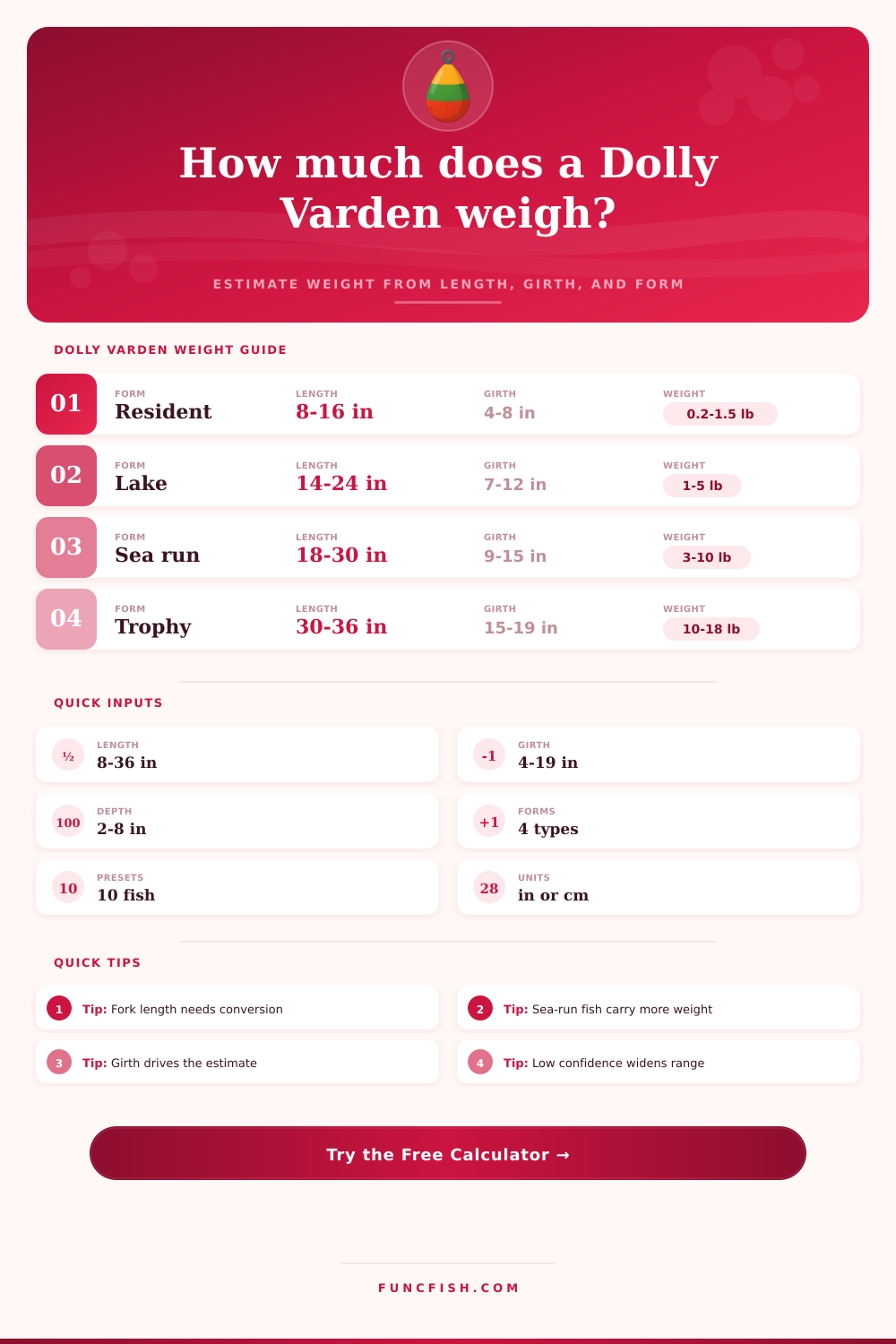
| Form | Typical length | Girth ratio | Weight cue |
|---|---|---|---|
| Resident stream | 8-16 in / 20-41 cm | 0.36-0.42 | Small, lean, insect-fed fish |
| Resident lake | 14-24 in / 36-61 cm | 0.39-0.45 | Deeper body with littoral forage |
| River fluvial | 16-28 in / 41-71 cm | 0.38-0.44 | Firm shoulders from moving water |
| Anadromous | 18-34 in / 46-86 cm | 0.41-0.49 | Heavy sea-run or salmon-feed fish |
| Habitat | Modifier | Forage clue | Estimate note |
|---|---|---|---|
| Cold headwater creek | 0.93 | Insects and small fish | Often leaner than the formula baseline |
| Alpine lake outlet | 1.00 | Scuds, larvae, minnows | Use measured girth carefully |
| Estuary tidewater | 1.07 | Marine prey and smolts | Bright fish may carry dense weight |
| Salmon tributary run | 1.10 | Eggs and flesh | Late-season girth can rise quickly |
| Season condition | Modifier | Common profile | Best measurement |
|---|---|---|---|
| Winter lean reserves | 0.91 | Narrow belly, lower girth | Girth plus depth |
| Summer normal condition | 1.00 | Balanced char profile | Total length and girth |
| Salmon egg and flesh feed | 1.12 | Round belly, full shoulders | Maximum girth |
| Post-spawn drawn down | 0.86 | Long fish with reduced mass | Confidence range |
| Confidence | Range width | Use case | Practical result |
|---|---|---|---|
| Excellent tape and girth | Plus/minus 7% | Fish measured on a wet tape | Tightest range |
| Good hand-measured fish | Plus/minus 11% | Fast release with solid girth | Reliable field estimate |
| Photo-only estimate | Plus/minus 25% | Length inferred from hand or net | Use as broad estimate |
| Rough memory estimate | Plus/minus 32% | No tape or direct girth | Large uncertainty band |
💡Measurement tips
Fork or total length: Dolly Varden are often recorded by fork length in field notes. The calculator converts fork length to estimated total length before applying the weight model.
Girth and depth: A sea-run char with the same length as a stream resident can weigh much more. Measure the widest girth and note body depth when the fish is especially full or drawn down.
Dolly Varden are a species of fish. The shape and weight of Dolly Varden change according to an environment in which they live. For instance, Dolly Varden that live in streams and eat insects will have a different shape than those that live in the sea and eat herring or salmon egg.
Thus, knowing the length of a Dolly Varden isnt enough to determine the weight of that Dolly Varden. The length, girth, and depth of a Dolly Varden must be known in order to calculate its weight with accurate. A weight estimate for a Dolly Varden can be obtained by inputting the length, girth, and depth of the Dolly Varden into the calculator.
How to Estimate the Weight of a Dolly Varden
Length is used as a baseline measurement for the Dolly Varden, but the girth of a Dolly Varden is the most important of the three measurement in determining the weight of that Dolly Varden. A Dolly Varden may be long but have a low weight if its girth is small. In contrast, a Dolly Varden may be short in length but have a high weight if its girth is deep and large.
Depth is another important measurement for distinguish between Dolly Varden with different weights. The habitat in which a Dolly Varden lives and the season in which it lives in that habitat will impact the weight of the Dolly Varden. For instance, a Dolly Varden that lives in a cold headwater creek will contain less weight than a Dolly Varden that lives in a salmon tributary.
The calculator account for these habitat differences with the habitat and condition modifiers for the calculator, such as the forage slider for Dolly Varden. The forage slider allows for the selection of the type of prey that the Dolly Varden eat; either insects or marine prey. Thus, this slider allows the calculator to account for the difference in habitat in which each Dolly Varden live.
The condition of a Dolly Varden in a certain season may impact the weight of the Dolly Varden. For instance, Dolly Varden that have just spawned may have a length that is longer than the weight of the Dolly Varden indicate. Similarly, Dolly Varden that are preparing to spawn or are in marine state will have more weight in their girth and depth.
A selection of the state of the Dolly Varden in the calculator allows the weight range to reflect the actual state of the Dolly Varden. If girth and depth are not measured, the weight range will be more wide than if the Dolly Varden was measured in these factors. A photo of the Dolly Varden will also be less accurate than if the Dolly Varden was measured with a tape.
Many people may only focus on the length of the Dolly Varden. Length is an easy measure to obtain for the Dolly Varden, but length only indicates the weight of the Dolly Varden if the length of each Dolly Varden is the same; for example, a three-pound Dolly Varden may have the same length as a five-pound Dolly Varden. Thus, knowing the length, girth, and depth of the Dolly Varden is important for estimating the weight of the Dolly Varden.
Additionally, the user must also select the form of the Dolly Varden. The anadromous form of the Dolly Varden is heavier than the resident Dolly Varden stream form. Thus, the calculator provides a higher factor for anadromous Dolly Varden compared to the resident form of the same species in order to provide more accurate measurement of the weight of the Dolly Varden.
A comparison grid allows for the Dolly Vardens weight to be compared to other species of char. Bull trout, brook trout, and Arctic char have similar body plan to the Dolly Varden, however, the proportions of each of these species is different from the Dolly Varden. For instance, the brook trout may have more girth relative to the length of the fish than the Dolly Varden has relative to its length.
Thus, you cant calculate the weight of each species of char from the weight formula of another form of char. This calculator provides an estimate for the weight of a Dolly Varden. However, the calculator does not account for all variables that may impact the weight of a Dolly Varden.
For instance, the temperature of the water in which it lives, the success of the Dolly Varden in catching its prey, and the genetics of the Dolly Varden can impact the weight of a Dolly Varden. If the range of weights calculated in the calculator is narrow, the weight of the Dolly Varden is more firm. However, if the range is more wide, then the weight of the Dolly Varden is uncertain, and the individual should record the measurements of the Dolly Varden.
With regular use of this calculator, the individual will remember the specific meaning of each measurement of the Dolly Varden. Thus, over time, the individual will be able to more quick estimate the weight of a Dolly Varden.