Bull Trout Weight Calculator
Estimate bull trout weight from life form, total length, widest girth, body depth, river or lake habitat, temperature band, forage condition, maturity class, confidence, and units.
📌Bull trout presets
⚙Life form, habitat, and measurements
Model: this calculator blends a char length-girth estimate, a body-depth cross-check, and a relative condition index, then adjusts for bull trout life form, river or lake habitat, water temperature band, forage condition, maturity class, and measurement confidence.
Bull trout weight estimate
Enter measurements and calculate to see the estimate.
Calculation breakdown
📊Bull trout profile cards
Resident headwater
Fluvial river
Adfluvial lake
Lake cruiser
🐟Char comparison grid
Bull trout
Long cold-water char with resident, river, and lake-linked forms.
Dolly Varden
Similar char profile, often compact at the same length.
Brook trout
Smaller char with deeper compact bodies in rich water.
Lake trout
Large lake char with long frame and strong girth at trophy sizes.
Arctic char
Variable lake and river forms with broad seasonal body changes.
📘Reference tables
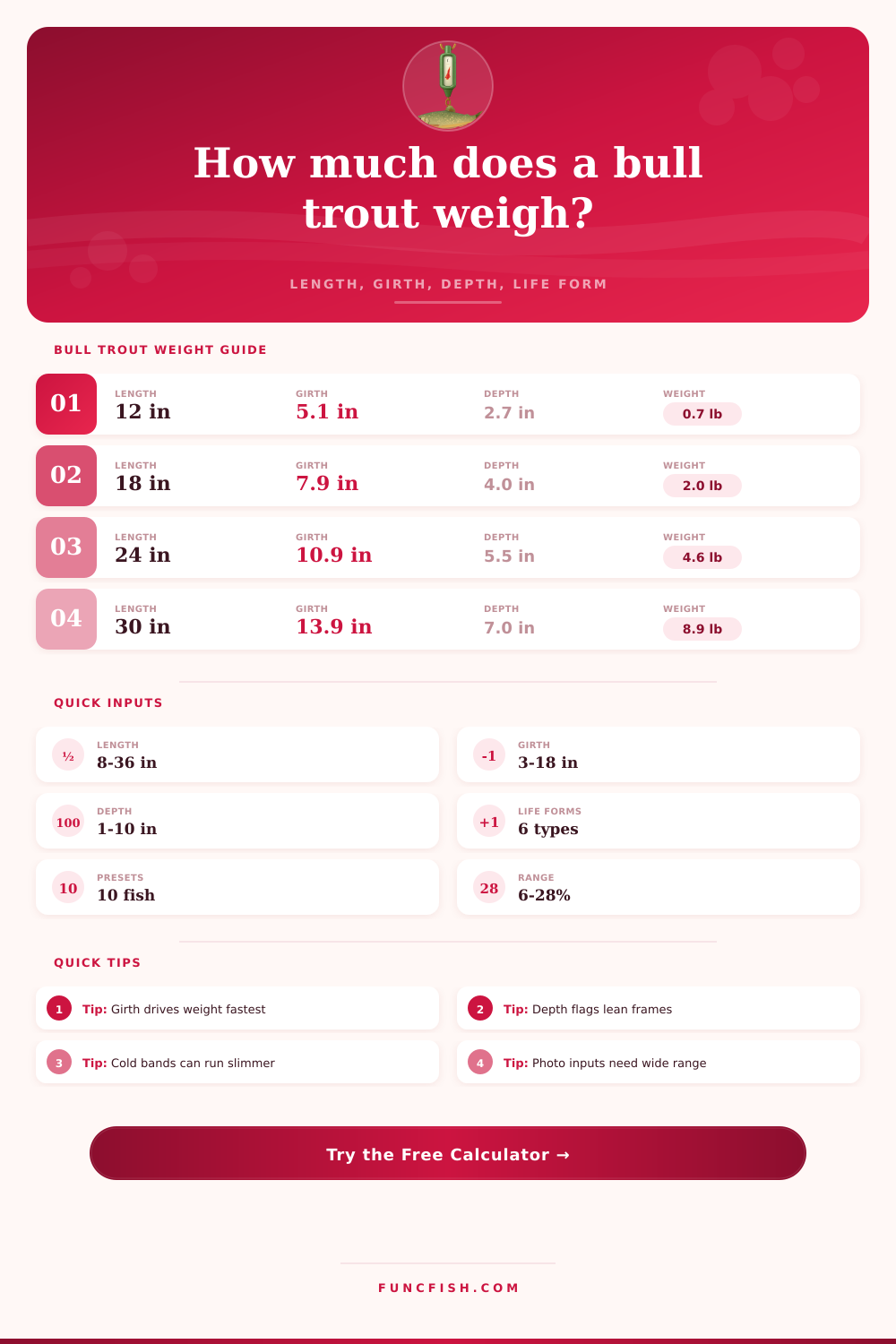
| Length class | Typical girth | Typical depth | Estimated weight band |
|---|---|---|---|
| 10 in / 25 cm | 3.8-4.4 in / 9.7-11.2 cm | 2.0-2.3 in / 5.1-5.8 cm | 0.35-0.55 lb / 159-249 g |
| 14 in / 36 cm | 5.5-6.3 in / 14.0-16.0 cm | 2.9-3.3 in / 7.4-8.4 cm | 0.9-1.4 lb / 0.41-0.64 kg |
| 18 in / 46 cm | 7.2-8.2 in / 18.3-20.8 cm | 3.7-4.3 in / 9.4-10.9 cm | 1.8-2.6 lb / 0.82-1.18 kg |
| 22 in / 56 cm | 9.0-10.3 in / 22.9-26.2 cm | 4.7-5.3 in / 11.9-13.5 cm | 3.2-4.5 lb / 1.45-2.04 kg |
| 26 in / 66 cm | 11.0-12.5 in / 27.9-31.8 cm | 5.7-6.5 in / 14.5-16.5 cm | 5.3-7.4 lb / 2.40-3.36 kg |
| 30 in / 76 cm | 13.0-14.8 in / 33.0-37.6 cm | 6.7-7.6 in / 17.0-19.3 cm | 8.0-11.0 lb / 3.63-4.99 kg |
| Life form | Body profile | Calculator effect | Best input priority |
|---|---|---|---|
| Resident headwater char | Shorter, leaner frame | Uses higher coefficient and lower fullness | Precise length and girth |
| Fluvial river adult | Long current-built body | Neutral bull trout river profile | Length, girth, and depth together |
| Adfluvial lake-river adult | Deep body and stronger girth | Raises fullness and condition expectation | Maximum girth plus maturity class |
| Lake-dwelling cruiser | Deep, steady open-water body | Moderately raises weight estimate | Body depth cross-check |
| Juvenile rearing fish | Small, narrow frame | Trims adult shape assumptions | Small-measurement accuracy |
| Migratory river runner | Long frame, variable girth | Widens confidence range slightly | Confidence and maturity class |
| Temperature band | Condition tendency | Weight factor | Range behavior |
|---|---|---|---|
| Icy: under 40 F / 4 C | Slow fullness, leaner profile | 0.96 | Range widens slightly |
| Cold: 40-48 F / 4-9 C | Baseline cold-water profile | 1.00 | Standard range |
| Prime cold: 49-55 F / 9-13 C | Strong feeding condition | 1.04 | Standard range |
| Cool edge: 56-60 F / 13-16 C | Variable body fullness | 0.98 | Range widens |
| Variable mixed band | Mixed shape and feeding signals | 0.99 | Range widens most |
| Forage condition | Shape clue | Weight factor | Calculator note |
|---|---|---|---|
| Sparse insects | Narrow belly, lower depth | 0.91 | Condition index usually falls |
| Aquatic insect drift | Balanced small-prey profile | 0.98 | Best for resident stream fish |
| Mixed insects and small fish | Baseline river-lake profile | 1.00 | Neutral forage setting |
| Kokanee, sculpin, or minnow rich | High girth and depth | 1.10 | Best for lake-linked adults |
| Late-season full body | Full shoulders and belly | 1.08 | Raises condition index |
| Lean recovery condition | Lower girth for length | 0.88 | Wider range and lower class |
💡Measurement tips
The classic formula squares girth, so a small widest-point girth error can shift the estimate more than a larger length error.
If body depth is shallow for the selected life form, the calculator trims the result even when the entered girth looks high.
This calculator is a measurement and body-profile estimator only, using the dimensions and profile inputs above.
The formula for estimate the weight of a bull trout incorporates several specific variable in the calculation of the species’ estimated weight; the body shape of bull trout change based upon environmental and life history factors. Each of these variable must be provided to the calculator in order to provide an accurate estimate of the weight of that bull trout. Each of these specific variable includes the life form of the bull trout, the habitat where the bull trout lived, the temperature band of the bull trout’s environment, the forage condition of the bull trout, and the maturity class of the bull trout.
The life form of the bull trout will indicate if the bull trout is a resident or migratory bull trout; these two life forms has different body shapes. Additionally, the habitat that the bull trout inhabited will impact the weight of that bull trout; bull trout living in different habitat will have different access to food source. Bull trout live in reservoirs and in smaller headwater runs that contain kokanee fish; the access to food will impact the weight of the bull trout.
How to Estimate the Weight of a Bull Trout
The temperature band of the bull trout will affect its metabolism, as well as the rate at which the bull trout gain weight. The forage condition of the bull trout will impact the amount of food that it ate in the past; if the bull trout ate a great deal of food in the past, it will have more body mass than a bull trout that is recovering from its spawning season. Finally, the maturity class will impact the mass of the bull trout; a young adult bull trout will have less body mass than a large post-spawn bull trout of the same length.
The two primary physical measurement of a bull trout are its girth, its depth, and the length of its body; length will give the length of the bull trout, someone will measure its girth around the widest part of its body, and the person will measure its depth from the back of the bull trout to its belly. Both the girth and the depth are used to calculate its weight; the girth will be the strongest signal of the weight of the bull trout, although the length will provide information for the bull trout’s length. In addition to length, girth, and depth, another physical measurement that can be used is the blend setting; this blend setting will allow an individual to provide the calculator with information regarding how much they trust the physical measurement of the bull trout versus its expected body shape according to its life form.
The calculator will produce two different output measurement for each bull trout that is evaluated. The first is a condition index, which provides the weight of the bull trout as compared to the average weight for that type of bull trout and habitat. A condition index that even closely relates to 100 indicates that the bull trout has a balanced weight; a condition index that is less than 100 indicates lean bull trout, while a condition index that is higher than 100 indicates that the bull trout ate heavily during the spawning season.
The second output is the class label, which indicates into which group the bull trout can be classified; bull trout can be juvenile, young adult, adult, or large adult bull trout, depending upon its length, its weight, and its maturity class. In order to use this calculator, an individual will need to first measure the length of the bull trout, its girth around the widest part of its body, and its depth from its back to its belly. Each of these physical measurement will need to be entered into the calculator.
Following these measurement, the individual will need to provide information regarding the life form, habitat, temperature of its environment, the forage condition in its habitat, and its maturity class. The length, girth, and depth measurement will be used to calculate the weight of the bull trout; additionally, the habitat and forage information will be incorporated into the calculation of the weight of the bull trout. Finally, the blend setting will allow an individual to provide information as to how much they trust the physical measurement of the bull trout compared to its expected body according to its life form.
Bull trout does not follow a standard growth curve for several different reason; bull trout that live in different habitat will contain different amounts of food and will gain different weight. Bull trout that eat kokanee fish will have more girth than bull trout that eat only insect. Bull trout that are in the process of spawning will have more length than bull trout of the same age but will have less body mass; they expend their energy reserve during the spawning season.
Additionally, the temperature and the availability of food in the habitat can change, which will continue to impact the weight of the bull trout throughout its spawning season. Thus, while the calculator will provide a consistent result, the calculator cannot account for all of the changes that may occur in the bull trout’s environment. Finally, there are a variety of reference table that contain additional information regarding each of the parameters for bull trout.
These tables indicate the length of the bull trout in a specific range, and the girth and depth of bull trout of that same length. The tables also indicate how each life form and each temperature band will change the weight of the bull trout. These tables were created based off field observation of bull trout of each of these different category; these observation will allow an individual to determine the health of each bull trout in relation to the other bull trout of its habitat.
Thus, if a bull trout does not have a weight in the expected range, that individual should of re-examine the measurement of that bull trout. This model is not based in the laboratory, but it is repeatable and basing the same measurement as the biologist assessing the weight of bull trout population.