Triggerfish Weight Calculator
Estimate triggerfish weight from species group, fork length, maximum girth, body depth, reef depth, body class, condition, confidence, and unit system.
📌Triggerfish presets
⚙Species, shape, reef depth, and measurements
Model: triggerfish have deep, laterally compressed bodies, so this tool blends a fork-length and girth estimate with a body-depth cross-check. Species group, reef depth, body class, condition, and confidence adjust the final range.
Triggerfish weight estimate
Enter measurements and calculate to see the estimate.
Calculation breakdown
📊Triggerfish species profile grid
Gray Triggerfish
Queen Triggerfish
Titan Triggerfish
Black Durgon
Grid values show common field ranges in inches for adult reef fish and depth-to-fork ratios used by the calculator.
🧭Triggerfish and reef fish comparison grid
Triggerfish
Deep-bodied, armored head, compact tail wrist.
Snapper
Longer oval body with moderate shoulder depth.
Grouper
Chunky head and thick body for length.
Parrotfish
Laterally compressed but often longer-framed.
Hogfish
Lean, tapered profile with lower girth.
Filefish
Flat profile, light for body length.
📘Reference tables
| Species group | Common fork length | Typical girth ratio | Body-depth ratio | Weight note |
|---|---|---|---|---|
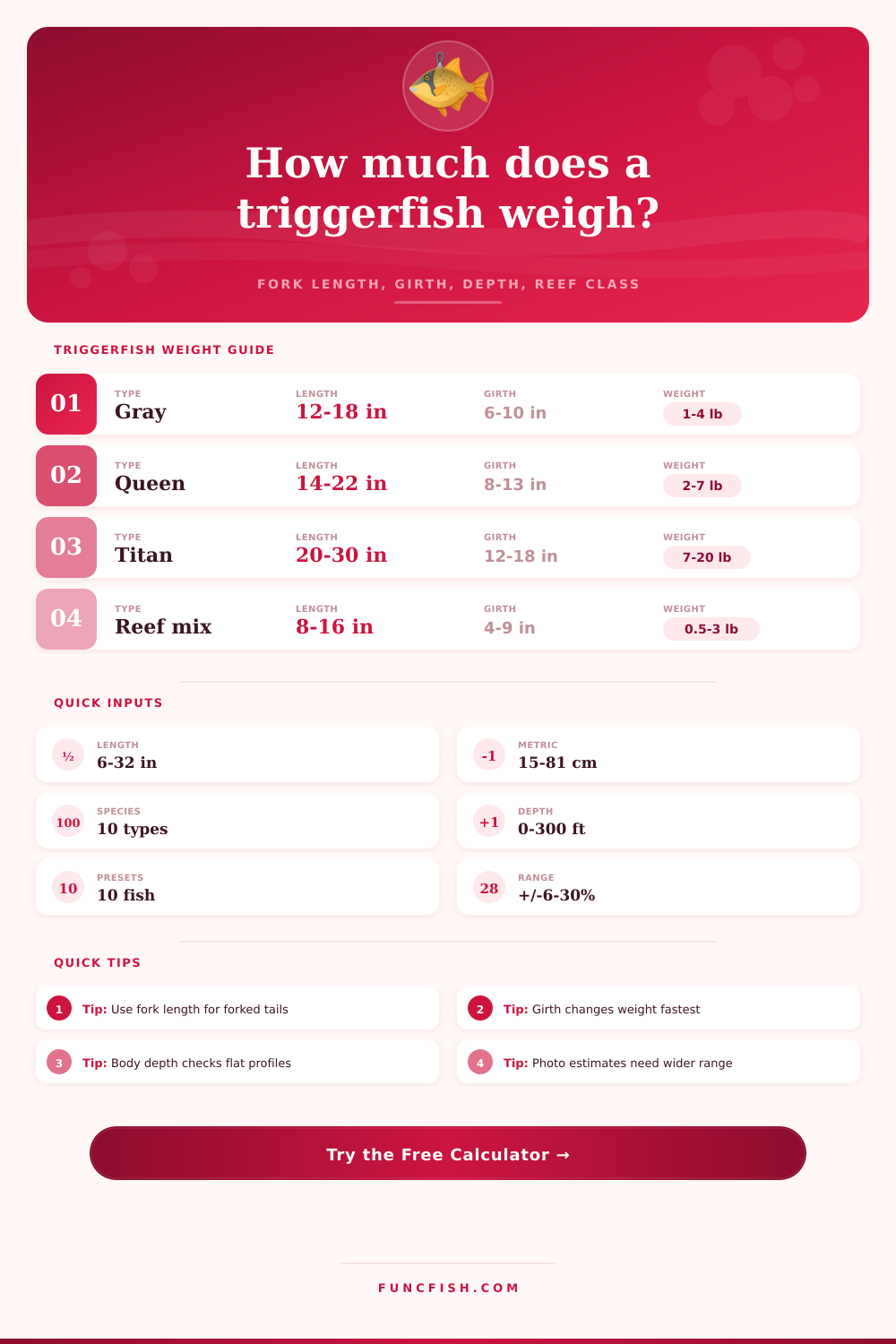
| Gray triggerfish | 10-20 in / 25-51 cm | 0.48-0.60 of fork | 0.32-0.39 of fork | Common reef and wreck profile |
| Queen triggerfish | 12-24 in / 30-61 cm | 0.52-0.64 of fork | 0.36-0.43 of fork | Deep body with tall shoulder |
| Titan triggerfish | 20-32 in / 51-81 cm | 0.56-0.70 of fork | 0.38-0.46 of fork | Very heavy adult reef fish |
| Black durgon | 8-18 in / 20-46 cm | 0.42-0.55 of fork | 0.30-0.37 of fork | Leaner slope and reef edge body |
| Lagoon triggerfish | 6-14 in / 15-36 cm | 0.45-0.58 of fork | 0.34-0.41 of fork | Small but very compressed |
| Fork length | Gray triggerfish | Queen triggerfish | Heavy reef fish | Field read |
|---|---|---|---|---|
| 10 in / 25 cm | 0.6-0.9 lb | 0.7-1.1 lb | 0.8-1.2 lb | Small adult or juvenile |
| 14 in / 36 cm | 1.5-2.4 lb | 1.8-3.0 lb | 2.0-3.5 lb | Keeper-size class |
| 18 in / 46 cm | 3.0-4.9 lb | 3.8-6.2 lb | 4.5-7.5 lb | Strong adult profile |
| 22 in / 56 cm | 5.5-8.5 lb | 6.8-10.5 lb | 8.0-13.0 lb | Large reef trigger |
| 28 in / 71 cm | 10-16 lb | 13-20 lb | 16-28 lb | Trophy heavy class |
| Reef depth band | Imperial | Metric | Expected fish cue | Calculator effect |
|---|---|---|---|---|
| Lagoon or patch | 0-30 ft | 0-9 m | Small to mixed reef fish | Slightly wider range |
| Shallow reef edge | 31-90 ft | 9-27 m | Typical gray and queen adults | Neutral baseline |
| Deep ledge or wreck | 91-180 ft | 28-55 m | Thicker adult fish common | Small fullness lift |
| Deep slope | 181-300 ft | 55-91 m | Ocean and durgon profiles | Range widens slightly |
| Confidence setting | Best input | Expected error | Use when | Range behavior |
|---|---|---|---|---|
| Excellent | Board plus girth tape | About 6-8% | Fish stayed straight and measured | Tightest band |
| Good | Careful deck measurement | About 9-12% | Fork, girth, and depth recorded | Standard band |
| Standard | Quick tape check | About 13-17% | Normal boat estimate | Moderate band |
| Rough or photo | Estimated girth or memory | About 20-30% | Curved fish or photo-only input | Wide band |
💡Measurement tips
Triggerfish are compressed and deep, so girth is the biggest weight driver. If girth is estimated from a photo, choose profile backup and use a wider confidence setting.
Body depth should usually land near one-third to just under one-half of fork length. A much taller or flatter value can signal a tape or perspective error.
Triggerfish have body shapes that make it difficult for a person to accurately guess the weight of a triggerfish from it’s appearance. Triggerfish species typically have deep bodies from the back to the belly of the triggerfish, and the thick shoulder plate of a triggerfish can make the species appear to be either more or less in weight than the actual weight that the triggerfish possesses. Furthermore, a triggerfish may appear to be a modest weight from its side view, but the triggerfish may actualy have a much more substantial weight when measured.
For these reasons, it is best to use a calculator that can accurately estimate the weight of a triggerfish based off its body measurements. Such a calculator will take the measurements of a triggerfish that is weighed on a boat, and will convey to a triggerfish weight estimator the weight range of the triggerfish based upon its body structure and the weight of the triggerfish species. While the length of the triggerfish is one of the measurements that the calculator utilizes to determine the weight of the triggerfish, the measurement of the girth of the triggerfish is the one that has the most influence upon the calculation of the weight of that triggerfish.
How to Estimate a Triggerfish’s Weight
Because the body of triggerfish species is compressed from side to side, the girth of the triggerfish is indicative of the weight of the triggerfish. Furthermore, the calculator also measures the length and depth of the triggerfish to ensure that the girth of the triggerfish is not an influence upon the weight estimation of the triggerfish. Each species of triggerfish must be selected with the calculator to ensure that the weight calculations reflect the differences of the different species of triggerfish; for example, queen triggerfish have deeper shoulder plates than gray triggerfish, and titan triggerfish species tend to have more body mass of the same length as other triggerfish species.
These features will start the weight calculation of the triggerfish when the user selects these parameters correctly. The depth at which the triggerfish is encountered on its reef is another factor that can influence the weight calculation of the triggerfish with the calculator. For example, triggerfish species that live on deep ledges within reef environments tend to have thicker body frames than triggerfish species of the same species that live on shallow reefs.
Each triggerfish species has different body classes and conditions, and these parameters can also be entered into the calculator. For example, triggerfish may be classified as either a “nest guarder” with heavy shoulders, or as a “lean traveler” that has not eaten recently. Additionally, the confidence level in the measurements of the triggerfish can have an impact upon the width of the confidence band; measurements that are taken with a measuring board and tape will have more confidence in the measurement than measurements that are made from triggerfish pictures that may be taken when the triggerfish is in movement.
The reference tables that are included with the weight calculator for triggerfish species show the typical length, girth ratios, and body depths of triggerfish species. These tables are not to replace the calculator, but exist as a means of indicating whether the triggerfish of interest falls into the normal range for that species. For instance, if the body depth of the triggerfish falls into the expected range of the species, the calculator will produce a narrower confidence band; however, if the body depth is outside of the expected range, the calculator will widen the confidence band to indicate that the triggerfish is either heavier or leaner than most triggerfish of that species.
While the calculator attempts to take the different variables of a triggerfish into account, there are additional variables regarding the condition of the triggerfish with which a person should be aware. For instance, if the triggerfish fought heavily before being weighed on the boat, it may have lost some of the belly fullness that contributes to its body weight. Similarly, if the triggerfish is a female triggerfish that is spawning, it may have extra body mass due to the spawning process; however, that body mass will dissapear once it releases its eggs.
Additionally, if the body measurements are based upon pictures of the triggerfish, those measurements may have a different weight than the real triggerfish if the pictures were taken from certain angles; in this case, utilizing the profile backup option for weight estimations will expand the weight range of the triggerfish estimation. While many people may focus upon the length of the triggerfish as the measuring parameter that determines the weight of the triggerfish, focusing only upon length is a mistake in estimating the weight of the triggerfish. The girth and depth of the triggerfish are other factors that should be considered in estimating the weight; length only allows for the estimation of the weight of all triggerfish of the same length, but the weight of a slab-sided triggerfish may differ in weight from a heavy-shouldered triggerfish by several pounds.
Thus, both girth and depth measurements should be entered into the calculator for the best estimation of the weight of the triggerfish. The same concepts can be applied to comparing the weight of a triggerfish to other species that live on reef environments. For example, snapper fish of the same length as a triggerfish will have less girth and depth to the body of the snapper fish; thus, the formula created for triggerfish will overstate the weight of the snapper fish.
The comparison grid created for triggerfish weights includes these comparisons to allow individuals to determine if their fish has the body structure and measurements of a triggerfish. The calculator will calculate the weight of the triggerfish once the individual sets the various parameters within the calculator; thus, individuals do not have to memorize the coefficients of the weight of each triggerfish species. To use the triggerfish weight calculator, the length, girth, and depth of the triggerfish should be measured while the triggerfish is straight on the deck.
Additionally, the individual using the calculator should also select the species of triggerfish, the body class and condition of the triggerfish, and the level of confidence in the measurements. The calculator will output the weight of the triggerfish, as well as the weight range. The weight range helps to convey to the individual whether the weight of the triggerfish was a solidly-recorded weight or a rough estimation of the true weight.
Thus, the process of measuring triggerfish rather than guessing the weight of triggerfish is a helpful process that can be enabled through the use of this calculator.