Skipjack Tuna Weight Calculator
Estimate skipjack tuna weight from fork length, girth, body depth, school or ocean zone, body condition, maturity, and measurement confidence.
📌Skipjack tuna presets
📏Measurements and tuna profile
Skipjack tuna estimate
Calculated weight, condition, length class, and confidence range.
Calculation breakdown
📊Skipjack calculator reference grid
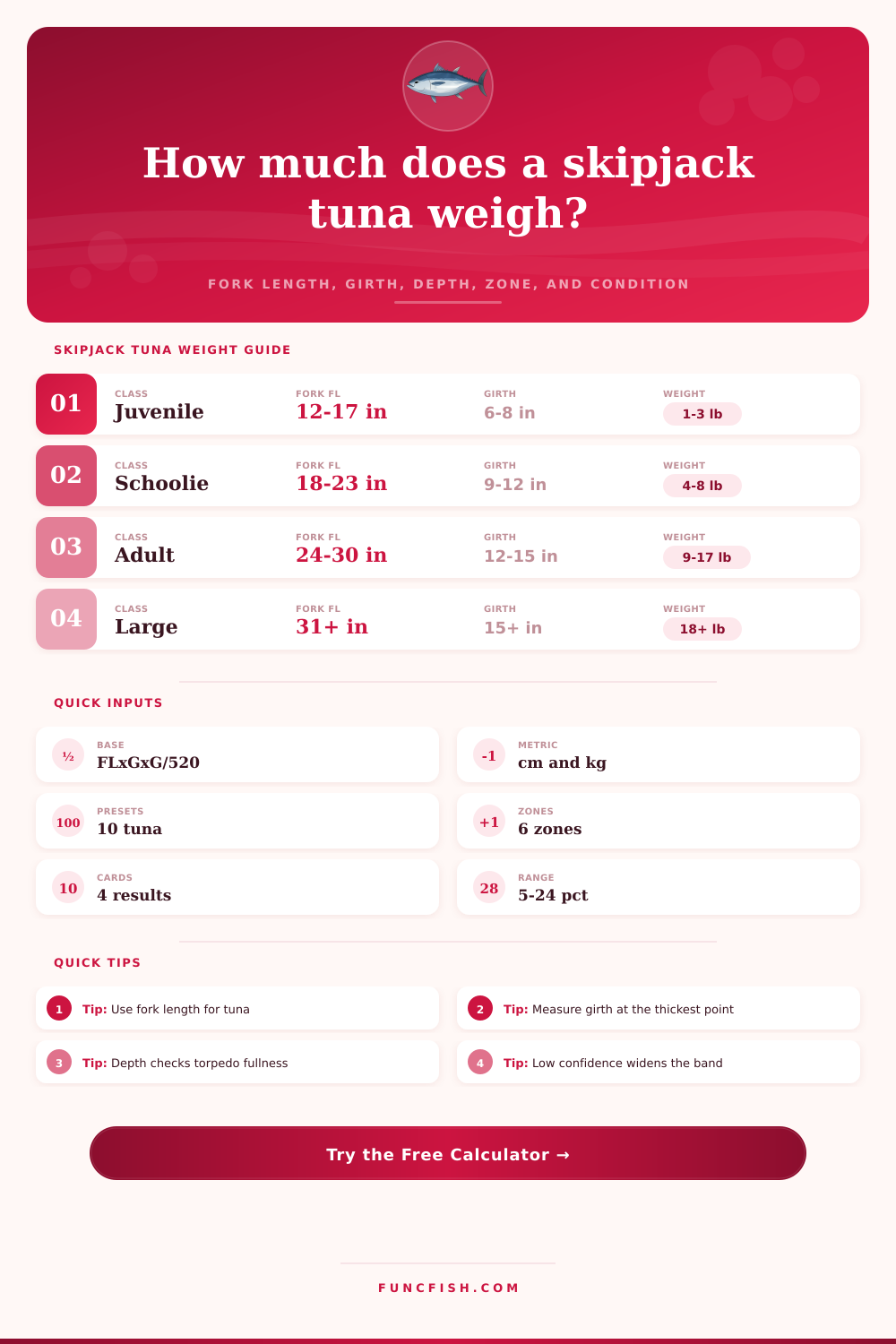
📋Skipjack size reference
| Skipjack class | Fork length | Typical girth | Usual weight |
|---|---|---|---|
| Juvenile surface fish | 12-17 in / 30-43 cm | 6-8 in / 15-20 cm | 1-3 lb / 0.5-1.4 kg |
| Schoolie tuna | 18-23 in / 46-58 cm | 9-12 in / 23-30 cm | 4-8 lb / 1.8-3.6 kg |
| Adult offshore fish | 24-30 in / 61-76 cm | 12-15 in / 30-38 cm | 9-17 lb / 4.1-7.7 kg |
| Large skipjack | 31-36 in / 79-91 cm | 15-18 in / 38-46 cm | 18-30 lb / 8.2-13.6 kg |
🌊Ocean zone adjustment table
| Zone | Weight factor | Profile clue | Use when |
|---|---|---|---|
| Surface foamer school | 0.96 x | Lean quick-feeding fish | Bird piles or surface spray |
| FAD mixed-size school | 0.99 x | Mixed body condition | Fish gathered around floating structure |
| Island or reef edge | 1.02 x | Often thicker shoulders | Drop-offs, banks, and island edges |
| Offshore current line | 1.00 x | Baseline ocean runner | Temperature breaks and rips |
| Equatorial warm pool | 1.04 x | Fed-up tropical profile | Warm water bait concentration |
| Deep blue roaming school | 1.01 x | Steady adult profile | Open blue water without structure |
🧬Condition and maturity reference
| Input | Factor range | Body sign | Calculator effect |
|---|---|---|---|
| Lean runner | 0.91-0.96 x | Narrow belly and hard shoulders | Lowers weight and index |
| Average adult | 0.99-1.02 x | Clean torpedo profile | Baseline estimate |
| Fed-up fish | 1.05-1.09 x | Rounded belly from bait | Raises weight and index |
| Pre-spawn female | 1.10-1.16 x | Deeper belly and fuller girth | Highest maturity adjustment |
🐟Tuna comparison grid
Skipjack tuna
Compact, fast, torpedo-shaped tuna. Girth changes weight quickly, but most fish stay below large yellowfin size.
Yellowfin tuna
Longer and heavier at the same adult class. Larger fish often need a different length-weight curve.
Blackfin tuna
Similar compact profile, usually smaller. Depth and girth are useful checks for mixed offshore catches.
Bonito
Often slimmer and lighter for the same fork length. Use skipjack settings only for true skipjack tuna.
💡Measurement tips
Skipjack tuna is a type of fish that can be encountered when anglers are fishing for pelagic species. Skipjack tuna are often found near bird piles, they are often found near floating debris, and they are often found near temperature breaks in the water. These location are often easy to find when fishing from a small boat.
Additionally, skipjack tuna are often described as a fast species that is often willing to eat, so they is considered to be reliable fish to catch. However, the weight of the fish can be difficult to determine using only one measurement of the fish. For example, the length of the skipjack tuna can provide misleading information about the weight of the tuna as the skipjack tuna may be long but thin from traveling great distance, or the skipjack tuna may be long but thick from eating a bait ball of tiny fish.
How to Measure a Skipjack Tuna’s Weight
Therefore, a weight calculator that asks for the length, girth, and depth of the tuna will provide an accurate measurement of the weight of the tuna. The calculator will use these three different measurements because they provide a more complete picture of the fish. In order to use the calculator, an individual must use a specific point of reference on the fish.
One of the measurement for the weight of the skipjack tuna is the fork length of the tuna, which is the length from the tip of the snout of the tuna to the fork in the tail of the tuna. This location is the preferred location for the measurement because the angler will find the fork in the tail easy to find regardless of how the tuna is lying on the deck of the fishing boat. The girth of the fish is the measurement of the widest part of the skipjack tuna.
This measurement is taken behind the pectoral fins of the tuna. A third measurement is the depth of the body of the tuna, which is also a measurement that should be taken as skipjack tuna that may appear round from the side may have a more greater weight than the girth measurement of the tuna alone. Therefore, these three measurements, when used in the weight calculator, will produce an accurate measurement of the weight of the tuna.
However, if these measurements do not match the expected weight of the species, the weight calculator will produce a range of weights rather than a certain weight. The zone in which the skipjack tuna lives in the ocean can also play a role in the shape of the tuna. For instance, skipjack tuna in surface foamer schools may have a lean body structure to the tuna compared to the skipjack tuna that live near an island edge or a reef drop from which the tuna can easily catch their prey.
Therefore, a tuna of the same length could have a different weight due to the zone from which it was caught. Additionally, the maturity of the tuna could impact the weight of the tuna. For instance, a pre-spawn female tuna will have a greater amount of mass in the belly than a lean male skipjack tuna of the same length.
Therefore, the calculator allows for these differences to be accounted for so that the weight of the tuna isnt the same for all adult tuna. Another variable that individuals may not consider when catching and measuring skipjack tuna is the condition of the tuna. For instance, skipjack tuna that eat flying fish will have a different body structure than those that live in the area of temperature breaks in the ocean.
The calculator also asks for the condition index of the tuna, which provides an indication of whether that tuna is above or below the average structure of a skipjack tuna of that length. Those who use the calculator can use the condition index to decide whether they would like to remain in that area or travel to a new area in the ocean. For instance, a high condition index and a large girth measurement in the skipjack tuna suggest that the tuna have been feeding recently on prey in the ocean, while a low condition index for a long tuna may indicate that the school of tuna is moving to a new area in the ocean.
The quality of the measurement of the tuna can impact the results of the calculator. For example, if an individual carefully measured the length, girth, and depth of the tuna using a board and tape measure, the weight calculator will provide the most accurate weight of the tuna of that measurement. However, if the individual instead takes a picture of the tuna or makes an approximate guess of its length and depth, the weight calculator will provide a range of weights rather than a certain weight.
Therefore, the calculator incorporates these differences to make sure that those who use the calculator dont believe the rough measurement of the tuna is the precise weight of the fish. For instance, anglers may use such precision with calculating the weight of the tuna to compare the weight of their catch from different fishing trips. While skipjack tuna are often used as a proxy fishing species for the larger tuna species, the two species are not the same.
For instance, yellowfin tuna and blackfin tuna are different than skipjack tuna, but both species has similar weight calculations. Therefore, if an individual utilizes a general formula to calculate the weight of a tuna fish, that calculation may be either too high or too low due to the difference between the species. The calculation that is included in the weight calculator for skipjack tuna is based upon the physical features of the skipjack tuna species so that the weight of the tuna remains accurate and useful.
There are various reasons for accurately determining the weight of the skipjack tuna that is caught. For example, knowing the weight of the tuna could help an individual to track the catch throughout the year. Additionally, knowing the weight of the tuna can allow an individual to decide how many fish may be able to be held in their cooler.
Finally, knowing the weight of the fish will allow the individual to accurately and fairly compare the catch of different anglers who may be fishing in the same area. Therefore, accurate weights of the tuna will help individuals to provide accurate records of the species and to make better decisions regarding where to fish and when to go fishing. In order to recieve an accurate weight of the skipjack tuna from the calculator, the individual should follow a specific process.
The individual should measure the length, girth, and depth of the tuna while the tuna is still fresh. Additionally, the location of the water in which the tuna was caught should be noted. Finally, the individual should allow the calculator to perform the calculations.
Additionally, the individual should pay attention to the numbers that result from the calculator for that specific tuna to gain the knowledge of that individual regarding the specifics of the tuna that was caught.