Dorado Weight Calculator
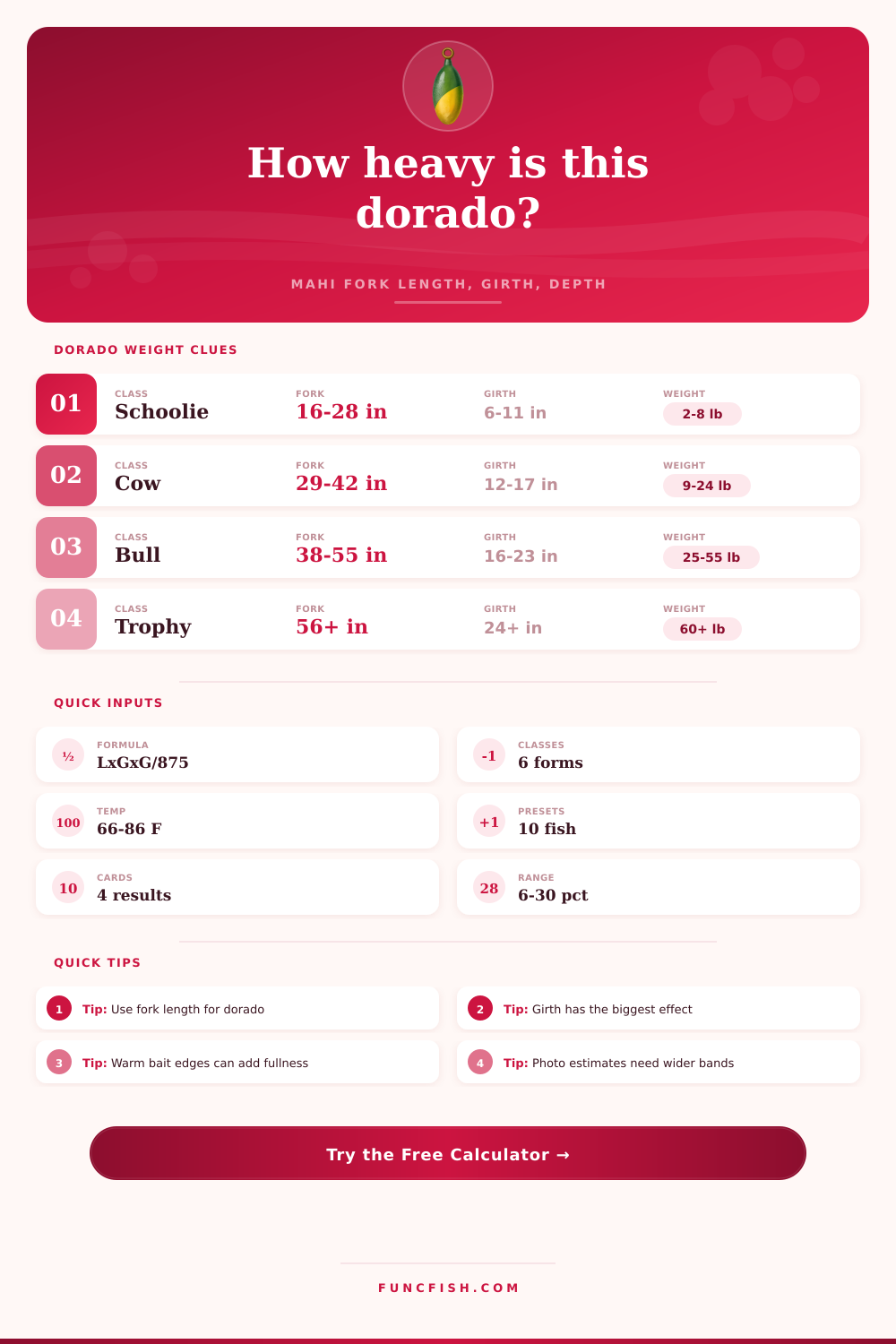
Estimate mahi mahi or dorado weight from fork length, maximum girth, body depth, bull or cow class, ocean temperature, forage condition, maturity, and measurement confidence.
📌Named dorado presets
⚙Class, measurements, forage, and confidence
Model: the estimate starts with fork length times girth squared divided by a dorado coefficient, then cross-checks body depth, bull-cow form, ocean temperature, forage, maturity, and confidence.
Estimated dorado weight
--
Calculation breakdown
📊Dorado factor grid
Core formula
Bull frame
Cow frame
Confidence
📘Reference tables
| Dorado size class | Fork length | Typical girth | Estimated weight |
|---|---|---|---|
| Weedline schoolie | 16-24 in / 41-61 cm | 6-9 in / 15-23 cm | 2-6 lb / 0.9-2.7 kg |
| Subadult current fish | 25-34 in / 64-86 cm | 10-14 in / 25-36 cm | 7-16 lb / 3.2-7.3 kg |
| Cow female dorado | 32-44 in / 81-112 cm | 13-18 in / 33-46 cm | 14-30 lb / 6.4-13.6 kg |
| Bull male dorado | 38-55 in / 97-140 cm | 16-23 in / 41-58 cm | 24-55 lb / 10.9-24.9 kg |
| Trophy bull | 56-68 in / 142-173 cm | 24-30 in / 61-76 cm | 60-100 lb / 27-45 kg |
| Bull-cow class | Model factor | Expected depth ratio | Weight reading note |
|---|---|---|---|
| Juvenile schoolie | 0.91 | 0.165 of fork length | Slim fast-growth fish; girth is often modest. |
| Subadult mixed school fish | 0.97 | 0.178 of fork length | Balanced current-edge shape before strong sex dimorphism. |
| Cow female dorado | 1.01 | 0.190 of fork length | Full belly can raise weight without the tall bull head. |
| Bull male dorado | 1.06 | 0.205 of fork length | Tall head and shoulders need a higher profile allowance. |
| Post-spawn lean cow | 0.88 | 0.182 of fork length | Same fork length may carry noticeably less mass. |
| Ocean temperature band | Temperature cue | Model effect | Use in calculator |
|---|---|---|---|
| Cool edge | 66-70°F / 19-21°C | 0.96 to 0.98 | Use when fish came from cool upwelling or a cold color break. |
| Productive warm edge | 71-80°F / 22-27°C | 1.00 to 1.04 | Best range for normal dorado body fullness. |
| Hot surface water | 81-86°F / 27-30°C | 0.98 to 1.02 | Can still be heavy if forage is concentrated. |
| Unknown temperature | Use average value | Wider range | Set confidence lower if the temperature is a guess. |
| Forage or maturity signal | Multiplier range | Body cue | Range effect |
|---|---|---|---|
| Sparse bait or empty stomach | 0.93-0.96 | Pinched belly, narrow girth behind the shoulder. | Normal if measured well. |
| Active bait edge | 1.03-1.06 | Full stomach line and stronger shoulder roundness. | Tight if girth is measured. |
| Flying fish and squid feed | 1.07-1.10 | Heavy offshore fish with deep shoulder and full belly. | Slightly wider for very full fish. |
| Peak mature heavy fish | 1.06-1.09 | Large adult mass, especially broad bull or ripe cow. | Wider if maturity is inferred from a photo. |
| Spent or worn post-spawn fish | 0.87-0.91 | Long body, lower reserve, reduced belly fullness. | Wider because appearance varies. |
🌊Pelagic species comparison grid
Dorado / mahi
Slab-sided fast-growing pelagic with strong fork-length and girth sensitivity.
Wahoo
Longer torpedo body; same fork length usually carries less girth mass.
Yellowfin tuna
Rounder body with more mass at the same girth and shorter profile.
Skipjack tuna
Compact school fish with high muscle density and smaller top-end size.
King mackerel
Long coastal pelagic that needs a leaner shape interpretation than dorado.
💡Measurement tips
Dorado tails add extra total length, especially when the fish is flexed. Use fork length so the same formula works for schoolies, cows, and bulls.
Girth is squared in the model, so a loose tape loop changes weight quickly. Body depth is a cross-check for bull shoulders, cow fullness, and photo distortion.
Weight estimates are for field logs and fish comparison. A certified scale is the final weight reference.
When you bring an dorado to a boat and you want to know teh weight of the dorado, you may find yourself guessing the weight of the dorado. It is difficult to guess the weight of the dorado because the fish may appear smaller when the dorado is tired, compared to the size of the dorado when the dorado first struck at the bait. The weight of the dorado is an important figure in that it will determine whether you will keep the dorado or if you will release the dorado back into the water.
Using certain measurements of the dorado, you can estimate the weight of the dorado. There are three main measurements of the dorado that determine the weight of the dorado. The first measurement is the fork length of the dorado, which is important because the length remain the same regardless of the flexing of the tail of the dorado.
How to Estimate a Dorado’s Weight
The total length of the dorado is not used in the calculation of the weight of the dorado, as the length changes with the flexing of the tail of the dorado. The second and third measurements of the dorado that can be used to calculate the weight are the girth and body depth of the dorado. Girth is important in that its measurement gets squared in the calculation of the weight of the dorado; a small change in the girth of a thick dorado will have a more greater impact on the calculated weight than the same change to the girth of a slim dorado.
Body depth can be used to determine if the dorado have full shoulders or a thin belly. It is important to select a class within the tool, which reflects the differences in the physical characteristics of male dorado fish and female dorado fish. Bulls, or male dorado fish, have more mass in their heads and shoulders compared to female dorado fish.
Therefore, a bull of a specific fork length and girth will weigh more than a cow of the same measurements. Additionally, post-spawn dorado fish may be long, but typically will have less weight than a dorado of the same length that has not spawned. Therefore, it is important to make sure that you select the correct class of dorado.
Other factors in determining the weight of the dorado include the ocean temperature, the condition of the forage in the water, the maturity stage of the dorado, and the condition of the dorado. The temperature of the ocean impacts how actively the dorado fish feed, as well as the way that the dorado hold their shape in the water. Warm ocean water makes the dorado fill out, while cooler water produces dorado that appear to be long for there weight.
The condition of the forage will impact the mass of the dorado; if the dorado eats alot of bait, it will have more mass in its stomach and shoulders. Additionally, the maturity stage of the dorado will impact the relationship between the depth and length of the dorado. Juveniles have different depth measurements to length measurements than mature bull dorado.
Finally, the condition score will tell you if the dorado was unusually heavy or lean compared to dorado of similar measurements. Unlike trophy rating systems, this score does not relate to the dorados fighting ability, but helps to provide an idea of how the dorado compares with expected measurements. A range of weights is provided for every result from the tool.
The reason for providing a range is that all measurements can have some uncertainty. If you carefully measure the dorado for girth and depth, the range will be narrow. If you quickly guess the weight of the dorado, or if a photo is taken of the dorado from an angle, the range will be more extensive.
Additionally, if the maturity or the condition of the forage is merely inferred, the range will be more extensive than if you directly observe the maturity and the condition of the forage. Therefore, the range will expand with less information given about the dorado. Many people who use the tool will focus on the single weight value of the dorado.
It is more helpful, however, to also examine the weight range and the condition score of the dorado. A narrow weight range with a condition score in the middle of the scale indicates a dorado with a more reliable weight. A weight range that is wide in size indicates that the dorado was measured quickly, or that its physical condition makes it difficult to determine the weight of the dorado.
Therefore, the number provided is useful for making comparisons, but should not be considered an exact weight of the dorado. The reference tables for each size class of dorado are not rules that define the weight of each class of dorado. Instead, the tables exhibit the typical behavior of each size class of dorado.
For instance, a small dorado that weighs more than the table suggests may have consumed a large amount of food. Additionally, a bull dorado that weighs less than the table suggests may be a post-spawn dorado. Thus, these tables provide context for the dorado being evaluated, but do not provide any verdicts about the dorado.
One of the best ways to learn how to use the tool is to use it to measure many dorado on the same trip. By measuring many dorado, you will become aware of the conditions that produce heavy dorado fish or light dorado fish. The calculator makes it easy to learn these patterns in the dorado.
While you can use the calculator to make your estimations of the weight of the dorado, you may also develop an understanding of how to use the tool as a result of measuring many dorado on the same fishing trip. The most important value of the tool is obtained by making comparisons between one fishing trip to another fishing trip. The weight of the dorado on a single trip does not change your decisions about the dorado, but if you compare the weights of a number of dorado during one trip to the weight of a number of dorado caught on another trip, you can determine if the dorado are in good physical condition.
Additionally, if you fish at regular intervals, you can determine if the feeding habits of the dorado change over time. Thus, while the calculator and the reference tables may translate the measurements of the dorado into a useful format, the true value of the tool exists in its ability to make comparisons between trips.