Apache Trout Weight Calculator
Estimate Apache trout weight from length, girth, body depth, habitat class, stream or lake growth zone, seasonal forage, condition factor, and measurement confidence.
📌Apache trout presets
⚙Weight estimate inputs
Apache trout weight estimate
Apache trout field estimate.
Full breakdown
📋Habitat coefficient cards
Headwater Creek
Meadow Pool
High Lake
Reservoir Edge
🔀Apache trout comparison grid
Apache Trout
Compact stream trout profile with variable lake fullness.
Rainbow Trout
Often a broader hatchery or lake body at similar length.
Brook Trout
Short, deep body can look heavier than length alone suggests.
Brown Trout
Longer frame with strong weight changes by forage and season.
📊Reference tables
| Apache trout length | Lean girth guide | Full girth guide | Approx weight window |
|---|---|---|---|
| 8 in / 20 cm | 3.5 to 3.8 in / 8.9 to 9.7 cm | 4.0 to 4.3 in / 10.2 to 10.9 cm | 0.12 to 0.20 lb / 0.05 to 0.09 kg |
| 10 in / 25 cm | 4.4 to 4.8 in / 11.2 to 12.2 cm | 5.0 to 5.4 in / 12.7 to 13.7 cm | 0.25 to 0.42 lb / 0.11 to 0.19 kg |
| 12 in / 30 cm | 5.4 to 5.8 in / 13.7 to 14.7 cm | 6.1 to 6.6 in / 15.5 to 16.8 cm | 0.45 to 0.75 lb / 0.20 to 0.34 kg |
| 14 in / 36 cm | 6.4 to 6.9 in / 16.3 to 17.5 cm | 7.2 to 7.8 in / 18.3 to 19.8 cm | 0.75 to 1.25 lb / 0.34 to 0.57 kg |
| 16 in / 41 cm | 7.4 to 7.9 in / 18.8 to 20.1 cm | 8.3 to 8.9 in / 21.1 to 22.6 cm | 1.15 to 1.90 lb / 0.52 to 0.86 kg |
| 18 in / 46 cm | 8.3 to 8.8 in / 21.1 to 22.4 cm | 9.3 to 9.8 in / 23.6 to 24.9 cm | 1.65 to 2.65 lb / 0.75 to 1.20 kg |
| Habitat class | Weight factor | Expected body shape | Best calculator clue |
|---|---|---|---|
| Cold headwater creek | 0.94 x | Long, trim body in current | Lower girth and depth ratios |
| Meadow pool sequence | 1.02 x | Balanced body with steady feeding | Average girth near 50% length |
| Canyon pocket water | 0.96 x | Fit current fish with moderate depth | Depth slightly below meadow fish |
| Spring-fed run | 1.00 x | Even growth and stable profile | Good default for mixed data |
| High lake margin | 1.06 x | Deeper body when forage is steady | Depth and girth both rise |
| Small reservoir edge | 1.09 x | Heavier body with lake forage | Use when belly and shoulders are full |
| Growth zone | Multiplier | Forage signal | Use when |
|---|---|---|---|
| Upper stream, cold growth | 0.93 x | Small aquatic insects | Fish looks narrow for length |
| Middle stream, mixed growth | 0.99 x | Mixed drift and surface food | Balanced stream estimate |
| Lower stream, warmer growth | 1.03 x | Broader feeding window | Fish has fuller belly |
| Meadow complex, steady food | 1.04 x | Terrestrial and aquatic mix | Stable pool habitat |
| Lake edge, littoral food | 1.07 x | Scuds, nymphs, and minnows | Lake-margin fish |
| Lake open-water cruiser | 1.10 x | Higher cruising growth | Longer, deeper lake fish |
| Season or forage | Condition effect | Body cue | Calculator impact |
|---|---|---|---|
| Winter midge trickle | Lean reserve | Lower belly mass | Reduces estimate modestly |
| Spring aquatic insects | Recovering condition | Shoulders begin filling | Slight positive adjustment |
| Summer mixed insects | Baseline feeding | Average girth and depth | Neutral to slight gain |
| Late summer hopper window | Fuller body | Wider belly profile | Raises condition factor |
| Fall full-condition feeding | Strong reserve | Full belly and back | Highest seasonal stream factor |
| Lake minnow or scud forage | Deep lake body | Higher girth and depth | Best with lake growth zones |
Weight estimates are field calculations. Use a calibrated scale when exact weight matters.
💡Measurement tips
Tip: Girth is squared in the formula, so one loose tape reading can move the weight more than a small length error. Measure the deepest part of the Apache trout body without compressing it.
Tip: Body depth is a useful check when two fish share the same length and girth. A deeper back-to-belly profile usually means a fuller Apache trout condition index.
Knowing the weight of an Apache trout is important because the weight of an Apache trout provide information about the health of the Apache trout. An Apache trout that weigh more than the expected weight for the length of the Apache trout is thriving in it’s habitat. An Apache trout that weighs less than the expected weight for the length of the Apache trout is struggling in its habitat.
Individuals can use the weight calculator to calculate the weight of an Apache trout by entering the length, girth, depth, and habitat information for the Apache trout. The weight calculator is useful in that it allow individuals to calculate the weight of the Apache trout without having to physically weighing the Apache trout. Apache trout lives in specific environments within their habitat.
How to Use the Apache Trout Weight Calculator
Many Apache trout live in cold stream that flow from the high plateaus. Many Apache trout live in stocked lakes near the timber line. Apache trout that live in a headwater creek will have a long and lean body.
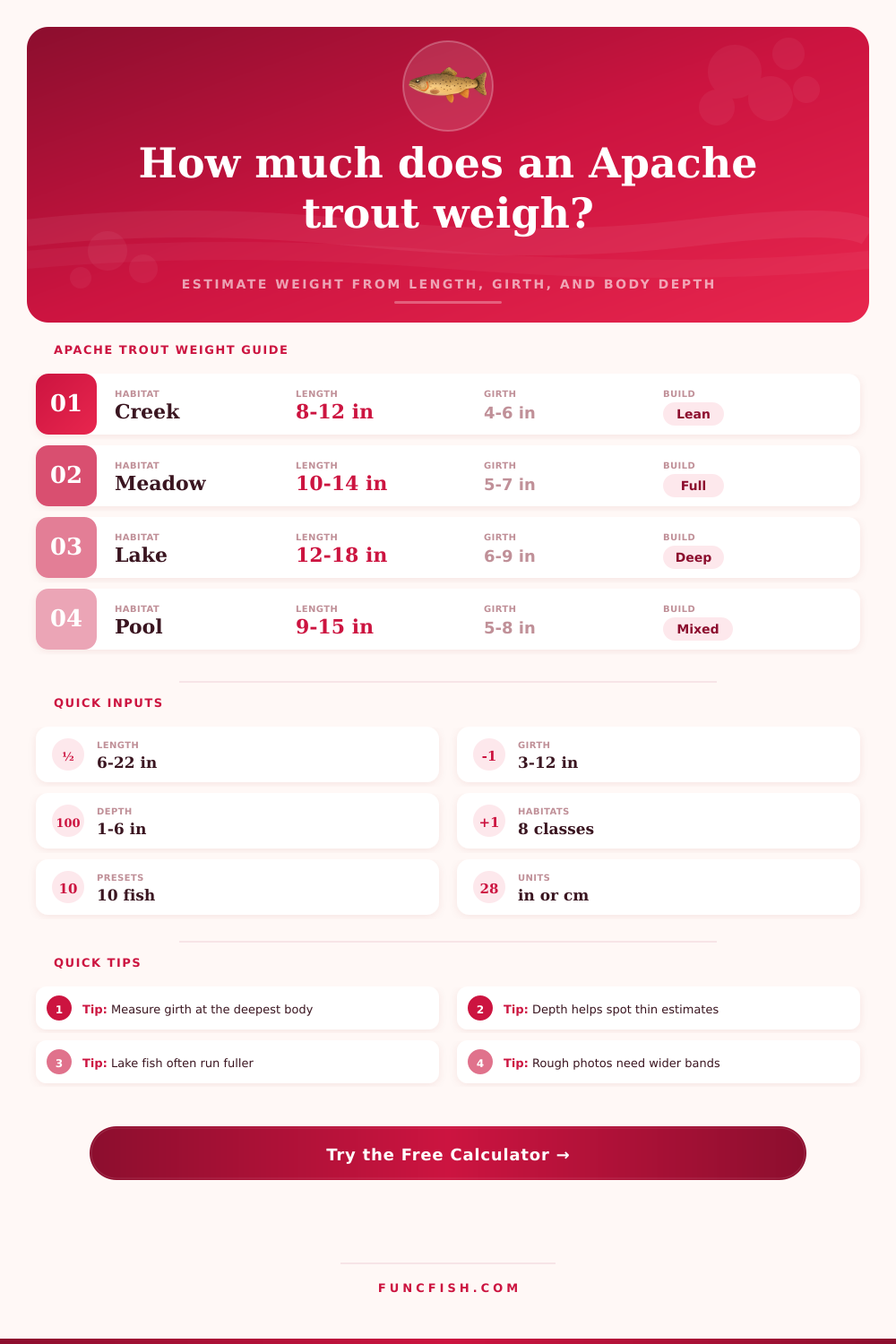
Apache trout that live in a meadow pool or a lake margin will have more girth. Because the body shape of an Apache trout will vary according to the habitat in which it lives, it is not possible to create a simple length to weight ratio for Apache trout. The weight of an Apache trout will change based off the shape of the Apache trout, the season in which the Apache trout was caught, and the water where the Apache trout live.
While individuals can use the length of the Apache trout to provide a basic estimate of the weight of the Apache trout, the girth of the Apache trout is the most important measurement of the Apache trout in calculating its weight. The volume of the Apache trout increase more quickly according to the girth of the Apache trout then the length of the Apache trout. The depth of the Apache trout is another important measurement.
The depth measurement allows for the recognition of two Apache trout of the same length but different depths. The deeper the Apache trout the better physical condition the Apache trout is in. An individual can use the depth of the Apache trout in the calculation of a condition index.
This index allow an individual to determine if the Apache trout has enough energy reserves to spend the winter or if the Apache trout has used those reserves to spawn. The habitat in which the Apache trout lives will affect the weight of the Apache trout. Apache trout that live in cold headwaters will have a lower condition index than Apache trout that live in meadows or lakes.
The cold headwaters experiences a short growing season and limited forage. Apache trout that live in meadows or lakes have a longer growing season and have more available forage. The growth zone of the Apache trout in the weight calculator is important because Apache trout that live in the upper areas of a stream will grow more slow than Apache trout that live in an open water lake.
The forage that is available in the habitat in which the Apache trout lives will affect the weight of the Apache trout. For example, Apache trout that live in an area where grasshoppers is available will weigh more than Apache trout of the same length but caught in an area with fewer grasshoppers. The weight calculator takes into account the different forage seasons in applying a factor to the weight of the Apache trout.
The accuracy of the measurement of the Apache trout is also important. The weight calculator will ask the individual to rate the quality of the measurements of the Apache trout. More accurate measurements will result in fewer uncertainties in the calculate weight of the Apache trout.
The weight calculator does not provide the final answer to the weight of the Apache trout. However, it is a tool that can be used to make informed guesses as to the weight of the Apache trout. The weight calculator can be used to compare the weight of one Apache trout to another Apache trout caught in different waters.
With the weight calculator it is also possible to identify patterns in the Apache trout in relation to there habitat. For example, it may be possible to identify that Apache trout from a certain growth zone are heavier than those from another zone. Additionally, it may be possible to determine that a particular Apache trout is in poor condition in relation to its habitat.
The reference tables on this page can provide information on the typical girth and depth of Apache trout in each habitat class. Additionally, the tables will provide information on how the growth zone and forage season can alter the weight factor of the Apache trout. By tracking the weight of the Apache trout over the many seasons in which they live in their habitat, it is possible to determine how the Apache trout population change over time.
Through this tracking it is possible to determine the impact of a cold spring on the Apache trout population, for example. Additionally, it becomes possible to determine in which areas of the Apache trout habitat Apache trout will be heavy and in which areas the Apache trout will be lean. Through using the Apache trout weight calculator an individual can understand the difference between an Apache trout from a lake and an Apache trout from a canyon.
Additionally, the weight calculator allow an individual to understand the weight and condition of the Apache trout without using a scale to measure the Apache trout.