Tench Weight Calculator
Estimate tench weight from size class, total length, widest girth, body depth, lake, canal, or estate pond habitat, body condition, season and feeding index, confidence, and unit system.
📌Tench presets
⚙Size, habitat, and measurements
Model: tench are thick, barrel-bodied coarse fish, so this estimator blends the standard length-girth formula with a body-depth cross-check and a habitat profile guardrail. Confidence widens the range when girth or depth is guessed.
Tench weight estimate
Calculation breakdown
📊Tench habitat data grid
Estate Pond
Canal Cut
Lake Margin
Silt Pool
🐟Coarse fish comparison grid
Tench
Thick olive coarse fish with rounded belly and broad shoulders.
Bream
Deeper and flatter slab body; depth can exceed tench at length.
Carp
Rounder and heavier at the same length when shoulders are full.
Crucian
Compact deep body, usually lighter and shorter than specimen tench.
Roach
Slimmer silver fish; girth and depth are lower for the same length.
📘Reference tables
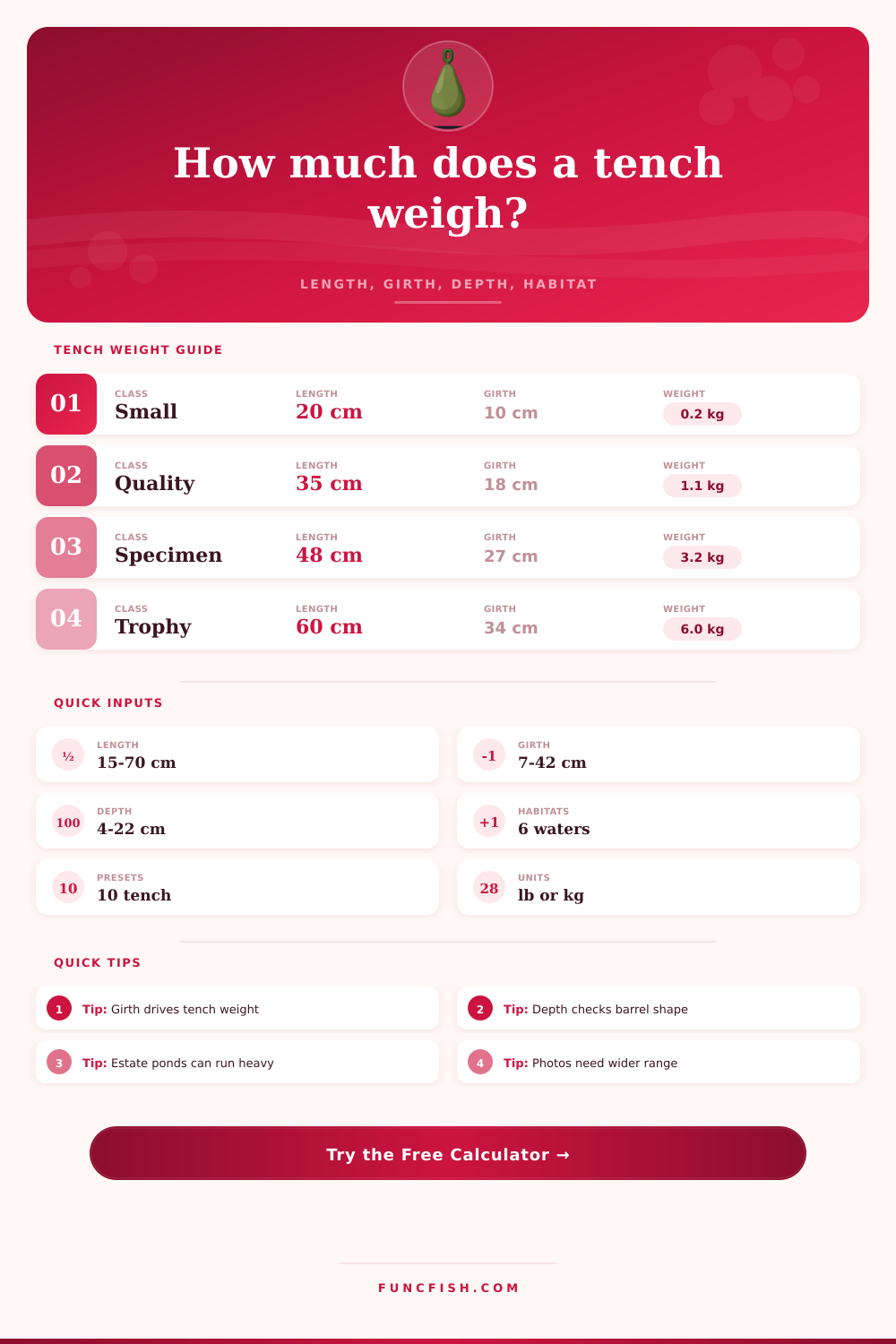
| Tench size class | Total length | Typical girth | Typical body depth | Weight guide |
|---|---|---|---|---|
| Small tench | 15-25 cm / 6-10 in | 7-13 cm / 2.8-5.1 in | 4-7 cm / 1.6-2.8 in | 80-350 g / 3-12 oz |
| Quality tench | 26-40 cm / 10-16 in | 13-22 cm / 5.1-8.7 in | 7-12 cm / 2.8-4.7 in | 0.35-1.8 kg / 0.8-4 lb |
| Large tench | 41-48 cm / 16-19 in | 22-27 cm / 8.7-10.6 in | 12-15 cm / 4.7-5.9 in | 1.8-3.2 kg / 4-7 lb |
| Specimen tench | 49-58 cm / 19-23 in | 27-33 cm / 10.6-13 in | 15-18 cm / 5.9-7.1 in | 3.2-5.4 kg / 7-12 lb |
| Trophy tench | 59-70 cm / 23-28 in | 33-42 cm / 13-16.5 in | 18-22 cm / 7.1-8.7 in | 5.4-8.2 kg / 12-18 lb |
| Habitat | Expected shape | Girth ratio | Depth ratio | Calculator note |
|---|---|---|---|---|
| Estate pond or old moat | Full, rounded body | 0.55 x length | 0.32 x length | Often heavy for length when food is rich. |
| Canal cut or navigation | Longer, leaner body | 0.50 x length | 0.29 x length | Confidence range helps with photo estimates. |
| Natural lake margin | Balanced to broad | 0.53 x length | 0.31 x length | Baseline stillwater tench setting. |
| Gravel pit or clear stillwater | Firm, steady profile | 0.52 x length | 0.30 x length | Can be sleek in clear, open water. |
| Silt pool or club water | Heavy barrel body | 0.56 x length | 0.33 x length | Profile guardrail may raise expected girth. |
| Weed bed or lily pad bay | Compact and deep | 0.54 x length | 0.32 x length | Depth cross-check is useful here. |
| Season and feeding index | Fullness effect | Factor | Range note | Best cue |
|---|---|---|---|---|
| Winter low feeding | Lower belly volume | 0.94 x | Moderate | Depth at shoulder |
| Spring pre-spawn fullness | High belly mass | 1.09 x | Variable | Widest girth |
| Summer regular feeding | Baseline condition | 1.00 x | Normal | Length plus girth |
| Warm silt-bed feeding | Full and rounded | 1.05 x | Normal | Girth and depth |
| Post-spawn lean period | Spent-down body | 0.90 x | Wide | Condition setting |
| Autumn heavy feeding | Reserve gain | 1.06 x | Tighter | Girth at belly |
| Confidence setting | Use when | Base range | Profile blend | Practical result |
|---|---|---|---|---|
| Measured length, girth, and depth | Fish was taped carefully | +/- 7% | 0% | Tightest output |
| Measured length, estimated shape | Length solid, girth approximate | +/- 13% | 16% | Good field estimate |
| Quick mat estimate | Fast handling or moving fish | +/- 20% | 32% | Broad but useful range |
| Photo or memory estimate | No tape or angled photo | +/- 29% | 50% | Range only |
💡Measurement tips
Tench weight changes quickly with girth because the length-girth part squares it. Measure the deepest belly and add body depth when the fish is thick but the wrap was awkward.
Canal tench can be long and lean, while estate pond tench often look barrel-shaped. Match the habitat first, then choose lower confidence for photos or quick mat estimates.
This calculator estimates fish weight from measurements and body profile inputs only. It does not provide fishing rules, seasons, limits, licenses, harvest guidance, or fish care guidance.
Tench has a specific body shape that affects the weight of the fish. While many believes the length of the tench is the only measurement that can be used to determine the weight of the tench, the length of the tench dont provide an accurately measurement of the weight of the tench due to the cylindrical body shape of the tench. Because the body shape of the tench is more cylindrical in shape then flat, the tench will feel heavier than if it were simply the length of the tench.
Thus, an estimator that uses the girth and depth of the tench is more accurate in measuring the weight of the tench than an estimator that only considers the length of the tench. To estimate the weight of the tench, the user must enter three different measurements of the tench into the calculator: the length of the tench, the girth of the tench, and the depth of the tench. In addition to these measurements, the user must also select a habitat profile for the water in which the caught tench live.
How to Estimate Tench Weight
Based upon these entered values, the calculator will provide the user with an estimated weight for the tench, a likely weight range for the tench, and a condition index score for the tench. This condition index score indicates whether the tench possesses normal reserves of body weight or whether it possesses an unusual amount of weight relative to the length of it’s body. The habitat in which the tench lived can impact the weight of that tench.
For instance, tench that live in estate pond or old moats will often have more girth than those tench that live in canals. The reason that tench in ponds and moats have more girth is due to the different types of food that live in these various habitats. As such, the calculator must account for this value.
The user does not need to know the mathematical calculation of the calculator to be aware that the habitat that the tench was caught from can impact its weight; the user simply needs to be aware if the tench was caught from a silty pool or a gravel pit. The time of year that the tench was caught can impact the weight of the tench. For instance, a female tench in spring may have more weight then a tench of the same length that was caught in the fall due to the fact that the female tench is preparing to spawn during spring.
However, after spawning the female tench will lose that extra weight. Thus, the user can use the feeding index for the tench in the calculator to indicate whether the tench has lost its weight due to spawning during the year. The calculator will adjust the weight range that is provided to account for this loss in weight.
It is important to be aware of the confidence in the measurements that are entered into the calculator. For instance, if the user is estimating the girth of the tench from a photograph of the tench, the actual girth of the tench may be off by one or two centimetres. Thus, if the user chooses the “photo or memory” option in the calculator, that weight estimate will also include the habitat profile to keep the estimate of the tenchs weight honest.
The result will exhibit a broader range of weights for that tench. The depth of the tench can also be used as a check for the girth of the tench. Tench are often thick through the shoulder portion of its body.
Thus, by entering the depth of the tench as one of the measurements required by the calculator, the calculator can verify the girth of the tench. If the depth and girth of the tench agree, the condition index of the tench will increase and the weight of the tench will have a narrower range. However, if the depth and girth of the tench do not agree, the calculator will reveal such a mismatch and the weight of the tench will have a wider range of possible weights.
The calculator produces a single weight value for a tench that incorporates the depth and girth measurement of that tench. The comparison grid for the calculator allows the user to compare the tench to other fish species that live in the same habitat as the tench. For instance, a tench and a bream may have the same length, but due to the higher girth to length ratio of tench relative to bream, the tench will usually weigh more then the bream of the same length.
Additionally, because the girth to length ratio of tench is higher, tench will reach a specimen size more quickly than bream. Now that the user knows the estimated weight of the tench, the user can make a decision regarding the tench. For instance, if the weight of the tench is within the expected range for that habitat, the tench is a normal tench.
However, if the weight of the tench is near the top of the weight range for that habitat profile, then either the tench has better genes than other tench of similar length or the water where the tench lives is particularly rich in the ecosystem. While the calculator cannot determine the genetic make-up of the tench or the nutrient content of the water in which it lives, the calculator removes any doubt in the user as to the weight of the tench. It is important for the user to understand that the weight of the tench cannot be a single number.
Even with a tape measure the weight of the tench can be slightly off. Thus, the calculator indicates the range of the weight of the tench rather than providing a specific weight. For instance, if the range of the weight of the tench is half a kilogram, it is appropriate to state that the tench weighs between 3.1kg and 3.6kg.
Using a range for the weight of the tench will protect the accuracy of the records of the tench’s weight and protect the credibility of the individual calculating the weight of the tench. Thus, the calculator transform the estimates of the length, depth, and girth of the tench to a weight value of the tench.