Knotless Knot Rig Calculator
Build a carp rig geometry from hook size, hair length, bait diameter, hooklink material, line test, turns, kicker length, and target species.
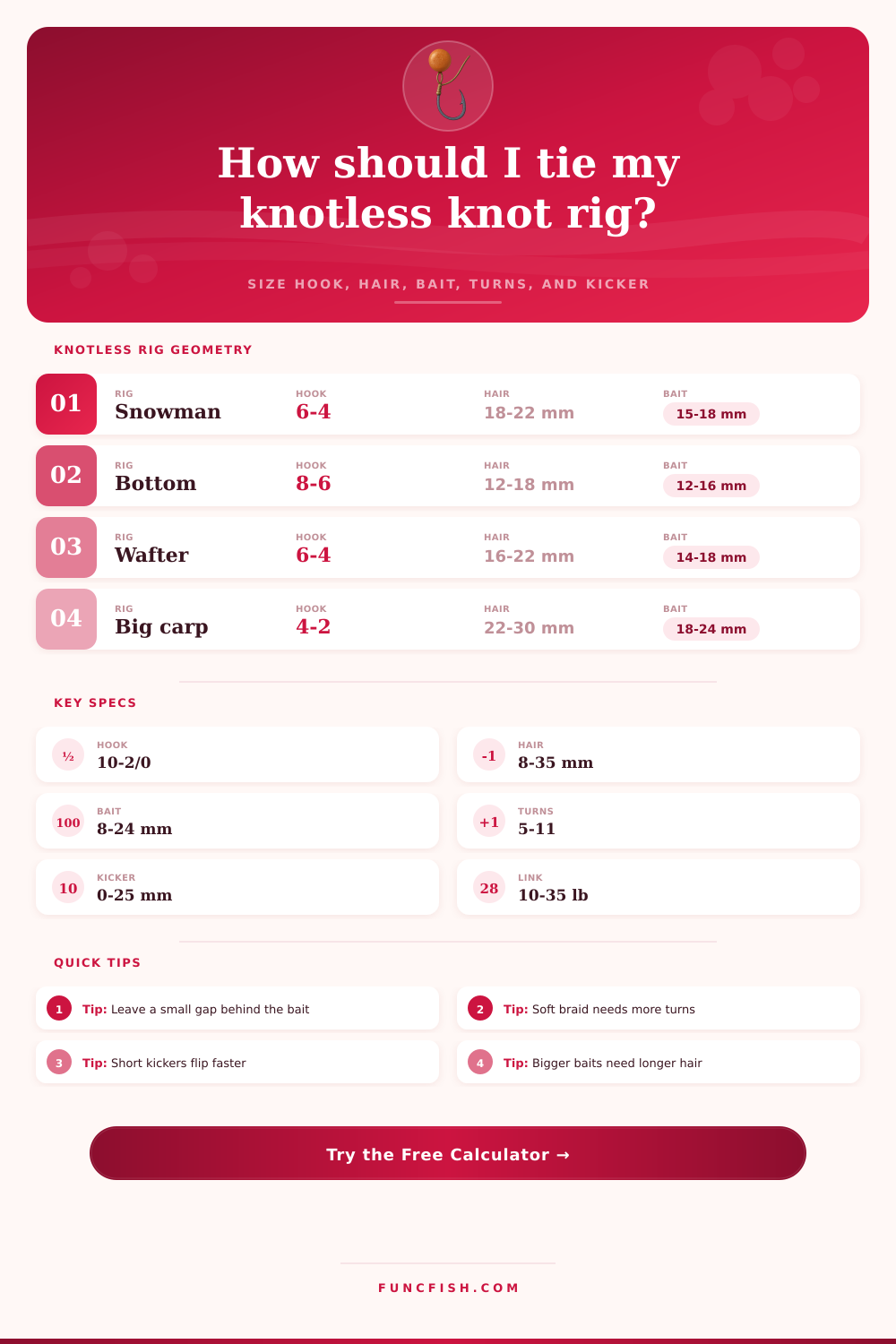
📌Named knotless rig presets
⚙Rig geometry inputs
Knotless rig geometry results
Balanced hook, hair, bait, turns, and kicker geometry.
Rig geometry breakdown
🧭Carp rig geometry grid
Bottom Bait
Wafter
Snowman
Big Fish
📊Reference tables
| Hook size | Approx gap | Shank span | Typical bait |
|---|---|---|---|
| Size 10 | 7-8 mm | 11-13 mm | 8-12 mm corn, pellet, mini boilie |
| Size 8 | 8-10 mm | 13-15 mm | 10-14 mm boilie or corn stack |
| Size 6 | 10-12 mm | 15-18 mm | 12-16 mm bottom bait or wafter |
| Size 4 | 12-14 mm | 18-21 mm | 15-18 mm boilie, snowman, pellet |
| Size 2 | 14-17 mm | 21-24 mm | 18-22 mm boilie or large snowman |
| Size 1 to 2/0 | 17-23 mm | 24-31 mm | 22-30 mm catfish or oversized carp bait |
| Hooklink material | Stiffness | Turn effect | Geometry note |
|---|---|---|---|
| Soft coated braid stripped | Low | Add 1-2 turns | Best when the hair exits cleanly opposite the point. |
| Semi-stiff coated braid | Medium | Standard turns | Stripped last inch improves bait movement. |
| Fluorocarbon | High | Use fewer neat turns | Needs careful bedding to avoid coils at the eye. |
| Combi rig section | Mixed | Standard plus hinge | Works well with a short supple hair section. |
| Heavy sinking braid | Low-medium | Add 1 turn | Good for close range or snag pressure. |
| Stiff boom material | Very high | Reduce turns | Often benefits from a separate hair or soft section. |
| Species | Hook range | Bait diameter | Hooklink test |
|---|---|---|---|
| Common carp | 8 to 2 | 12-22 mm | 12-25 lb |
| Mirror carp | 6 to 2 | 14-24 mm | 15-30 lb |
| Grass carp | 8 to 4 | 10-18 mm | 10-20 lb |
| Crucian carp | 12 to 8 | 6-10 mm | 4-10 lb |
| Tench | 10 to 6 | 8-14 mm | 6-12 lb |
| Barbel | 8 to 4 | 10-18 mm | 10-18 lb |
| Presentation | Hair target | Kicker target | Best use |
|---|---|---|---|
| Bottom boilie | Bait diameter plus 2-5 mm | 8-14 mm | Clean gravel, clay, or light silt. |
| Wafter | Bait diameter plus 4-8 mm | 10-18 mm | Balanced bait that needs fast turning. |
| Snowman | Stack height plus 6-10 mm | 12-20 mm | Selective carp rig with visible bait. |
| Corn or tiger nut | Bait stack plus 2-6 mm | 6-12 mm | Smaller mouths and pressured fish. |
| Pellet hair | Pellet diameter plus 3-7 mm | 8-16 mm | Feeder and short-session rigs. |
| Zig foam or pop-up | Bait diameter plus 4-10 mm | 0-10 mm | Buoyant rigs where hinge movement matters. |
💡Rig tuning tips
With a knotless knot, the bait should clear the hook bend enough to swing without masking the point. Increase hair length before changing hook size if the bait sits hard against the bend.
Shrink tube and kickers speed up hook rotation, but a very long kicker on stiff material can make the rig act like a rigid claw. Use the score as a geometry prompt, then test it in water.
The knotless knot is one of the main components of many carp rig. The knotless knot is important in that the knot allows for the hair and the hook to move independent of one another. This independent movement of the hair and hook allows for the gentle take of the fish to becomes a strong hook and fish hold.
Many individuals may make the mistake of using the same length of hair and the same number of turns in their knotless knots for any given carp rig that they create. The length of the hair and the number of turns in the knotless knot should change based off the size of the bait that is to be used in the rig, as well as the stiffness of the hook-link. If these two factors is not correctly adjusted in relation to the size of the bait, the hook point may be masked by the bait or the rig may fail to flip correct when the fish takes on the bait.
How to Tie and Adjust a Knotless Knot for Carp Rigs
Each of these factors, therefore, must be considered in relation to one another to ensure that the knotless knot will function accordingly when used with the carp rig. One of the first measurements that must be considered in creating the knotless knot is the size of the hook. The size of the hook dictates the scale of all other measurement that are to be made for the knotless knot.
For instance, a size 10 hook provides for very little room for error in relation to the size of the bait that is to be used, but a size 4 hook allow for more movement in relation to the size of the bait. In this case, a size 4 hook will require longer hair than a size 10 hook. In each case, the angreter can use a calculator to determine the correct length of the hair, the size of the hook, and the bait diameter to avoid any guessing in relation to whether or not the point of the hook will be clear when the carp takes on the bait.
In each instance, the actual size of the hook is less important than the relationship of the size of the hook to the size of the bait that will be used in the knotless knot. The second variable that must be adjusted in the creation of the knotless knot is the length of the hair. The length of the hair must be adjusted such that the bait can fully clear the bend of the hook, but the length of the hair must also be short enough to ensure that the hook point is not masked by the bait after the fish takes upon the bait.
Should a wafter or a snowman be added to the rig, for instance, the length of the hair will change. In this instance, the angreter can use a tool to adjust the length of the hair in relation to the diameter of the bait to ensure that the new addition to the rig will still function appropriately. Furthermore, an angreter must also consider if they would like their bait to sit in close proximity to the bend of the hook or if they would like the bait to sit in a greater distance from the bend of the hook.
The third variable in the knotless knot is the material of the hooklink. The material of the hooklink will determine the number of turns that is required in the knotless knot. For instance, if the material of the braid is soft, the braid will compress when it is under tension, which means that there will need to be an extra wrap or two in the knotless knot to avoid the hair from slipping on the hook.
Materials like fluorocarbon or boom sections that are of a stiff material will hold their shape with fewer wraps around the hook, but too many wraps may create a coil in the hair that lifts the bait off of its line. In this case, the calculator that is used to determine the number of turns required for the knot will take into account the stiffness of the material. Furthermore, this number of turns is important because the turns will hold the hair at the angle at which the kicker of the carp rig is created.
The fourth variable in the creation of a knotless knot is the length and angle of the kicker. The length and angle of the kicker will determine at what rate the bait will flip over once the fish takes upon it. A short kicker may work well for those who fish on a lakebed that contains clean gravel, but those who fish on a lakebed that contains silt or weed may require a kicker of a different angle to overcome the resistance of that silt or weed.
A model of the carp rig can be used to determine the length and angle of the kicker in relation to the stiffness of the materials of the rig; this will tell the angreter the rate at which the rig will flip once the fish is moving away from the bait. The angle and length of the kicker will change based upon the type of lakebed in which the angreter is fishing, therefore, the angle of the kicker may have to be changed from one fishing session to the next. In addition to the length of the bait, the size of the hook, the length of the hair, the material of the link, and the length and angle of the kicker, there are two additional factor that the angreter should consider: the species of the carp that is to be targeted, and the line test of the carp rig.
Each of these species will have a certain strength to their fight with the angreter, as well as the strength of the lakebed. The strength of the line will change the diameter of the line itself, which changes the number of turns in the knotless knot. The calculation of the knotless knot will incorporate these factors to the angreter’s knowledge so that they will not create a knot that is too strong for the size of the hook.
Furthermore, reference tables can be used to determine the strength of each of the different species of carp. These reference tables will allow the angreter to ensure that they are within the appropriate range of line strength for that species. Finally, once all of the calculations have been made, the angreter is required to test each of the rigs that have been created.
Despite creating a knotless knot with all of the mathematical measurement that are appropriate for the carp rig that is to be created, it is possible that once the bait is thredded into the hair and the kicker is shrunk, the hair may be too close to the hook. In this case, three version of the same knotless knot can be tied. Each of the three version can be tested in the water to determine which version of the knot will land best on the lakebed and which will turn in the water when the fish begin to move away from the bait.
The calculator will assist in the creation of the knotless knot, but the movement of the fish in the water will show which small adjustment to the knot will create the best results for that specific day.