Boat Trailer Brake Size Calculator
Estimate trailer brake size, loaded axle demand, stopping margin, and load class from boat weight, trailer weight, axle count, axle rating, wheel diameter, terrain grade, tow speed class, load margin, and unit mode.
📌Named boat trailer brake presets
⚙Boat, trailer, axle, wheel, grade, speed, and margin
Model: loaded trailer mass is adjusted by your margin setting, terrain grade, and tow speed class, then compared with axle rating and a selected brake hardware baseline to estimate a practical brake size class.
Trailer brake sizing estimate
Calculation breakdown
🛠Brake package response grid
Compact Drum
Common Drum
Heavy Drum
Marine Disc
🚤Trailer and boat comparison grid
Light skiff trailer
Aluminum jon boat, small flats skiff, or lightweight utility boat.
Bass or walleye rig
Fiberglass bass boat, aluminum walleye boat, or compact center console.
Bay and pontoon
Heavier fishing pontoon, bay boat, wake boat, or tandem bunk trailer.
Offshore trailer boat
Walkaround, pilothouse, cuddy, or triple-axle saltwater trailer.
📑Reference tables
| Brake package | Typical axle lane | Wheel diameter lane | Best boat trailer match |
|---|---|---|---|
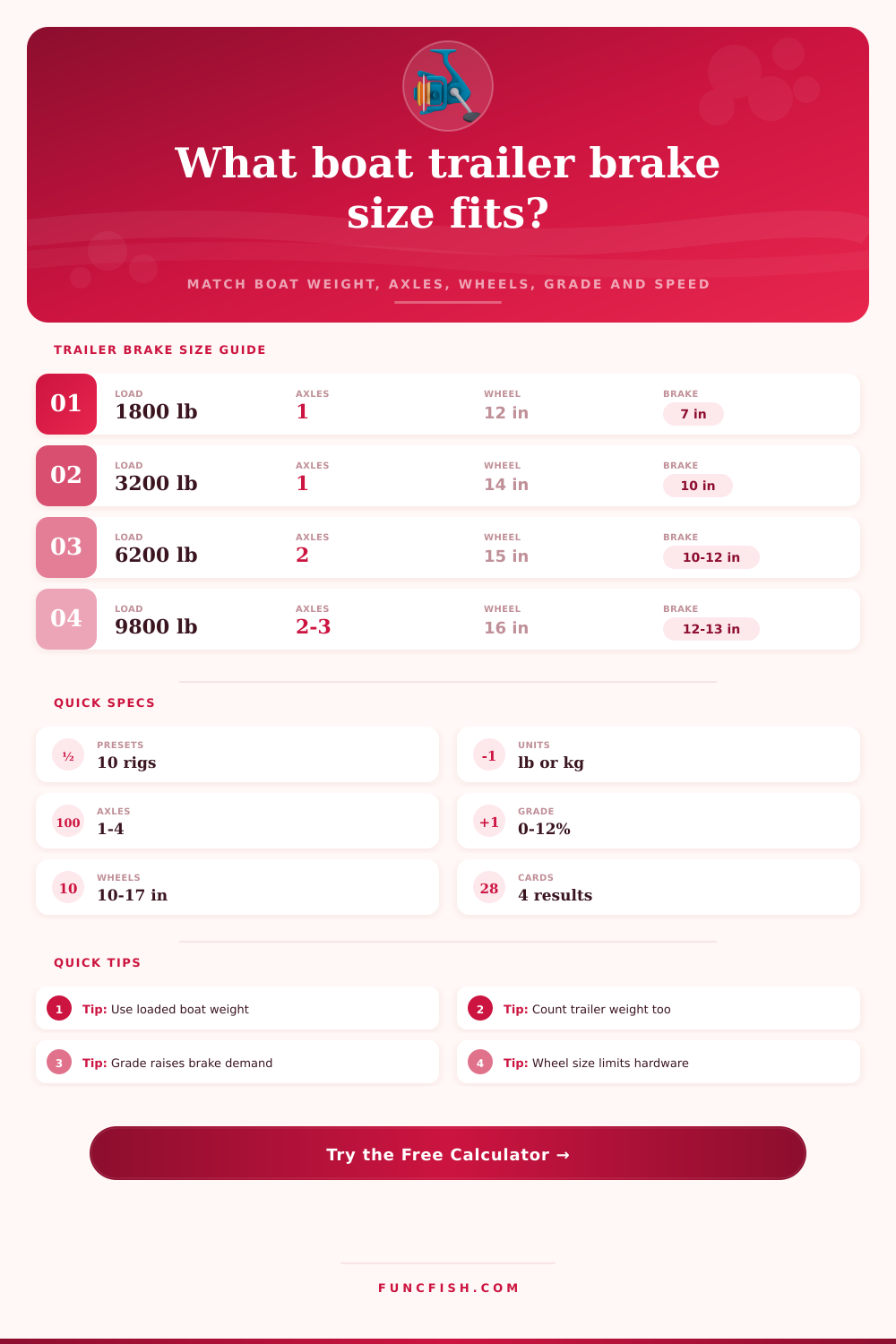
| 7 in electric drum | Up to about 2000 lb per braked axle | 10 to 12 in wheels | Small skiffs and short-ramp utility trailers. |
| 10 in electric drum | About 3000 to 3500 lb per braked axle | 13 to 15 in wheels | Bass boats, walleye boats, and many tandem trailers. |
| 10 in marine disc | About 3500 to 4200 lb per braked axle | 13 to 15 in wheels | Compact saltwater rigs and frequent ramp dunking. |
| 12 in drum | About 5000 to 6000 lb per braked axle | 15 to 16 in wheels | Heavier tandem boats and higher axle ratings. |
| 12 to 13 in disc | About 6000 to 7000 lb per braked axle | 15 to 17 in wheels | Offshore walkarounds, cuddy boats, and high-load trailers. |
| Loaded trailer class | Axle pattern | Axle load target | Brake sizing note |
|---|---|---|---|
| Ramp skiff | Single axle | Under 2000 lb per axle | Small hardware can fit if wheel clearance is tight. |
| Fishing single | Single axle | 2000 to 3500 lb per axle | 10 in packages are a common planning lane. |
| Tandem recreational | Two axles | 2500 to 4500 lb per axle | Use grade and speed factors to compare 10 vs 12 in. |
| Heavy tandem | Two axles | 4500 to 6000 lb per axle | Often points toward 12 in hardware or disc capacity. |
| Triple offshore | Three axles | 3500 to 6000 lb per axle | Axle count spreads load but total energy remains high. |
| Terrain and speed input | Model factor | When to use it | Result effect |
|---|---|---|---|
| Ramp shuffle | 0.86 to 0.95 | Low-speed ramp movement and marina lanes. | Lowers thermal demand compared with road towing. |
| Local roads | 1.00 to 1.08 | Short trips with moderate speed and frequent stops. | Baseline for normal mixed-use fishing trailers. |
| Highway tow | 1.18 | Open-road tow with steady cruising speed. | Raises brake size pressure from higher energy. |
| Fast highway | 1.30 | Higher cruising speed or rolling hill routes. | Favors more stopping margin. |
| Mountain descent | 1.42 plus grade | Long descents, passes, and steep approaches. | Strongly increases estimated brake demand. |
| Wheel diameter | Common brake fit lane | Load behavior | Calculator note |
|---|---|---|---|
| 10 to 12 in | 7 in drum | Compact wheel clearance limits larger packages. | If load is high, wheel size may be the constraint. |
| 13 to 14 in | 10 in drum or 10 in disc | Common for single and light tandem boat trailers. | Good middle lane for many bass and walleye rigs. |
| 15 in | 10 to 12 in drum or disc | Enough room for heavier common marine setups. | Watch axle rating and grade factors. |
| 16 to 17 in | 12 to 13 in disc or drum | Large wheel lane for offshore and heavy trailers. | High load may still need more axle capacity. |
These tables are estimating aids for matching trailer load, wheel clearance, and brake package capacity. For final parts selection, use component markings and the trailer or brake manufacturer data.
💡Brake size calculation tips
Boat weight changes quickly with fuel, batteries, trolling motors, livewell water, coolers, and tackle. A loaded number gives the brake estimate a better starting point than catalog dry weight.
More axles reduce load per axle, but the same boat and trailer still carry the same total braking energy. That is why this calculator shows both axle load and stopping margin.
Selecting a correct brakes for your trailer is a process that requires you to calculate the total weight of the trailer and the total weight of the loads that will be on the trailer. The total weight of the trailer’s load will include the weight of the boat that will be on the trailer, the weight of the fuel in the boat, the weight of the boat battery, and the weight of any gear (such as tackle or ice) that may be on the boat. In addition to these variables, you must also account for the curb weight of the trailer itself.
The total weight that the trailer brakes must be able to stop is the total weight of the boat, the gear on the boat, and the weight of the trailer itself. If you dont account for these variable, you may select trailer brakes that are too small for the trailer and its load. In addition to trailer and boat weights, the terrain that the trailer will encounter will impact the function of the trailer brakes.
How to choose the right trailer brakes
The terrain will also impact the amount of heat that the trailer’s brakes will generate. For instance, if the trailer is required to travel down a sustained downgrade, the trailer brakes will have to work harder to move the trailer at a slower rate. Consequently, the trailer brakes will generate more heat if you drive the trailer down a sustained downgrade.
Additionally, if you drive the trailer at higher rates than on flat terrain, the trailer brakes will generate more heat. If the trailer brakes generates too much heat while in use, the brakes may experience a phenomenon known as “brake fade,” which is when the trailer brakes lose there ability to stop the trailer. Thus, you must select trailer brakes that can manage the terrain on which the trailer will be driven.
The number of axles that the trailer has will impact the distribution of the trailer’s load, but will not impact the total mass of that load. For instance, if the trailer has more axle, the load will be distributed to more axles, which will lower the load on each individual axle. However, the total energy that the trailer brakes must manage will be the same.
A calculator can help to determine the total requirements for the trailer brakes. The calculator can account for the weight of the trailer’s boat, the weight of the trailer, the number of axles the trailer have, the rating of each axle, the size of the trailer’s wheel, and the terrain and speed on which the trailer will be driven. Thus, using a trailer brake calculator can help you to avoid selecting trailer brakes that are too small to handle the trailers load.
Another variable that you must consider when selecting trailer brakes is the trailer’s wheel size. Larger sized trailer wheels will provide more space for the trailer brakes, but smaller sized trailer wheels may prevent the installation of some trailer brake package. Thus, you must make certain that the trailer brakes that you select will physically fit within the wheels of the trailer.
In addition to accounting for each of the individual variables of the trailer, it is also important to include a load margin when calculating the total weight of the trailer. A load margin allow for differences in the weight of the trailer’s components; for instance, there may be a difference between the dry weight of the trailer when empty and the loaded weight of the trailer when it is filled with fuel and gear. A load margin provides a safety buffer for the trailer’s brakes.
A safety buffer helps to account for the possibility of differences in the total weight of the trailer and its load. Thus, including a load margin within the calculation of the total weight of the trailer helps to ensure that the trailer brakes will be able to handle any difference in the trailers total weight. Some of the mistake that people make when selecting trailer brakes include selecting brakes based off the axle rating of the trailer, rather than the total loaded weight of the trailer; ignoring the terrain and grade on which the trailer will be driven; and assuming that adding axles to a trailer will solve all of its braking problem.
You can avoid these mistakes by referring to the tables that list different brake packages and the trailer components with which they are compatible. For instance, a 7-inch drum brake may work for a trailer that transport a light skiff, but would not be sufficient for a tandem trailer that is designed to transport several thousand pound of boats and gear. Finally, you should also consider your specific trailer and the route that you will drive your trailer on.
For instance, the brake package that works for a trailer that drive on flat roads may not provide the same performance on mountain passes. Similarly, a trailer brake package that may be too large for a trailer that makes short trips to boat ramps may be the better package for a trailer that will be driven over long distances. Thus, the best trailer brake package is one that will ensure that the trailer will stop as needed, and that its brakes will provide consistent and predictable stopping power when driven at any necessary rate.
You should of checked all these things before you go. It is alot of work but it is important.