Jack Plate Setback Calculator
Estimate a practical outboard setback, prop-to-pad starting height, steering clearance, and water pickup margin for fishing boats with jack plates.
📌Scenario presets
⚙Boat and jack plate measurements
This calculator gives a setup starting point. Final height changes should be tested gradually while watching water pressure, steering tension, prop ventilation, and transom condition.
Jack plate setup estimate
Full calculation breakdown
📋Jack plate equipment grid
Manual 4 in
Manual 6 in
Hydraulic 6 in
Hydraulic 10 in
📐Setback reference tables
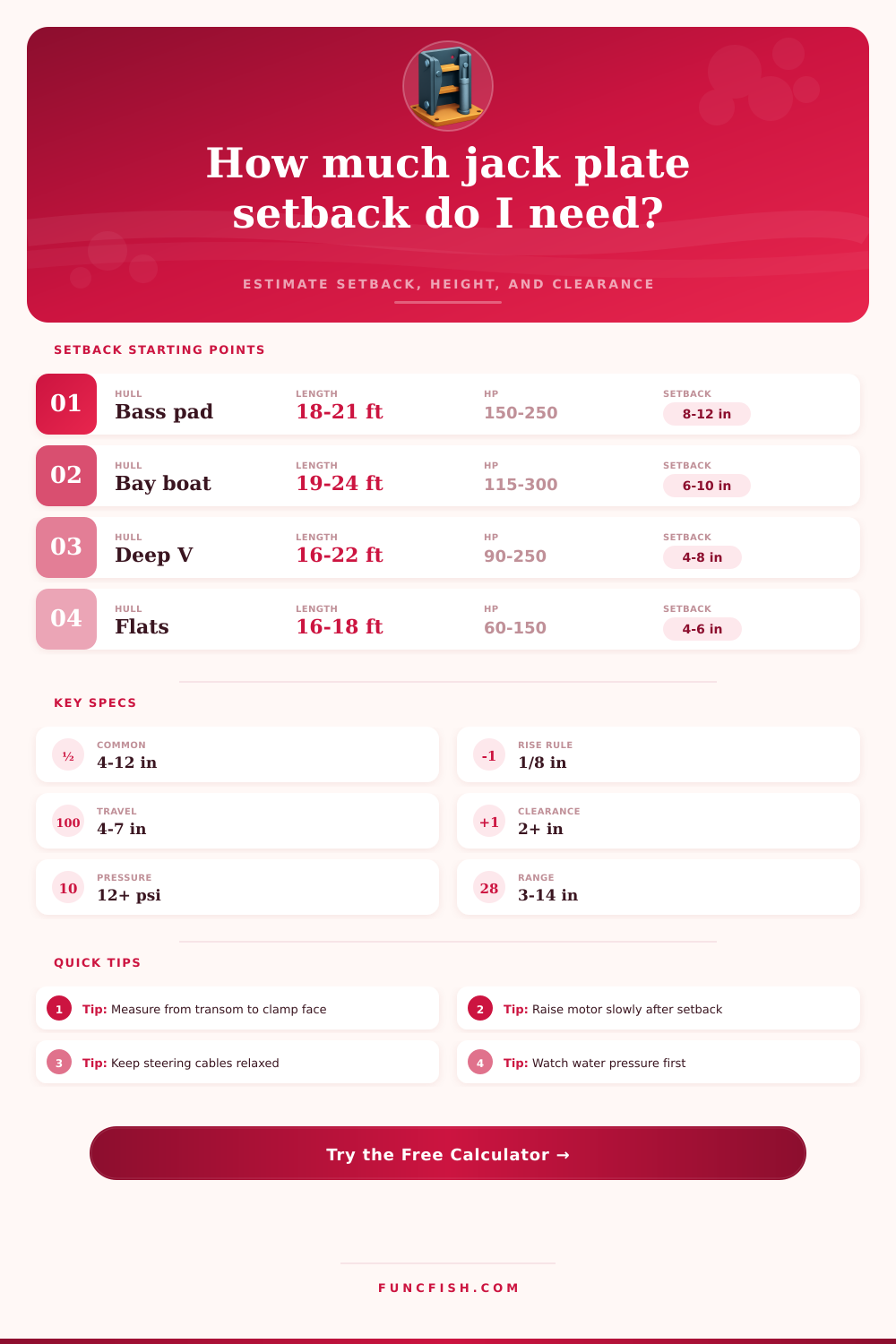
| Hull style | Common setback | Starting prop-to-pad | Setup note |
|---|---|---|---|
| Pad-bottom bass hull | 6-12 in / 15-30 cm | 2.75-3.75 in below | Often likes more leverage and height |
| Aluminum mod-V | 4-8 in / 10-20 cm | 3.75-5.00 in below | Needs conservative height in chop |
| Bay boat / hybrid V | 6-10 in / 15-25 cm | 3.50-4.75 in below | Hydraulic travel helps shallow water |
| Flats skiff | 4-6 in / 10-15 cm | 2.25-3.50 in below | Pickup style limits final height |
| Deep V walleye hull | 4-8 in / 10-20 cm | 4.00-5.50 in below | Bow control matters more than height |
| Fishing pontoon | 3-6 in / 8-15 cm | 5.00-6.50 in below | Avoid over-raising in aerated water |
| Setback added | Height change rule | Steering allowance | Pressure watch |
|---|---|---|---|
| 0-4 in | Baseline height | 1.0 in slack | Standard pickups usually safe |
| 5-8 in | Raise about 0.50-1.00 in | 2.0 in slack | Check pressure at full trim |
| 9-12 in | Raise about 1.00-1.50 in | 3.0 in slack | Low pickups help high running |
| 13-14 in | Raise only after testing | 4.0 in slack | Heavy load needs extra margin |
| Fishing use | Target behavior | Setback bias | Height bias |
|---|---|---|---|
| Bass tournament load | Bow lift and speed | More setback | Moderately higher |
| Walleye trolling | Stable trim and bite | Moderate setback | Conservative height |
| Flats poling | Shallow takeoff | Short setback | Higher with pickups |
| Bay/inshore casting | Lift plus chop control | Moderate-high | Hydraulic range |
| Pontoon fishing | Clean water feed | Low setback | Lower gearcase |
| River tunnel | Skinny water run | Short bracket | Tunnel matched |
💡Setup checks
Tip: After adding setback, raise the motor in small steps and record speed, rpm, water pressure, steering feel, and prop ventilation at each height.
Tip: If steering cables, hydraulic hoses, or control cables tighten before full turn or full tilt, treat the clearance result as a hard limit.
Jack plate setback is the process of move a motor as far back from the transom as possible on a boat. The jack plate setback plays an important role in how a boat will behave when under load, when at speed, and when encountering shallow water. The jack plate setback plays with many different variables of a boats design.
A calculator allows someone to find the proper jack plate setback by accounting for each of these variable, as opposed to guessing at the proper setting. Jack plate setback provide the motor with leverage. Additionally, the jack plate setback helps to shift the weight of the boat towards the stern of the boat.
How to Find the Right Jack Plate Setback
By increasing the jack plate setback, the angle of the propeller as it moves through the water change. Furthermore, increasing the jack plate setback provides more space to raise the motor of a boat without the propeller of that boat losing its grip on the water. This is especially important for pad bottom hulls.
However, the amount of jack plate setback is also important for other hull style due to the different amounts of weight that other hulls have in their sterns and the different ways in which their props pick up water from the waters surface. Provide the calculator with the hull style of the boat, the horsepower of the boat, the weight of the fishing load that the boat will carry, and the type of jack plate that is being used. The calculator will use these four input to arrive at the math that is necessary to calculate the proper jack plate setback for that boat.
One of the main factor in the proper jack plate setback is the hull shape of the boat. Hull shape is a primary factor in the determination of proper jack plate setback. For instance, boats with deep V hulls experience choppy water, and deep V hulls require the propeller of the boat to be lowered and for the jack plate setback to be of a more moderate value to ensure that the bow of the boat does not wander from the direction in which the operator intends to travel.
In contrast, flats skiffs is used in very shallow waters. Thus, flats skiffs require for the jack plate setback to be shorter so that the stern of the flats skiff does not drop to the water too deep when the boat is traveling on the water at speed. The hull shapes of the boat will impact the suggested jack plate setback, even if the horsepower and length of the boat remain the same.
The weight and the load of the boat will also have an impact upon the jack plate setback. The propeller of a boat requires different amounts of grip in the water with different amount of weight behind the propeller. For instance, a boat that is hauling fuel and gear will require a different amount of jack plate setback then a boat that is transporting a light load.
The type of plate that is used can also have an impact upon the jack plate setback. For instance, the movement of the motor with a manual six-inch jack plate will differ from a hydraulic ten-inch jack plate. The ten-inch jack plate can be adjusted while the boat is on the water, but the manual six-inch jack plate cannot be adjusted while the boat is on the water.
Additionally, the travel range of the jack plate must be considered. The jack plate setback cannot be adjusted to any value that exceeds the travel range of the jack plate. By moving the jack plate beyond its travel range, an operator may risk developing tension in the steering cables or the hydraulic lines of the boat.
The style of water pickup that the boat uses can also have an impact upon the proper jack plate setback. For instance, standard side pickups for boat props will lose water pressure more quick than props with nose-cone designs or low-water designs. This factor must be considered in the calculation of the proper jack plate setback for a boat.
Clearance of the propeller of the boat from potential contact with other components of the boat is also a critical factor in the proper jack plate setback for a boat. Many boat owners and operators may discover the importance of jack plate setback too late in the outing of a boat. By moving the motor of a boat away from its splashwell, and by changing the arc of the steering cables of the motor, the jack plate setback can lead to issue in which the cables will become pinned or caught on other components of the boat while the boat is in motion.
The jack plate setback calculator will warn an operator if additional length is required for the steering cables of the boat, or if the hydraulic lines that control the movement of the propeller must be rerouted to avoid any potential issues with binding of those lines or cables. Following the calculation of the proper jack plate setback, the adjustment must be made to the boat itself. When making the adjustment, raise the motor in small increment and test the boats performance with each increment of jack plate setback.
While raising the motor, pay close attention to the water pressure that is provided by the propeller, the feel of the boats steering while in motion, and the propeller for signs of ventilation. Although the jack plate setback calculator has provided an ideal height for the motor of a boat, and has even provided a target for the water pressure of the propeller, the water will provide the last and final information that is needed regarding the proper adjustment of the jack plate setback for that specific model of boat and that specific load of the boat. Most boats will function best within a narrow window of jack plate setback.
This range of best performance is rarely the maximum height to which the jack plate can be moved. The purpose of the jack plate setback is to allow the boat to lift and carry its load without porpoising. Additionally, ensuring that the jack plate setback is properly adjusted will allow the boat to have enough steering margin to turn in choppy water.
Once the operator of the boat has tested the initial setting for the jack plate setback, and once adjustments have been made to that initial setup based off how the boat move in the water, the operator will deem the jack plate setback correct for that model of boat.