Copper Line Depth Calculator
Estimate trolling depth from copper length, line class, speed, current, leader drag, and lure pull, then back-solve the copper needed for a target zone.
📌Scenario presets
⚙Copper trolling inputs
Copper depth estimate
Full breakdown
📋Copper line reference grid
18 lb Micro
27 lb Copper
32 lb Copper
45 lb Copper
60 lb Copper
Weighted Steel
Hybrid Core
45 lb Deep
📏Depth and speed reference tables
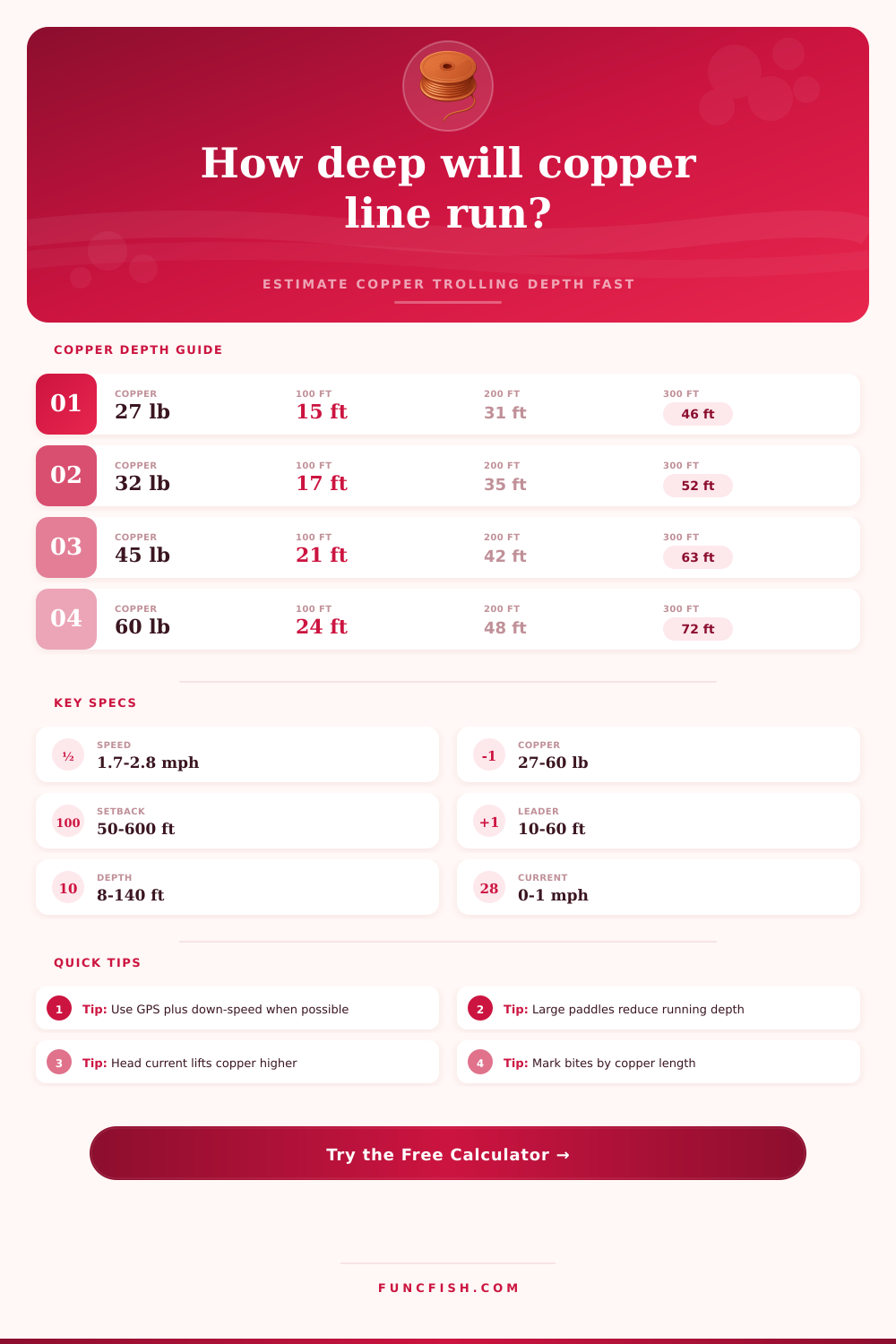
| Copper class | Typical sink at 2.2 mph | Best target band | Common use |
|---|---|---|---|
| 18 lb micro copper | 12 ft per 100 ft / 3.7 m per 30 m | 8-40 ft / 2-12 m | High trout, coho, clear water |
| 27 lb copper | 15.5 ft per 100 ft / 4.7 m per 30 m | 15-55 ft / 5-17 m | Brown trout, walleye, steelhead |
| 32 lb copper | 17.5 ft per 100 ft / 5.3 m per 30 m | 25-75 ft / 8-23 m | Mixed salmon and walleye spreads |
| 45 lb copper | 21 ft per 100 ft / 6.4 m per 30 m | 45-110 ft / 14-34 m | King salmon and deep spoon work |
| 60 lb copper | 24 ft per 100 ft / 7.3 m per 30 m | 70-140 ft / 21-43 m | Deep salmon and lake trout lines |
| Speed through water | Depth effect | When it happens | Calculator adjustment |
|---|---|---|---|
| 1.6-1.9 mph / 2.6-3.1 km/h | Runs deeper | Cold water, inside turns | Multiplies sink rate upward |
| 2.0-2.4 mph / 3.2-3.9 km/h | Baseline | Most salmon spoon trolling | Near listed copper chart depth |
| 2.5-2.8 mph / 4.0-4.5 km/h | Runs higher | Steelhead, aggressive kings | Reduces sink rate for lift |
| Cross current | Variable | Boards surge or stall | Adds a mild stability penalty |
🎣Species and spread matching
| Target | Typical strike zone | Copper length range | Common line choice |
|---|---|---|---|
| Brown trout shoreline | 8-25 ft / 2-8 m | 50-150 ft / 15-46 m | 18-27 lb copper |
| Coho high line | 15-35 ft / 5-11 m | 100-200 ft / 30-61 m | 27-32 lb copper |
| Walleye basin | 25-55 ft / 8-17 m | 150-300 ft / 46-91 m | 27-32 lb copper |
| Steelhead offshore | 25-65 ft / 8-20 m | 150-300 ft / 46-91 m | 27-45 lb copper |
| King salmon | 45-100 ft / 14-30 m | 250-500 ft / 76-152 m | 45-60 lb copper |
| Lake trout | 70-140 ft / 21-43 m | 350-600 ft / 107-183 m | 45-60 lb copper |
| Lure load | Depth factor | Leader note | Spread note |
|---|---|---|---|
| Clean spoon | 1.00 | Low drag, clean depth | Good outside board choice |
| Thin crank | 1.06 | Some plug dive added | Watch inside turn surges |
| Diving plug | 1.12 | Plug lip adds pull and dive | Give extra board spacing |
| Flasher and fly | 0.90 | Rotating drag lifts copper | Better middle or inside |
| Paddle and meat | 0.84 | Largest drag penalty | Keep away from short high lines |
💡Practical calculation checks
Tip: Copper charts are estimates. A probe depth, repeated strike notes, and lure style should override a chart when the same setup repeats.
Tip: If the board stalls on an inside turn, the copper often drops deeper for a short window before rising again as speed recovers.
Copper line depth is used to determine the depth that the lure should travel in the water column. There is many different variables that may impact the depth of the copper line. The length of the copper line may be set to provide depth to the lure, but many other variable can impact the depth of the copper line.
For example, the speed of the boat, the current in the water, and the type of lure that anglers are utilizing can all change the depth to which the copper line travels. Because of these variables, many anglers may find themself with their lures either too deep or too shallowly to the fish in the water column. The copper line will sink to the floor of the water column because the weight of the copper line is more greater than the weight of the water.
What Affects Copper Line Depth
However, the copper line also travels at an angle behind the boat. The angle of the copper line may change based off the speed at which the boat is traveling. As the boat increases in speed, the water appears to move fasterly past the copper line, lifting the copper line.
Should the boat slow in speed, the copper line will drop in relation to the water. Additionally, the type of lure that anglers use can also impact the depth of the copper line. For example, heavy lures can create more drag than other which will lift the copper line.
Other lures will create less drag which will allow the copper line to remain at a deeper point in the water column. The current that exist in the water can also change the depth of the copper line. For instance, if the current is a head current it will increase the speed of the water that passes the copper line which will lift the copper line.
A tail current will have the opposite effect on the copper line, allowing it to sink to the bottom of the water column at a lower depth. The calculator asks for several different parameters of the fishing situation to determine the depth of the copper line. For example, you should input the length of the copper line into the calculator as well as the type of lure, the length of the leader line and backing, the current in the water, and the speed of the boat.
Each of these parameter is used in the calculation of the depth due to their impact upon the copper line. For instance, the copper class will help to determine the depth at which the copper line will sink. Additionally, the different types of lures will create drag which may increase or decrease the depth of the copper line.
The length of the leader line and backing may impact the angle of the copper line which will impact it’s depth. Finally, the current and the boat speed are both important parameters to input as well because the boat speed determined on a GPS may not be the same than the actual speed of the water moving past the copper line. Many anglers make the mistake of assuming that the length of the copper line will set the depth of the copper line.
However, there is many other variables that will impact the depth. For example, if the copper line of a certain length travels to a depth that is perfect for the fish on a day with no currents, that same length of copper line may not travel to the same depth with a head current moving through the water. The calculator mathematically adjusts for these different variables to ensure that anglers dont have to guess at the depth to which the copper line will travel.
The shape of the copper line is also another factor in the depth of the copper line. The copper line does not fall in a straight line into the water and those who assume that the length of the copper line will determine its depth in the water may not easily calculate the depth. The steepness of the curve of the copper line will determine the distance between the boat and the lure.
If the copper line is at a steep angle, the distance between the boat and the lure will be short. If the copper line is at a shallow angle, the distance between the boat and the lure will be longer. This distance is important for ensuring that there is enough distance between the different lines of the copper line to avoid the lines from crossing each other in the water.
The type of fish that you are targeting may also impact the depth of the copper line. For instance, fish like brown trout typically live in shallow waters which means that shorter lengths of copper line may be required to reach the fish. King salmon, on the other hand, live in deeper waters which means that longer lengths of heavy copper line may be required to reach these fish.
Additionally, lake trout live in deep waters which again means that the depth of the copper line and the speed of the boat must be adjusted accordingly when targeting these fish. While the copper line depth calculator may not tell you where the fish are, it can help to ensure that the copper line reaches the depth where the fish live. The depth of the copper line will not necessarily be the same depth each day.
Many people may catch fish using a certain length of copper line at a certain speed. However, that depth may not be achieved if, for instance, the water temperature change or a different type of lure is utilized. Thus, the depth of the copper line will likely change.
It is important for anglers to use the depth calculator to determine the depth of the copper line in the case where any of these variables have changed so that the copper line may remain in the correct depth range. The movement of the boat may also change the depth of the copper line. If the boat makes an inside turn, the boat will slow which drops the copper line.
If the boat makes an outside turn the boat will go faster which lifts the copper line. These turns can change the depth and the spread of the copper line. The adjustments for the current and the boat turns included in the calculator are for these same reasons: to account for the different forces upon the copper line.
Thus, by using the copper line depth calculator, anglers can ensure that their line is placed into the correct strike zone for the fish being targeted.