Fish Gravlax Cure Calculator
Calculate salt, sugar, aromatics, cure time, liquid loss, and slice yield from fish weight, fillet thickness, cut style, and cure target.
📌Scenario presets
⚙Cure inputs
Gravlax cure result
Full breakdown
📋Ingredient density grid
Fine sea salt
Morton kosher
Diamond kosher
Granulated sugar
📐Cure ratio reference
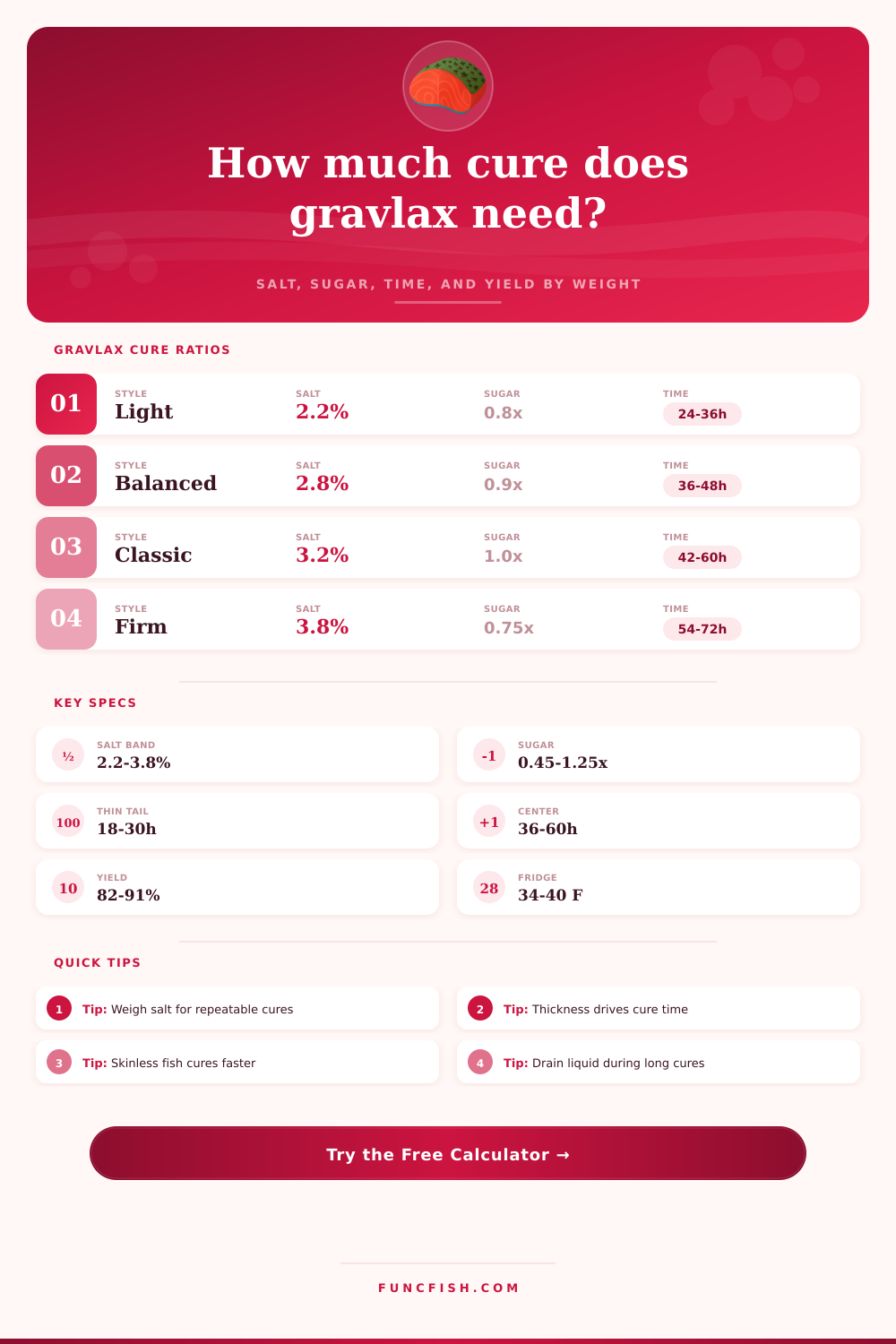
| Cure target | Salt by fish weight | Sugar to salt ratio | Typical result |
|---|---|---|---|
| Light slice cure | 2.2% salt | 0.80 x salt | Soft, shorter cure window |
| Balanced gravlax | 2.8% salt | 0.90 x salt | Moderate salt and clean texture |
| Classic equal sugar cure | 3.2% salt | 1.00 x salt | Traditional sweet-salt balance |
| Firm slicing cure | 3.8% salt | 0.75 x salt | Firmer texture and higher liquid loss |
| Low-sugar cure | 3.2% salt | 0.45 x salt | Less sweetness, firmer perception |
| Sweeter dill cure | 2.7% salt | 1.25 x salt | Softer, sweeter finished slices |
| Thickness at thickest point | Approximate cure window | Metric thickness | Timing note |
|---|---|---|---|
| 0.5-0.8 in | 18-30 hours | 1.3-2.0 cm | Tail and thin trim |
| 0.9-1.2 in | 30-44 hours | 2.3-3.0 cm | Small fillet or trout |
| 1.3-1.6 in | 42-60 hours | 3.3-4.1 cm | Center-cut salmon |
| 1.7-2.1 in | 56-78 hours | 4.3-5.3 cm | Thick loin or king salmon |
| Over 2.1 in | 72-96 hours | Over 5.3 cm | Split into smaller pieces for even cure |
🔢Fish and cut factors
| Fish type | Salt adjustment | Time adjustment | Yield tendency |
|---|---|---|---|
| Atlantic salmon | Baseline | Baseline | 87-90% |
| King salmon | +3% to salt amount | +5% time | 88-91% |
| Sockeye salmon | -2% to salt amount | -4% time | 84-88% |
| Steelhead | Baseline | -2% time | 85-89% |
| Trout or char | -4% to salt amount | -8% time | 84-88% |
| Sablefish | +5% to salt amount | +8% time | 89-92% |
| Cut style | Time factor | Loss factor | Calculation use |
|---|---|---|---|
| Center-cut fillet, skin on | 1.00 x | Baseline | Standard gravlax calculation |
| Whole side, skin on | 1.08 x | +1% | Large surface, uneven thickness |
| Tail section, skin on | 0.78 x | +1% | Thin section, faster cure |
| Skinless portions | 0.82 x | +2% | Salt reaches both sides faster |
| Belly-rich piece | 0.92 x | -1% | Higher fat cushions salt uptake |
| Thick loin block | 1.18 x | Baseline | Time driven by the center point |
💡Formula checks
Salt check: The calculator treats salt as a percent of raw fish weight, then adjusts by fish fat and cure target. Weighing salt is more repeatable than volume because salt densities vary widely.
Time check: The cure window is thickness-led. A heavy whole side may weigh much more than a center piece, but the thickest point controls the time estimate.
Yield check: Expected finished weight subtracts cure liquid loss and trimming loss. Firm cures, heavy drainage, and skinless pieces reduce yield more than light cures.
Surface check: Cure grams per 100 cm² helps compare batches. A very high surface loading signals that a thick cure layer should be spread carefully and evenly.
Making gravlax requires that you use the correct amounts of salt and sugar, and the amount of salt and sugar that you need to use depends on the type of fish that you are using. The amount of salt and sugar that is required for a two pound center cut of salmon will not be the same as the amount required for a thin tail piece of salmon of the same weight. Furthemore, the amount of salt and sugar that is required for a two pound center cut of salmon will not be the same as the amount that is required for a thick king salmon loin of the same weight.
Because the weight and thickness of the salmon can alter the gravlax recipe, use of a calculator to determine the amounts of salt, sugar and time required will eliminate the guesswork in the recipe. The type of fish that is to be prepared as gravlax can have an impact upon the amount of salt that is required to cure the fish. For instance, salmon species that contain more fat, such as king salmon and sablefish, can take in more salt than species that are leaner, such as sockeye salmon and trout.
How to Cure Salmon for Gravlax
This is due to the fact that the leaner species require the salt to reach the center of the salmon faster. Consequently, the leaner salmon fish will require less salt and a short time to cure than the fattier fish species. The thickness of the fish at it’s thickest point is more important than the total weight of the fish.
For instance, a four pound side of salmon that is only one and a quarter inches thick will cure faster than a two pound block of salmon that is two inches thick. The thickness at the thickest point of the salmon is the most important measurement to make certain that the salmon does not need to be cut into smaller portion to cure, or if the curing time will need to be lengthened to allow for the salt to reach the center of the fish. The cut of the fish can impact the way in which the gravlax will cure.
Skinless portions of the salmon will allow the salt to cure both sides of the salmon at the same time, which will cause the skinless portions to cure faster than salmon that contains its skin. Belly portions of the salmon contain more fat than other parts of the salmon filet, which will cause those portions to resist drying out during the curing process. Finally, tail portions of the salmon will be thinner than other portions of the salmon filet, which will allow the tails to overcure when using the same time as a center cut portion of the salmon.
The target texture for the gravlax will impact the amount of salt and sugar that is used in the preparation of the gravlax. Light cures will result in salmon that is softer to the teeth, but can be useful in preparing gravlax as an appetizer. Classic and firm cures will remove more liquid from the salmon than light cures, resulting in salmon that holds its shape when sliced.
The ratio of sugar to salt in the gravlax can change according to the target texture of the gravlax; a lower ratio will result in a savory gravlax, while a higher ratio will mellower the taste of the gravlax. The temperature of the refrigerator at which the gravlax is cured will slow the curing process of the salmon. This may be useful for salmon filets that are thick and require a longer curing process.
The liquid that is in contact with the salmon should be drained daily to remove the salty liquid that may develop against the surface of the salmon filet; if the salty liquid is not removed from the filet, it will slow the penetration of the salt into the salmon. Salt should be measured by weight instead of volume. Salt products can weigh differently in the tablespoon measurements, so using a calculator to determine the amount of salt and sugar that will be used in the recipe will prevent any error in measurement.
Furthemore, the gram measurement will be used to determine the amount of salt required because this is the measurement that will impact the cure of the salmon. Although there will be salt and sugar measurements in both grams and tablespoons in the calculator, the gram measurement should of been the one used in the preparation of gravlax. The amount of the fish filet that is cured will never weigh the same as the total weight of the fish filet that is used in the gravlax process.
The moisture will be lost from the salmon as a result of the curing process, and the amount of moisture that is lost can range from eight to fifteen percent of the total weight. This percentage of moisture loss, along with the trimming of the fish to remove any waste, will impact the final weight of the gravlax servings. Calculators take into account the amount of moisture that will be lost from the salmon to ensure that the chef knows the total weight of the gravlax servings that will result from the recipe.
Furthemore, by knowing the weight of the servings of gravlax, the chef can determine how many servings will be needed to cater to a group of individuals. In order to prepare gravlax successfully, each of the steps in the process should be followed. The fish should be weighed, the thickest point of the fish should be measured, the target texture for the gravlax should be chosen, and a calculator can be used to determine the amount of salt, sugar and time that is required to cure the salmon to the chosen texture.
Only if one or more of the variables of the recipe (such as temperature and cut of the fish) are changed should the salt, sugar or time be changed. Overall, then, the gravlax recipe can be followed to create a product with confidence if it is followed end to end.