Fly Line Backing Capacity Calculator
Estimate how many yards of backing will fit after changing fly line weight, fly line profile, backing diameter, packing tension, and rim reserve.
📌Scenario presets
⚙Capacity settings
Backing capacity estimate
Full breakdown
📋Backing material reference grid
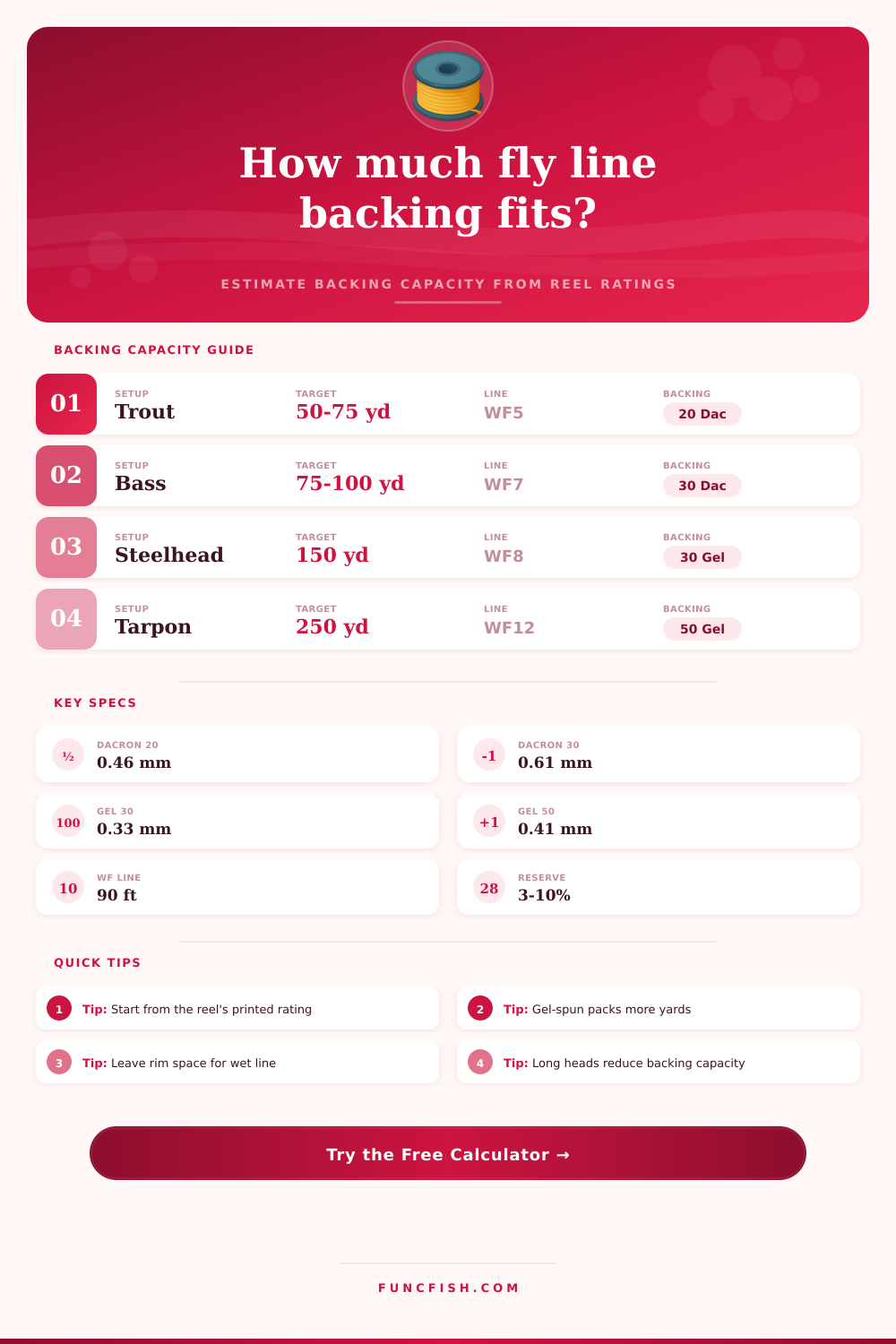
20 lb Dacron
30 lb Dacron
30 lb Gel-Spun
50 lb Gel-Spun
📐Fly line and backing tables
| Backing type | Approx diameter | Typical strength | Capacity note |
|---|---|---|---|
| Standard Dacron braid | 0.46-0.61 mm | 20-30 lb | Predictable fill and easy knots |
| Low-stretch Dacron | 0.48-0.58 mm | 20-30 lb | Slightly firmer spool feel |
| Gel-spun braid | 0.28-0.41 mm | 20-50 lb | More capacity in the same reel |
| Hollow braid | 0.51 mm | 50 lb | Large arbor saltwater option |
| Fly line profile | Volume multiplier | Capacity effect | Best checked when |
|---|---|---|---|
| Weight forward floating | 1.00 | Baseline | Most trout and bass reels |
| Double taper floating | 1.18 | Less backing | Longer thick belly on spool |
| Sink tip | 1.08 | Less backing | Dense tip and thicker coating |
| Full sinking | 1.16 | Less backing | Dense running section |
| Shooting head | 0.82 | More backing | Short head with thin runner |
| Saltwater WF | 1.12 | Less backing | Large warmwater tapers |
| Spey head | 1.35 | Less backing | Two-hand head systems |
| Long belly Spey | 1.55 | Much less backing | Long continuous belly lines |
| Scenario | Target backing | Common line | Capacity priority |
|---|---|---|---|
| Creek trout | 50 yd / 46 m | WF3-WF4 | Enough for balance |
| River trout | 75 yd / 69 m | WF5-WF6 | Standard trout reserve |
| Lake bass | 90 yd / 82 m | WF7-WF8 | Room for thick popper lines |
| Steelhead | 150 yd / 137 m | WF8-Spey | Long first runs |
| Salmon | 200 yd / 183 m | WF9-WF10 | Capacity before arbor size |
| Bonefish | 175 yd / 160 m | WF8-WF9 | Fast flats runs |
| Redfish | 125 yd / 114 m | WF8-WF9 | Balanced saltwater fill |
| Striped bass | 200 yd / 183 m | WF9-WF10 | Surf and current room |
| Tarpon | 250 yd / 229 m | WF11-WF12 | Maximum clean capacity |
| Spey casting | 150 yd / 137 m | Spey 7-9 | Head volume check |
| Adjustment | Capacity impact | Use this value | Why it matters |
|---|---|---|---|
| Rim reserve | Subtracts volume | 3-6% freshwater | Prevents line rubbing frame |
| Saltwater reserve | Subtracts more volume | 6-10% saltwater | Wet line and fast winding swell the stack |
| Loose packing | Shortens capacity | 0.92 factor | Air gaps between wraps use space |
| Tight packing | Raises capacity | 1.04 factor | More even layers fit more backing |
| Long head line | Shortens capacity | 1.35-1.55 line factor | Fly line takes more spool volume |
💡Practical checks
Tip: Use the reel maker's printed capacity as the baseline whenever possible. A reel marked WF5 plus 100 yd of 20 lb backing gives the calculator a real spool-volume starting point.
Tip: If the final number is close to your target, wind the first fill slowly and stop below the rim. Wet fly line and bulky knots can make a perfect dry fill too full.
To properly spool a fishing reel, you need to understand how much line will fit on the reel spool. Many people wants to know whether the backing will fit on the reel spool before adding the fly line to the reel spool. When spooling a fishing reel, there is several difficulty involved.
Most reel manufacturers will print one capacity on a box of the reel. However, the line and backing that are measured to determine this capacity are specific to the reel; other lines and backings will not provide the same measurement of how many yard of line will fit on the spool. Reel manufacturers will measure the capacity of the reel spool when use specific line and specific amounts of backing.
How to Know How Much Line Fits on Your Fishing Reel
However, when you introduce another material into the equation of the line that is to be fished, the capacity of the reel will change. For instance, a Spey line will occupy more of the capacity of the spool then a line with a short shooting head. Another example of the difference in capacity of line is that gel-spun backing will take up more of the capacity of the spool than Dacron backing.
Additionally, if you wind the backing loose on the spool, you will create air spaces within the spool that the line cant occupy. However, if you wind the backing with firm tension on the spool, you can force more of the backing into the spool. Another factor to consider when adding line to a reel is the rim reserve.
The rim reserve is the amount of space that is left empty at the top of the spool for the fishing line so that it does not rub against the fishing reel. Anglers will typically leave a rim reserve for their line to allow for the line to swell when it becomes wet. A rim reserve will be larger for saltwater fishing than freshwater fishing because saltwater fishing lines is thicker when wet and saltwater knots are bulkier than freshwater knots.
To determine the size of the rim reserve, there are calculators that can calculate the amount of rim reserve that your line will need. These calculators will ask for your reel capacity, the weight of your fly line, the weight of your backing, and the percentage of reserve that you want to leave on your reel spool. The answer that the calculator provides to you when you use the calculator will let you know if you have the appropriate amount of line for your reel.
If you do not have enough line for your needs, you will have to decide whether to use a thinner backing, reserve less space on your reel spool, or use a larger reel. However, if the calculator says that you have extra space on your spool, you will have more line to work with. The extra line can serve as insurance in case the fishing line break, or it can allow the line to sit lower on the reel spool.
Additionally, if you understand how to use this calculator, you will understand whether your chosen line and backing combination will cause you problems when you are fishing. There are also tables included with the line and reel that will help you to make these decision. The first table will provide information on the diameter of different type of backing.
The second table will show you the effect of different profiles of fishing line on the capacity of your reel spool. The third table will provide information on the target amount of line for different fishing scenario. These tables will allow you to avoid situation in which you do not have enough line for your fishing scenario or your line sits too highly on the reel spool.
However, the variables that exist in the real world will change the amount of line that fits on your spool. For instance, the bulk of the knots that you use can change the amount of line that can fit on the reel spool. Additionally, line has memory, so depending on how the line is manufactured, it can also take up more or less space on the reel spool.
Finally, the temperature of the line will also change the capacity of the line for reels with gel-spun line. Because of these variable, many anglers will wind the backing slow and leave it below the rim of the spool. You can use the calculator to determine how much line to put on the spool, but you will have to do a final check to make sure it is correct.
The goal of this calculation is to determine what kind of line will work best for your fishing scenario. For instance, the line that you use for small streams will not require as large of a rim reserve as the saltwater fishing line that you will use for species like tarpon or striped bass. The calculator will allow you to determine these variables before you begin to wind your line on the reel spool.
Once you understand each of the variables of the line and how they relate to the other variable, you will understand how to choose the proper amount of line to wind on the spool of your reel.