Fish Pickling Brine Calculator
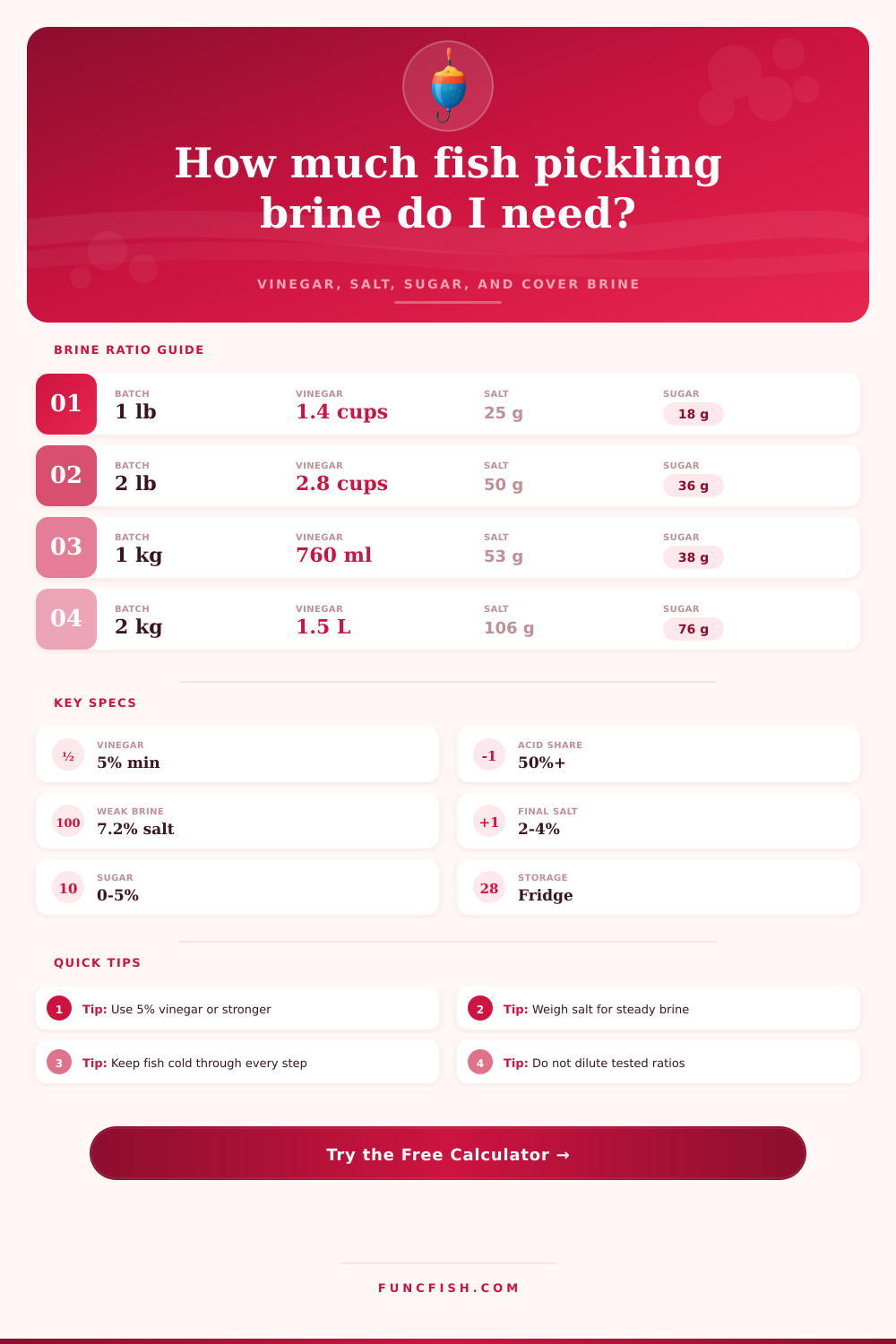
Calculate refrigerated fish pickling brine by weight, jar volume, vinegar strength, salt percentage, sugar percentage, and presoak requirements.
📌Batch presets
⚙Brine settings
Brine calculation
Full formula breakdown
📋Ingredient reference grid
5% Vinegar
Weak Presoak
Final Salt
Sugar
📐Formula reference tables
| Fish type | Density used | Brine multiplier | Suggested path |
|---|---|---|---|
| Lean white fish | 1.05 g/ml | 0.52 x fish volume | Final cover or presoak |
| Herring or smelt | 1.03 g/ml | 0.58 x fish volume | Weak presoak plus final brine |
| Northern pike | 1.05 g/ml | 0.62 x fish volume | Weak presoak plus final brine |
| Salmon or trout | 1.00 g/ml | 0.66 x fish volume | Oily fish stronger brine |
| Mackerel or sardine | 0.99 g/ml | 0.70 x fish volume | Firm salt cure plus final brine |
| Cooked flaked fish | 0.82 g/ml | 0.75 x fish volume | Cooked fish quick pickle |
| Vinegar share | With 5% vinegar | With 6% vinegar | Calculator status |
|---|---|---|---|
| 50% | 2.5% acid | 3.0% acid | Minimum reference line |
| 60% | 3.0% acid | 3.6% acid | Standard refrigerator brine |
| 70% | 3.5% acid | 4.2% acid | Sharper, firmer brine |
| 100% | 5.0% acid | 6.0% acid | No added water |
| Salt reference | Metric formula | US estimate | Use in calculator |
|---|---|---|---|
| Weak presoak | 72 g per L | 1 cup per gal | Presoak salt field |
| 2% final brine | 20 g per L | 1.1 tbsp per qt | Mild final salt |
| 3.5% final brine | 35 g per L | 1.9 tbsp per qt | Standard final salt |
| 4.5% final brine | 45 g per L | 2.4 tbsp per qt | Firm final salt |
💡Calculation checks
Reference: This calculator assumes refrigerated pickled fish and known-strength vinegar. It calculates ingredient quantities; it does not convert a recipe into a shelf-stable canning process.
Measurement: Weigh pickling salt when possible. Cup and tablespoon estimates are included for scaling, but salt crystal size changes volume measurements.
Making pickled fishes requires you to make a balance liquid brine. The balance of the brine is important for two reasons: the brine will affect the texture of the fish, and the brine will affect the shelf life of the fishes. For instance, if too little salts is used in the brine, the texture of the resulting pickled fish will tend to be soft.
If too many vinegar is used in the brine, the resulting pickled fish will have a taste that is more sharp. Because refrigerated pickled fish do not undergo heat processing, the ratio of ingredients that go into the brine need to be exact to ensure the safety of the fish. The type of fish that you use will have an impact upon the amount of liquid that must be used in the pickling process.
How to Make the Right Brine for Pickled Fish
Lean white fish fillets tend to pack together more tight than oily fish fillets, so there is less space within the fillets for brine to reside. Oily fish will release fat into the brine, which may potentialy weaken the acidity of the brine over time. These variables indicates a need for a salt presoak prior to covering the fish with brine.
A salt presoak helps to draw out moisture from the fish fillets, and firms the flesh of the fish without adding acid to the fish. Using a calculator will allow you to determine the amount of each ingredient to use in the brine, and the calculator will account for the oil content of the fish and the density of the fish in the jar. The thickness of the fish pieces is another variable to consider in the preparation of pickled fish.
The thicker the pieces of fish, the longer the curing process will have to occur. For instance, thinner pieces of herring will require a shorter curing process than thick slab of pike. If you season the thick pieces of fish too early in the curing process, the center of the fish will not be seasoned proper, while the outer parts may be properly seasoned.
Additionally, the thickness of the fish pieces also impacts the amount of liquid that will be trapped within the fish after performing the salt presoak. In addition to the measurements for the liquid brine, another requirement for pickled fish is the acidity level of the vinegar that will be used. The vinegar must have at least five percent acidity.
Using vinegar with less than five percent acidity will make the brine too weak to provide adequate shelf life for refrigerated pickled fish. A tool can help to determine the share of the vinegar that will be used in the brine. For instance, increasing the share of vinegar will make the flavor of the pickled fish more sharper, and will allow the fish to firm up faster.
However, an increased share of vinegar will also make the taste of the fish more aggressive. Decreasing the share of vinegar will make the taste of the pickled fish less sharp. Decreasing the share of vinegar also allows for the use of more liquid to perform the pickling process.
Decreasing the share of vinegar is useful for fish recipes that already contain salts. Both salt and sugar must be used in specific percentages in the preparation of pickled fish. For instance, the brine that covers the fish must contain between two and four percent salt.
This percentage of salt is enough to season the fish, but not too much that the fish will be too salty. If using a salt presoak, the percentage of salt should be approximately seven percent. Salt presoaks only take place for a short period of time, so the salt percentage must be higher than the percentage used in covering the fish with brine.
Sugar is also used in the brine for pickled fish. The sugar helps to round off the sharpness of the flavor of the acid in the brine, and helps to keep the texture of the fish supple. However, care must be taken to not use too much sugar in the brine.
If you use too much sugar in the brine, the fish will become sweet cured fish instead of pickled fish. Once you have determined the amount of each ingredient that will be used in the fish pickling process, the calculator will provide information regarding the exact volumes and weight of each ingredient. The calculator will also indicate whether or not the jars that you have selected are large enough to contain the fish and the amount of brine that will cover the fish.
This information prevents you from selecting a jar that will become too full of the pickled fish. Additionally, it is necessary to ensure that there is enough liquid to cover each piece of fish. If there is not enough liquid to cover the pieces of fish, those pieces of fish will discolor and dry out in the refrigerator.
Another consideration in the preparation of pickled fish is whether to reuse the same liquid brine for different batches of fish. Each time fish is prepared with a brine, the fish change the salt and acid levels in the brine. Additionally, the proteins and oils from the fish get into the brine.
Because of the oil and protein content of the fish, the shelf life of the brine shortens each time it is used in preparing fish. Therefore, fresh brine should always be used in preparing pickled fish. Another requirement in the preparation of pickled fish is that the process be maintained at controlled temperatures.
For instance, you should always keep the raw fish cold until it is placed into the jar. The brine should also be chilled before you pour it onto the fish. Additionally, the jars that contain the pickled fish should be stored on the coldest shelf of the refrigerator.
Small changes in temperature will kill the bacteria that helps to preserve the fish, so if the kitchen is warm, small batches of pickled fish should be made more often. By following the measurements and ratios indicated by the calculator, the fish will eventually finish curing, and will be cured to have a balanced taste and a clean smell.