Spawn Timing by Water Temp Calculator
Estimate pre-spawn, active spawn, peak timing, and confidence from current water temperature, recent trend, depth, clarity, and species-specific temperature windows.
📌Scenario presets
⚙Temperature settings
Spawn timing forecast
Full breakdown
📋Temperature signal grid
Largemouth
Smallmouth
Crappie
Walleye
📊Species water-temperature reference
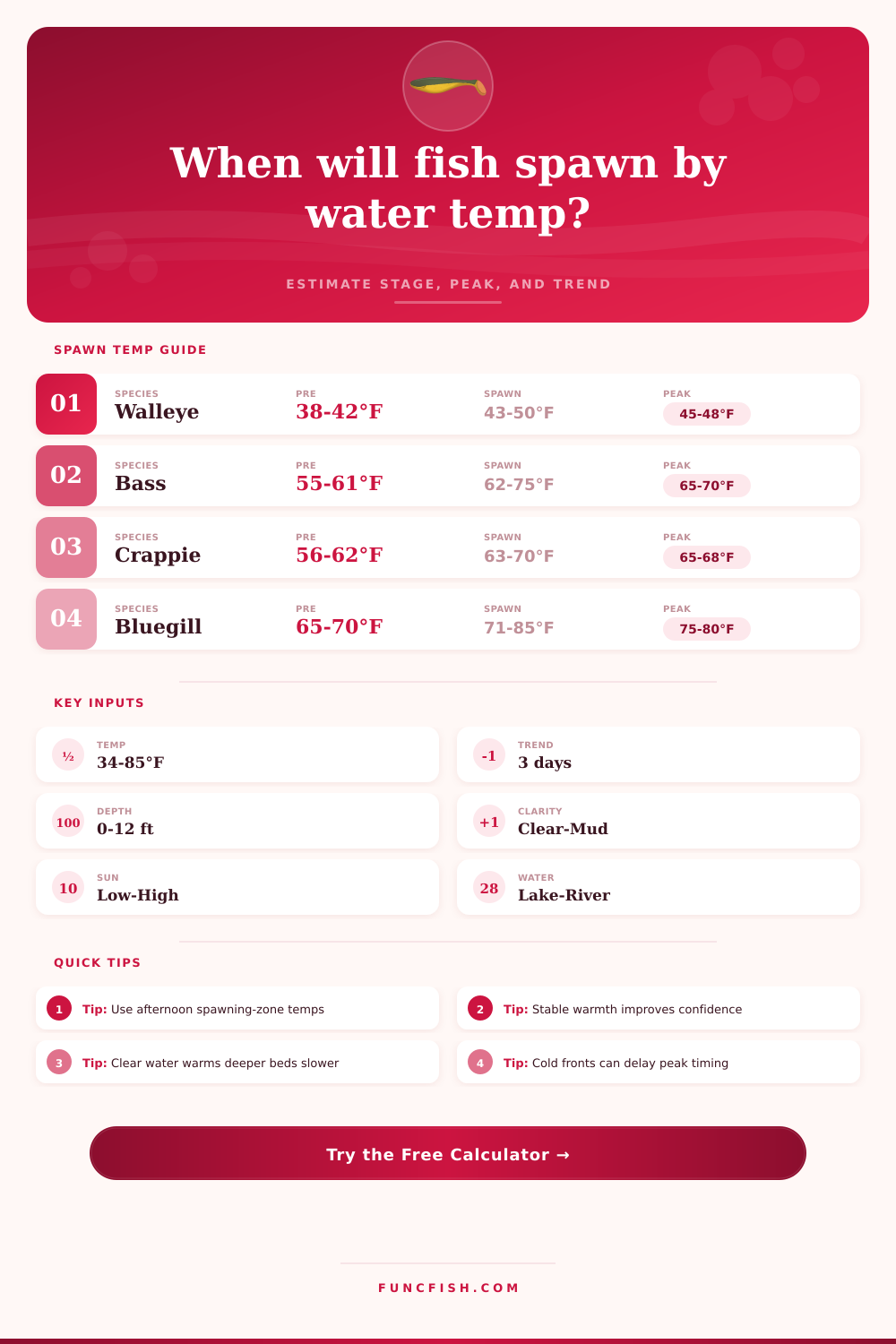
| Species | Pre-spawn trigger | Active spawn range | Peak thermal window | Common spawning-zone depth |
|---|---|---|---|---|
| Largemouth bass | 55-61°F / 12.8-16.1°C | 62-75°F / 16.7-23.9°C | 65-70°F / 18.3-21.1°C | 1-6 ft / 0.3-1.8 m |
| Smallmouth bass | 50-57°F / 10.0-13.9°C | 58-68°F / 14.4-20.0°C | 60-65°F / 15.6-18.3°C | 3-12 ft / 0.9-3.7 m |
| Crappie | 56-62°F / 13.3-16.7°C | 63-70°F / 17.2-21.1°C | 65-68°F / 18.3-20.0°C | 1-8 ft / 0.3-2.4 m |
| Bluegill | 65-70°F / 18.3-21.1°C | 71-85°F / 21.7-29.4°C | 75-80°F / 23.9-26.7°C | 1-5 ft / 0.3-1.5 m |
| Walleye | 38-42°F / 3.3-5.6°C | 43-50°F / 6.1-10.0°C | 45-48°F / 7.2-8.9°C | 1-10 ft / 0.3-3.0 m |
| Northern pike | 34-39°F / 1.1-3.9°C | 40-48°F / 4.4-8.9°C | 41-45°F / 5.0-7.2°C | 1-4 ft / 0.3-1.2 m |
| Channel catfish | 66-70°F / 18.9-21.1°C | 71-80°F / 21.7-26.7°C | 74-78°F / 23.3-25.6°C | 2-8 ft / 0.6-2.4 m |
| Rainbow trout | 42-47°F / 5.6-8.3°C | 48-55°F / 8.9-12.8°C | 50-53°F / 10.0-11.7°C | 1-3 ft / 0.3-0.9 m |
| Water condition | Thermal effect | Timing effect | Confidence effect |
|---|---|---|---|
| Protected full-sun pocket | Warms 1-3°F faster | Peak can arrive early | Higher if stable |
| Deep clear lake | Surface reads warmer than bed | Peak often lags | Lower if measured shallow |
| River current | Temps mix quickly | Shorter stable windows | Needs repeated readings |
| Muddy inflow | May warm shallow edges | Can jump suddenly | Lower after fronts |
| Falling water | Shallows can cool or dry | Peak can pause | Penalty applied |
💡Calculation checks
Tip: Take readings where fish can actually spawn. Surface temperatures over deep water can run several degrees warmer than a gravel flat, shaded pocket, or current seam.
Tip: A single warm afternoon can trigger movement, but the calculator gives more confidence when the lower spawn threshold has held for multiple stable days.
Timing a spawn run require an understanding of water temperature. Understanding water temperature require an understanding that water temperature is not a number. Fish do not respond to specific date on the calendar, but instead do respond to the warmth of the water in the areas where the fish plan to lay their egg.
Water temperature changes with depth in the area to be fished, water temperature changes with the shade of the area to be fished, water temperature changes with the flow of water in the area to be fished, and water temperature changes with the weather for the past three days. For instance, the water in a shallow area may warm up during a sunny afternoon, but the deeper water of a lake may not warm up to the same extent during that same sunny afternoon. Therefore, fish may be spotted in some area of a lake while other angler may not be finding any fish in other parts of the same lake run.
How to Use Water Temperature to Time Fish Spawning
Many angler make the mistake of measuring the temperature of the water in only a single spot in a lake, and then assuming that the remainder of the lake have the same water temperature. This assumption is incorrect for various reason. For instance, lakes have depth, and the temperature at the surface may be warm but does not reach the depth of the spawning bed.
Secondly, lakes may contain stained backwater that warm up to warmer temperature faster than the temperature measurement would indicate for those areas. Thirdly, rivers have water movement that evenes out the temperature every few hours. Each of these variable change the amount of time that the fish spend in the spawning area.
There is a tool that can help adjust the raw temperature measurement for each of the four listed variable. While this tool is not a replacement for the angler eyes on the water, it will help to remove the errors that can make angler believe that the water temperature are the same throughout a lake. Each of the variable for the tool is important for these same reason as listed above.
For instance, depth is one of the most important variable because it will determine if the temperature that is taken from the surface of the water is the same as the temperature of the spawning bed. Clarity will have an impact on how much sunlight enter the water, sun exposure and wind will impact if a small area of water can retain the warmth of the sun, and the three-day temperature trend will help to determine if the water is building towards its peak temperature or if it has stalled. Another factor that many angler tend to ignore is the stability of the water temperature.
A given species of fish may be within the proper temperature range for spawning, but if the water has only been warm for one afternoon, the fish may not begin to spawn. Each of the fish species require a few days of warm temperature prior to the fish beginning to stage and bed themself. The calculator include a function that accounts for this need for stable temperature.
This feature prevent the application of the tools of this calculation to lead angler to think that because the water temperature is within the proper range for that species, spawning has begun. In order to understand when the fish will reach their peak spawning period, you will want to use the reference table provide within the calculation tools. You do not have to memorize the temperature band for each of the species, but using the reference table will help to ensure that you are not guess at where the fish are in relation to their spawning cycle.
Once you have determine the temperature band for the species of fish that you are attempting to locate, you can easily understand in how many day the fish will reach their peak spawning period. For instance, if the calculation determine that the fish are three days from their peak spawning period, the fish are moving into the spawning area but have not yet reached the temperature required to initiate heavy spawning behavior. If the calculation states that the fish are past their peak spawning period, you should be looking for post-spawn behavior instead of spawning area.
Though there are variable in each lake that cannot be accounted for by any calculation, there are several example of the ways in which the temperature in lakes can change. For instance, rain can move the stained water from one part of the lake to another part of the lake with clear water. These changes in water temperature can change the outcome of calculation.
However, it does not make the tool useless; rather, it makes it important for angler to read the calculation and understand the condition of the lake in order to make adjustment to their fishing effort. By using the calculation tool as a means of determining when the fish are about to reach their peak spawning period, there will be fewer instance of angler making wasted trip to the spawning area. By taking temperature reading within the actual spawning zone rather than in the deep part of the lake, angler can ensure that they are focusing their effort on the area where the fish are actualy present.
Furthermore, by noting whether the temperature has been increase over the past three days, angler will have an understanding of whether the fish are still within their spawning period. By comparing the calculated temperature to the band of water temperature for the species of fish, angler will have an understanding of why the fish are present in one area of the lake rather than in another. Thus, the overall purpose of the calculation tool is to provide angler with an estimate of the spawning period of the fish in their area of interest.