Fishing Reel Retrieve Rate Calculator
Estimate retrieve per turn, real pickup speed, cranks to recover a cast, and cadence match from gear ratio, filled spool size, line type, lure pull, and handle rhythm.
📌Scenario presets
⚙Retrieve settings
Retrieve rate forecast
Full breakdown
📋Reel class reference grid
1000 Spin
2500 Spin
Baitcaster
Surf Spin
📐Retrieve and cadence tables
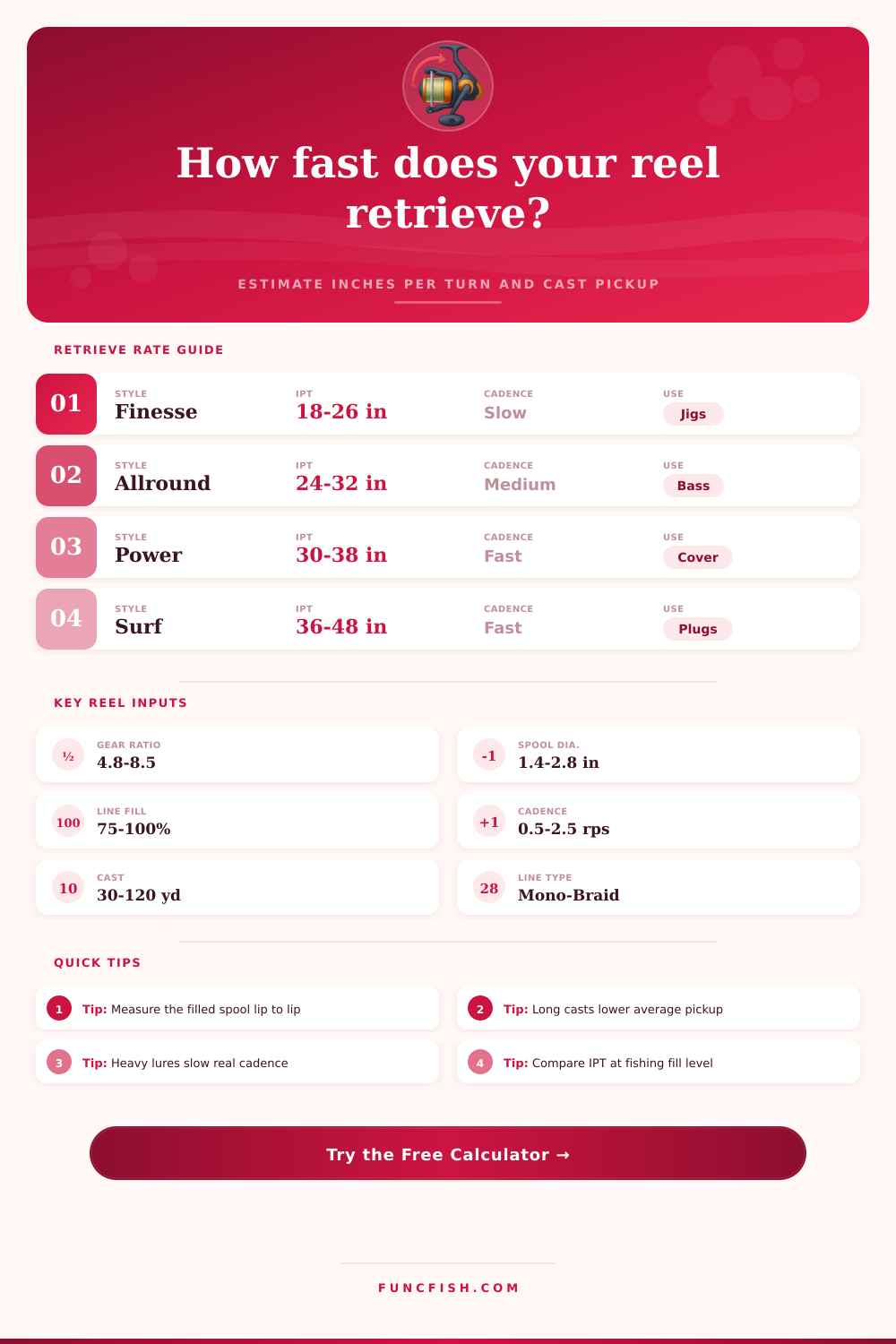
| Technique | Target IPT | Turns / sec | Best reel profile |
|---|---|---|---|
| Finesse bottom contact | 18-26 in / 46-66 cm | 0.5-1.0 | Medium spool, controlled pickup |
| Moving bait retrieve | 24-32 in / 61-81 cm | 0.9-1.5 | Balanced all-round ratio |
| High-speed reaction bait | 30-38 in / 76-97 cm | 1.4-2.2 | Fast gear or large spool |
| Surf casting and plugs | 36-48 in / 91-122 cm | 0.9-1.6 | Large spool with steady torque |
| Trolling pickup | 28-42 in / 71-107 cm | 0.6-1.2 | High capacity conventional |
| Float control | 12-24 in / 30-61 cm | 0.4-0.9 | Large arbor, light tension |
| Line type | Diameter sample | Spool drop effect | Retrieve note |
|---|---|---|---|
| 8 lb monofilament | 0.011 in / 0.28 mm | Moderate | Forgiving stretch, steady pickup |
| 12 lb monofilament | 0.014 in / 0.36 mm | High | Diameter changes spool faster |
| 17 lb fluorocarbon | 0.016 in / 0.41 mm | High | Stiffer line can reduce cadence |
| 10 lb braid | 0.006 in / 0.15 mm | Low | Thin line keeps pickup consistent |
| 30 lb braid | 0.011 in / 0.28 mm | Moderate | Good power without huge diameter |
| 50 lb braid | 0.014 in / 0.36 mm | High | Cover line with faster spool change |
| Reel class | Ratio range | Average IPT | Common match |
|---|---|---|---|
| 1000 spinning | 5.0-6.2:1 | 18-25 in / 46-64 cm | Trout, panfish, finesse jigs |
| 2500 spinning | 5.2-6.4:1 | 26-34 in / 66-86 cm | Bass, walleye, inshore light |
| Low-profile baitcaster | 6.3-8.5:1 | 24-36 in / 61-91 cm | Jigs, frogs, reaction baits |
| Surf spinning | 4.8-6.2:1 | 35-48 in / 89-122 cm | Long casts and plug control |
| Offshore conventional | 4.1-6.2:1 | 30-44 in / 76-112 cm | Trolling pickup and deep water |
| Centerpin / float | 1.0-1.0:1 | 12-22 in / 30-56 cm | Float drift correction |
💡Practical checks
Tip: A reel's advertised inches per turn is normally measured on a full spool. If you fish at 80 percent fill, actual pickup can be meaningfully lower.
Tip: Long casts reduce average retrieve because the spool starts smaller while line is out. Compare the cranks-to-recover result, not only the full-spool number.
The retrieve rate is the amount of lines that a person will pick up with each turn of the handle of their fishing reel. The retrieve rate for a fishing reel is actualy a vary number; the retrieve rate will change as the line that is cast out of the reel continue to leave the spool. As the line leaves the spool, the diameter of that spool will decrease, and a small diameter for the spool will lead to a lower retrieve rate for the line.
In order to purchase the correct fishing equipment for a fishing technique, a person must understand how each of these factors impact the retrieve rate of the line. The gear ratio for a fishing reel will impact the retrieve rate for the line. Specificly, the gear ratio will impact the number of times that the spool rotates for each turn of the handle of the fishing reel.
How Fishing Reel Retrieve Rate Works
A higher gear ratio will result in the spool rotating a higher rate for each turn of the handle. However, a high gear ratio will only provide a high retrieve rate if the diameter of the spool is also large enough to move a significant amount of line. Additionally, the diameter of the fishing line will also impact the retrieve rate.
Lines that is thick will create a large diameter for the spool, while thin lines will create a small diameter for the spool. Thin lines, like braided fishing line, will maintain the same diameter for the spool as the line is used. Thick lines, like monofilament fishing line, will lead to a decrease in the diameter of the spool, which will lead to a decrease in the retrieve rate for that line.
The cadence at which a person turns their fishing reel will impact the retrieve rate. Cadence is the rate at which a person turns their fishing reel’s handle. A person may turn their handle quick when they have a full spool of line, but may turn their handle at a slower rate when they have a nearly empty spool of line.
Additionally, the weight of the lure that is being used will also impact the cadence at which a person turns their fishing reel. A heavy lure will create resistance against the persons handle. This will slow the cadence at which the person turns their handle, which will impact the retrieve rate.
Cadence must be matched to the requirement of the fishing technique that is to be utilized. For instance, bottom contact fishing will require one retrieve rate, while reaction bait fishing will require a different retrieve rate for the line to effectively attract fish. The distance at which a person casts their line will impact the average retrieve rate for the line.
For instance, if a person casts their line a long distance from where they are standing, a large amount of line will leave the spool of their fishing reel. In this instance, the spool will start with a large diameter and end with a small diameter. Therefore, the retrieve rate will not be the same throughout the entire process of fishing with that line.
A person can calculate the average retrieve rate by inputting information about the gear ratio of the fishing reel, the spool diameter, the amount of line on the spool, and the cadence at which the line will be fished. The fishing retrieve rate calculator will provide an average retrieve rate for the line that is being use. An accurate average retrieve rate will allow a person to properly crank their fishing reel without over-perform or under-perform their fishing efforts.
Different type of fishing line will create different retrieve rates for the line. For instance, braided fishing line has a thin diameter, so it will maintain the same retrieve rate. Lines like monofilament and fluorocarbon have a thicker diameter than braided line, and will create a faster decrease in retrieve rate as the line is fished.
Additionally, because monofilament and fluorocarbon lines have more stretch than braided line, the retrieve rate also may change with these lines. Each of these difference is not a defect of the line, but comes with tradeoffs in the performance of the line. The baseline retrieve rate can be adjusted according to the information provided by the calculator.
For instance, if the retrieve rate is found to be too low for the requirements of the fishing technique, a person can decrease the diameter of the fishing line, or increase the amount of line that is on the spool. If the retrieve rate is too high for that fishing technique, a person can use a fishing reel with a lower gear ratio, or a person can utilize a thicker fishing line. By calculating the retrieve rate of a fishing line and reel prior to go fishing, a person can ensure that the line and reel will meet the requirements of the fishing technique.
They should of checked this before headin out.