Fishing Reel Max Drag to Line Test Calculator
Set reel drag from line test, knot retention, leader strength, reel rating, cover, and fishing style so the weakest link stays protected.
📌Scenario presets
⚙Drag and line settings
Drag setting forecast
Full breakdown
📋Line and drag reference grid
Mono
Fluoro
Braid
Wire
📐Reference tables
| Line or leader | Typical knot retention | Strike drag start | Safe max ceiling |
|---|---|---|---|
| Monofilament main line | 80-90% | 26-30% of weak link | 38-45% of weak link |
| Fluorocarbon main line | 75-85% | 24-28% of weak link | 35-42% of weak link |
| 4-carrier braid | 65-78% | 22-26% of weak link | 32-38% of weak link |
| 8-carrier braid | 70-85% | 23-27% of weak link | 34-40% of weak link |
| Wire leader | 88-95% | 20-24% of weak link | 30-36% of weak link |
| Fly tippet | 70-90% | 18-24% of tippet | 28-35% of tippet |
| Fishing scenario | Typical line test | Working drag | Adjustment note |
|---|---|---|---|
| Trout stream | 2-6 lb / 0.9-2.7 kg | 18-24% | Protect light tippet |
| Bass spinning | 6-12 lb / 2.7-5.4 kg | 24-30% | Rod absorbs surges |
| Walleye jigging | 8-12 lb / 3.6-5.4 kg | 24-28% | Moderate hooks and mouths |
| Catfish bottom | 15-30 lb / 6.8-13.6 kg | 28-35% | Use stronger terminal knots |
| Surf casting | 20-50 lb / 9.1-22.7 kg | 22-30% | Account for shock leader |
| Offshore trolling | 30-80 lb / 13.6-36.3 kg | 25-33% | Check at strike position |
| Rod power | Usual line range | Drag feel | Calculator effect |
|---|---|---|---|
| Ultralight | 2-6 lb / 0.9-2.7 kg | Very soft | Caps strike drag lower |
| Light | 4-8 lb / 1.8-3.6 kg | Soft | Small safety reduction |
| Medium-light | 6-12 lb / 2.7-5.4 kg | Moderate | Balanced setting |
| Medium | 8-17 lb / 3.6-7.7 kg | Versatile | Balanced setting |
| Medium-heavy | 12-25 lb / 5.4-11.3 kg | Firm | Allows slight increase |
| Heavy | 20-50 lb / 9.1-22.7 kg | Strong | Supports heavier drag |
| Extra-heavy | 40-100 lb / 18.1-45.4 kg | Very strong | Still limited by knots |
💡Practical checks
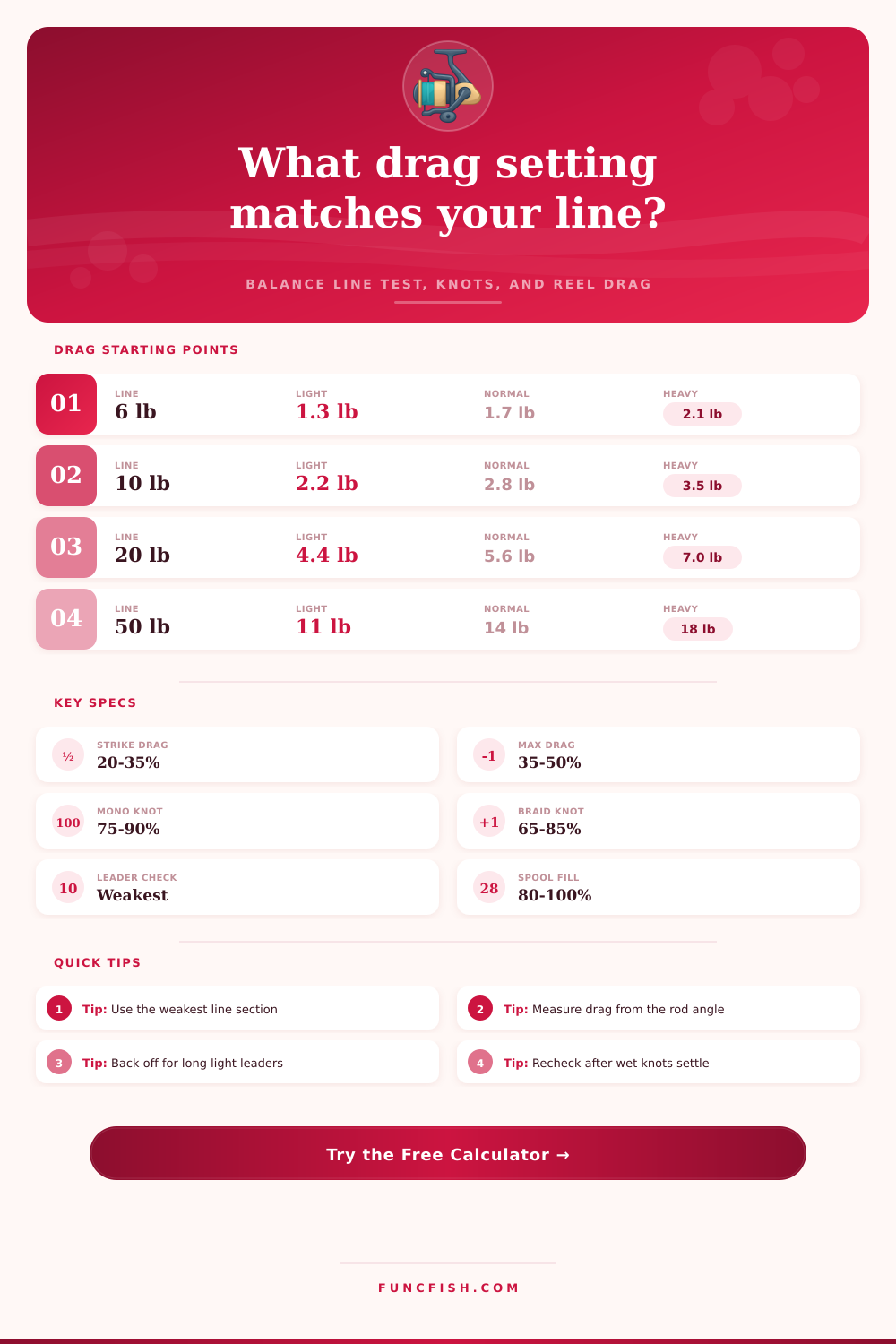
Tip: Set drag with the line running through the rod guides at a fishing angle. A straight pull from the reel can read lower than the load the line sees on the water.
Tip: If the leader is lighter than the main line, treat the leader and its knot as the real line test for drag math.
Setting the drag on a fishing reel is an important task to perform before going fishing. The drag setting will determine how much tension the fishing line will experience when the fish begin to pull on the line. If the drag setting is too high, the fishing line will break or the knot will fail.
If the drag setting is too low, the fish will pull the line into structure or obstacle. A drag calculator will help a person to find the correct drag setting for its fishing line and other fishing components by utilizing several different variable. The drag calculator will take into account the strength of the fishing line, the strength of the knots on the line, and the type of fishing rod that the angler will use to cast the line.
Use a Drag Calculator to Set Your Reel Drag
To determine the drag setting for a fishing system, the drag calculator will require the person to input several different variables into the drag calculator to arrive at the correct drag setting. For instance, the person will need to input the main line type and test weight, as will the type of knot that will be utilized on the line and the type of material for the fishing line leader. These two components are the weakest part of the fishing line.
The drag calculator will also ask for the type of cover in which the fish will be caught, as well as the power of the fishing rod. Each of these variable will affect the drag setting for the fishing line. Other variables that can be input include the percentage in which the fishing line will be filled into the reel, as well as the condition of the reel’s washers.
Each of these factor will change the drag setting accordingly. The drag calculator will provide two drag number for the fishing system. The first of these drag numbers is the strike drag, which indicates the amount of tension that should be set on the fishing line prior to the fish begins to pull on the line.
The other drag setting will be the safe max drag, which is the maximum amount of tension that the fishing line can take while the rod is bent while fishing. The safe max drag will be a higher number than the strike drag setting, but the line and the knots will be able to handle the max drag that is indicated. This drag setting allows for the possible surges in tension that a fish may create while on the fishing line.
The drag calculator will include reference tables for line types, fishing weights, and other factors. For instance, monofilament lines will have more stretch than braided lines, thus creating different percentages of drag for each of these different type of lines. Additionally, the drag calculator will indicate the drag settings for lines with fly tippets and light leaders, since those are the limiting factor for fishing lines with these components.
The drag settings for different covers of the ground and rods of different power will also be indicated in these tables. For instance, an ultralight fishing rod will be unable to transmit as much force as a heavy fishing rod. One of the mistake that many anglers make is using the drag setting to adjust the tension of the line based off the feeling of the line when the line is running straight off the fishing reel.
However, the tension that feels light when the line is straight off the reel may be much heavier when the line is passing through the guides of the fishing reel. In this case, it is recommended to use the drag calculator to determine the drag setting for the entire fishing system, rather than just the fishing reel. Additionally, the angler should evaluate each of the components of the fishing line to determine the weakest link.
The drag should be adjusted to accommodate for this weakest link. Another of the mistake that many anglers make is leaving the drag setting on the reel at the same setting after the initial knot on the fishing line becomes wet and loaded with tension with the fish. Knots may settle with the fish, and the strength of the knot may decrease after the fight between the fish and the fishing line.
Therefore, the angler should check the drag setting again after the initial catch by the fish to ensure that the drag setting is still appropriate for the fishing line. The advertised maximum drag for the fishing reel is a number that should not be used as the drag setting for the fishing line. The strength of the washers within the fishing reel may decrease with use, the heat build-up within the reel may increase, and the initial friction created when the reel begins to spin at startup will create increases in the tension in the line.
Thus, the drag calculator will adjust the advertised drag for the fishing reel to ensure that the drag setting is within the range that the line and knots can take. Additionally, the advertised drag will be reduced to account for these factor. The drag calculator will also allow the angler to adjust for a safety margin in the drag setting.
For instance, if the fishing line features a light leader or the fish will be caught in heavy cover, a conservative margin of safety should be selected for the drag setting. However, for fresh knots and open water, an aggressive safety margin can be set. This safety margin is not used to encourage anglers to adjust the drag setting to catch more fish.
Rather, the safety margin is used to ensure that the drag setting is adjusted to the different conditions of the fishing environment. Finally, the drag calculator will provide two different drag settings. However, these drag settings should only be used as a starting point.
The angler should test the line when setting the drag for the fish, and a quick test pull should be made to ensure the drag setting is correct. If the fish is particularly strong, the angler can tighten the drag knob to release the tension within the line. Otherwise, the drag setting will help anglers to focus their attention on the fishing line and the fish instead of the mathematical calculation of the drag setting.
You’ll find that the drag calculator makes the process much more simpley. One should of used this sooner to avoid breakin the line. If you’re looking for a more reliabel way, then this is it.
You’ll recieve better results with the modern way of doing things.