Weighted Hook Fall Rate Calculator
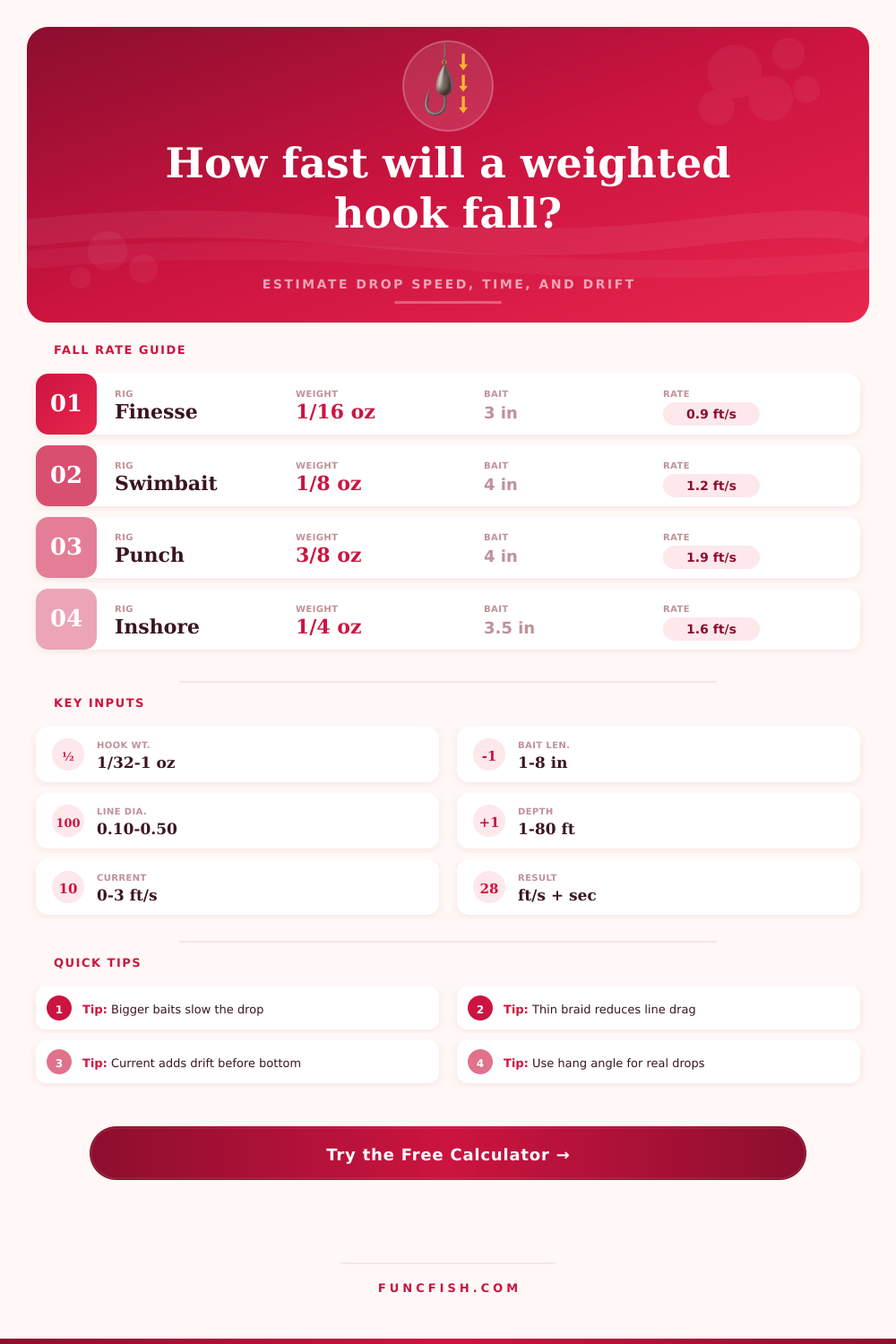
Estimate how quickly a weighted hook and soft bait will sink by combining weight, bait drag, line diameter, water depth, current, and rig posture.
📌Scenario presets
⚙Fall rate settings
Weighted hook fall forecast
Full breakdown
📋Weight and drag reference grid
1/16 oz finesse
Good for shallow docks, clear water, and slow flutter presentations.
1/8 oz utility
Balanced starting point for countdown swimbaits and light cover.
1/4 oz search
Useful when depth, current, or wind makes a light rig wander.
3/8 oz power
Fast drop through grass edges, brush gaps, and deeper targets.
📏Fall rate reference tables
| Weighted hook | Mass | Typical fall | Common use |
|---|---|---|---|
| 1/32 oz | 0.89 g | 0.45-0.75 ft/s | Micro bait, shallow trout |
| 1/16 oz | 1.77 g | 0.65-1.05 ft/s | Finesse bass, small swimbait |
| 3/32 oz | 2.66 g | 0.80-1.20 ft/s | Ned rig, light countdown |
| 1/8 oz | 3.54 g | 0.95-1.45 ft/s | General weighted hook |
| 3/16 oz | 5.32 g | 1.15-1.70 ft/s | Deeper docks and edges |
| 1/4 oz | 7.09 g | 1.30-1.95 ft/s | Current and open water |
| 3/8 oz | 10.63 g | 1.55-2.35 ft/s | Grass, brush, faster drops |
| 1/2 oz | 14.17 g | 1.75-2.70 ft/s | Deep targets and heavy cover |
| Bait profile | Drag effect | Area factor | Fall behavior |
|---|---|---|---|
| Stick worm | High | 1.35 | Slow shimmy, broad side |
| Ned / TRD | Moderate | 1.05 | Compact glide |
| Paddle tail | Moderate high | 1.20 | Tail pulse slows drop |
| Soft jerkbait | High | 1.40 | Side slip and dart |
| Craw trailer | High | 1.55 | Appendages parachute |
| Tube bait | Moderate | 1.15 | Spiral when unbalanced |
| Grub tail | Moderate | 1.10 | Tail flutter |
| Creature bait | Very high | 1.75 | Slowest bulky profile |
| Line type | Density note | Drag index | Fall tendency |
|---|---|---|---|
| 8-strand braid | Floats | 0.86 | Thin, least drag |
| 4-strand braid | Floats | 0.96 | Rougher surface |
| Monofilament | Near neutral | 1.08 | More bow and stretch |
| Fluorocarbon | Sinks | 1.02 | Straighter path |
| Copolymer | Near neutral | 1.04 | Middle response |
| Wire trace | Sinks | 1.25 | Heavy but high drag |
🎯Species and presentation match
| Target | Starting weight | Useful fall rate | Depth window |
|---|---|---|---|
| Clear-water bass | 1/16-1/8 oz | 0.7-1.3 ft/s | 3-15 ft |
| Grass-edge bass | 3/16-3/8 oz | 1.2-2.2 ft/s | 4-20 ft |
| River walleye | 1/8-1/4 oz | 1.0-1.8 ft/s | 6-25 ft |
| Speckled trout | 1/16-3/16 oz | 0.7-1.5 ft/s | 2-12 ft |
| Inshore redfish | 1/8-1/4 oz | 1.1-1.8 ft/s | 2-10 ft |
| Deep smallmouth | 3/16-3/8 oz | 1.3-2.1 ft/s | 15-35 ft |
💡Practical checks
Tip: Treat the result as a controlled estimate, then tune it on the water with a countdown beside the boat or bank. Bulky plastic, wind bow, and slack line can slow the real fall.
Tip: If the hook reaches bottom too far down-current, increase weight, lower the rod tip, or switch to thinner line before changing the whole presentation.
A weighted hook do not simply sink through the water to the target depth. In order for a weighted hook to reach the desired depth, it must overcome the resistance of the water itself. The resistance of the water are created by the mass of the weighted hook, the resistance created by the bait, and the resistance created by the fishing line.
If the mass of the weighted hook isnt sufficient to overcome the resistance of the water, the weighted hook will drift past the target area. The various forces acting upon the weighted hook include the angle of the line, the current of the water, and the shape of the soft plastic bait. Understanding how the weighted hook will move in the water will help the angler to effectively use the weighted hook.
How a Weighted Hook Sinks
The weight of the hook is one of the most important factors in determining the sinking rate of the weighted hook. The heavier the head of the hook, the more fast that the weighted hook will sink to the sea floor. However, the increased weight of the hook head will only have a positive effect on the sinking rate of the weighted hook if the bait and the fishing line dont create too much resistance.
Using the calculator that is included in this article allow the angler to input the size of the hook, the profile of the bait, and the diameter of the fishing line for the weighted hook. A 1/8 ounce hook head will allow for the soft plastic bait to move more natural through the water than a 3/8 ounce hook head because the 3/8 ounce hook head will punch through grass and current more effectively. The shape of the bait will also impact the sinking rate of the weighted hook.
The shape of the bait will impact the amount of resistance that the bait creates in the water. For example, if the bait is in the form of a stick worm, the side of the bait will present itself to the water and slow the fall of the weighted hook that contains the bait. A compact bait such as ned-style will move more easy through the water.
The posture of the bait will also impact the sinking rate of the weighted hook. If the bait is presented in a nose-down posture, it will feel as if the weighted hook is moving quick along the path that it is traveling. Using a horizontal or wacky posture for the weighted hook will create more surface area for the bait to fight against the water.
The more surface area that fights against the movement of the weighted hook, the longer that it will take for the weighted hook to reach the target depth. The calculator considers the different postures of the bait and adjusts for the changing rate at which the weighted hook will sink. Changing the posture of the weighted hook doesnt require a change in the weight of the hook.
The diameter of the fishing line will also impact the sinking rate of the weighted hook. Using a thicker fishing line will impact the sinking rate of the weighted hook. A thicker fishing line will increase the chance of a belly in the fishing line.
Braided fishing line will remain straighter in the water than fishing line that is made of monofilament. Because braid line will remain straighter in the water, the sinking rate of the weighted hook can be more easily read. Monofilament will stretch and bow in the water.
Because monofilament will stretch and bow in the water, it will add more time for the weighted hook to settle on the sea floor. The calculator is also able to consider different types of fishing line. To use the line type selector to change the type of fishing line that will be used for the weighted hook.
The current of the water and the angle of the fishing line will also impact the movement of the weighted hook. Even a modest current in the water may push the bait several feet downstream before the bait can reach the sea floor. This will occur especially with a high rod tip.
To reduce the sweep of the weighted hook in the water, either increase the angle of the fishing line or the weight of the head of the weighted hook. However, changing the angle of the fishing line or changing the weight of the weighted hook will also change the movement of the bait once the bait reaches the target. The calculator will show the result of the current of the water and the angle of the fishing line to help the angler decide whether to use a heavier hook or to change the type of fishing line and rod tip.
The type of fish that is being targeted and the cover in which the fish live will also impact the weight of the weighted hook. In water that is clear and with shallow rocks, the weighted hook may encounter more strikes when the bait moves slowly through the water. In areas with grass or deep brush, the bait should fall at a quicker rate to ensure that it does not get hung up on plants before it can reach the fish.
The reference tables will provide the weight of the weighted hooks that are typically used for different types of fish or bait. These tables are merely starting points for the angler to decide on the weight of the weighted hook. The actual current, wind, and even the type of bait will change the exact numbers that is used for the weighted hook.
The numbers that are calculated will be the starting point for the angler. To confirm the calculated sinking rate for the weighted hook, simply perform a countdown to the estimated time that the weighted hook will reach the sea floor. To perform this countdown, simply position the weighted hook next to the boat or along the bank of the body of water.
If the weighted hook reaches the sea floor either sooner or later than estimated, it is due to one of three factors. Either the line bows more than accounted for in the calculated sinking rate, the bait is bulkier than accounted for in the calculation, or the bait change its posture once it entered the water. Only adjust one of these factors at a time.
With experience with the weighted hook and the bait that is being used, the angler will find certain combinations of weight and bait that allow the weighted hook to reach the sea floor at a certain rate. Through experience, the angler will have more control over the sinking rate of the weighted hook.