Alabama Rig Wire Length Calculator
Calculate cut length for Alabama rig arms, center lead, nose twist, terminal loops, bend allowance, finished spread, and total frame wire from actual umbrella rig geometry.
📌Alabama rig presets
⚙Frame geometry settings
Measure across the widest snap or swivel centers after the arms are opened.
Angle is from the center wire axis to one outside arm, not the full side-to-side angle.
Wire length results
Full breakdown
🔧Wire material data grid
0.032 SS
0.035 SS
0.040 SS
Titanium
📏Arm geometry reference
| Finished spread | Outer angle | Projected arm span | Base outside arm before loops | Best rig style |
|---|---|---|---|---|
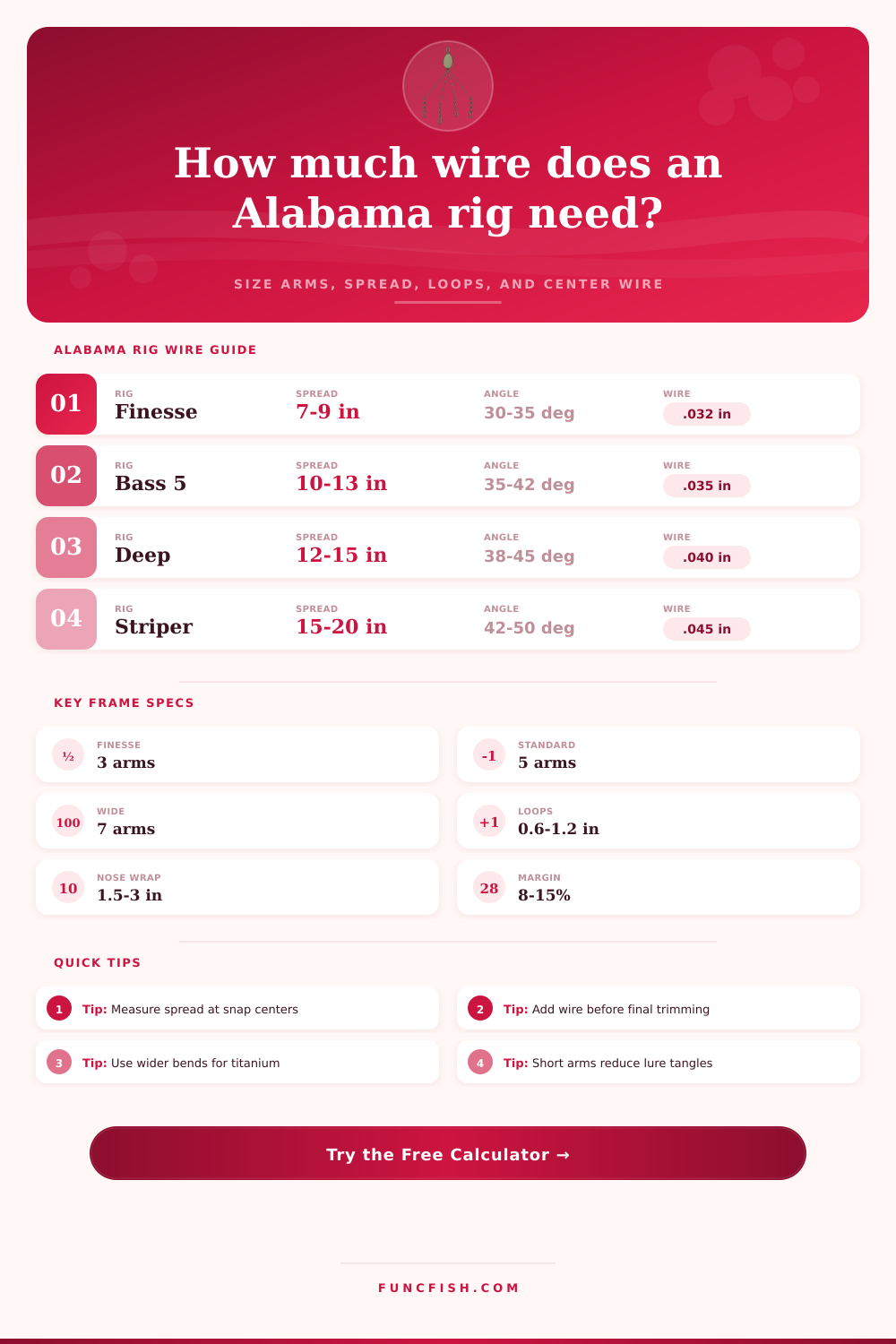
| 7 to 9 in | 30 to 35° | 3.5 to 4.5 in each side | 6.5 to 8.0 in | Mini, pond, pressured bass |
| 10 to 13 in | 35 to 42° | 5.0 to 6.5 in each side | 8.5 to 10.5 in | Standard bass swimbait frame |
| 14 to 16 in | 38 to 45° | 7.0 to 8.0 in each side | 11.0 to 13.0 in | Deep, wide school, clear water |
| 17 to 20 in | 42 to 50° | 8.5 to 10.0 in each side | 13.0 to 15.5 in | Striper, hybrid, open-water bait |
⚓Loop and nose allowance table
| Connection style | Terminal allowance | Nose or head allowance | When to use | Wire note |
|---|---|---|---|---|
| Simple loop eye | 0.55 to 0.75 in | 1.5 to 2.0 in | Small bass rigs, light heads | Cleanest cut estimate |
| Wrapped loop eye | 0.85 to 1.15 in | 1.8 to 2.4 in | Standard umbrella frames | Add tag room before trimming |
| Snap-swivel loop | 0.75 to 1.0 in | 1.8 to 2.5 in | Fast lure changes | Count drop length separately |
| Twisted heavy eye | 1.2 to 1.8 in | 2.5 to 3.5 in | Hybrid and striper loads | Needs more bend allowance |
🐟Species and frame comparison grid
| Target species | Typical arm count | Spread target | Wire diameter | Lure spacing goal |
|---|---|---|---|---|
| Largemouth bass | 5 wires | 10 to 13 in | 0.035 to 0.040 in | 1.5 to 2.5 in body gap |
| Smallmouth bass | 3 or 5 wires | 8 to 11 in | 0.032 to 0.035 in | 2.0 to 3.0 in clear-water gap |
| Spotted bass | 5 wires | 9 to 12 in | 0.035 in | Compact bait ball profile |
| White bass | 3 or 5 wires | 8 to 12 in | 0.032 to 0.035 in | Small shad imitation |
| Hybrid striper | 5 or 7 wires | 13 to 17 in | 0.040 to 0.045 in | Stable pull with larger heads |
| Striped bass | 5 or 7 wires | 15 to 20 in | 0.045 to 0.051 in | Wide school and heavy hardware |
📊Arm count cutting reference
| Arm count | Cut pattern | Tier ratio used | Best layout | Calculation note |
|---|---|---|---|---|
| 3 wire | 2 outside arms plus center | 100% outside pair | Finesse, pond, clear water | Lowest total wire and least drag |
| 5 wire | 2 outside, 2 mid, 1 center | 100% and 82% pairs | Standard Alabama rig frame | Most balanced bait ball shape |
| 7 wire | 2 outside, 2 mid, 2 inner, 1 center | 100%, 84%, 68% pairs | Big school or striper frame | Needs more margin and stiffness |
| Short cover | All arms trimmed compact | 88% to 94% of normal | Brush, docks, grass tops | Improves landing and roll control |
💡Wire cutting tips
Cutting margin: Keep the safety margin in the blank length, then trim after the nose twist and terminal loops are formed. Short wire cannot be recovered once the eye is wrapped.
Spacing check: Compare the calculator’s snap-center gap with lure body length. A positive body gap means the swimbaits can pulse without constantly tapping each other.
A homemade Alabama rig is created from a piece of metal wire that’s bent into an exact shape. Then it has to be perfect so the bait swim in a straight line under water without being torn apart when a fish smacks it. When you cast it out, even a tiny mistake in measurement makes the group of baits tangle up or collapse.
Every guy guesses until they’re cutting up a bunch of scrap wire but this calculator tool does math for you. Simply type in how many arms you want and your target spread. As the bait ball spins out, finished outside spread sets the size of the bait ball diameter. A compact bait ball is what you want when clear water fishing for smallmouth bass where you want it to look like a single school of shad.
How to Make Your Alabama Rig Work Better
When deep fishing for striper, you need maximum coverage. You adjust the arm length using both the angle between arms and the spread. Because the outer arms go farther from the pivot point, the arms is longer than the center wires. This is accounted for in the tool. Rig: Most builders cut all the wires to equal lengths, making the rig look uneven. Outer wires should of be much longer due to geometry; the tool will calculate this for you.
The standard is a five-wire frame that balances how the lure move, the drag, and weight. Three-wire frames is good in heavy cover but not as bulky as a proper bait ball. Seven-wire frames are too heavy with excessive drag… Thicker wire are needed to stabilize.
A larger bend takes up more space in a bend radius. For example, you don’t want tight loops of heavy gauge wire because they will kink. This tool helps by providing extra length for these bends so that making the eye doesn’t result in short arms. Then there is loop on the end. This is why I mentioned eye loops are simple loops that use less wire than a crimp or wrapped sleeve.
Hardware size matter too if you’re using snap swivels as these add to the drop length. When starting out, anglers tend to lose stuff at the twist in the nose where the wire loop back up through head insert. This area gets a normal amount of extra length accounted for by the calculator, but be careful and even then trim it slightly long just in case. You’ll be able to cut it shorter if needed after you test it out.
How evenly the wire bend also impacts your retrieve as a skewed frame rolls and wobbles all over the place. Keeping a consistent bend angle makes for more consistant behavior and helps set the armspan projection. Forgiving: Titanium memory wire will snap back in place if you do goof up. Not as forgiving: Stainless steel stays put better after being set. So pick based off how much control you want while building.
Straight Caster: A good rig casts straight. A great rig open all the way each and every time. Numbers give you a starting point. Water gives you an end point. Take the rig out and test it.
If your lures gets too close together, cut the arms a little shorter. If they look too fake, reduce the number of arms or widen the gap between them. Keep cutting until it looks right, then keep fishing until it works actualy.