🐟 Arctic Char Weight Calculator
Estimate Arctic Char weight from length & girth measurements — imperial & metric
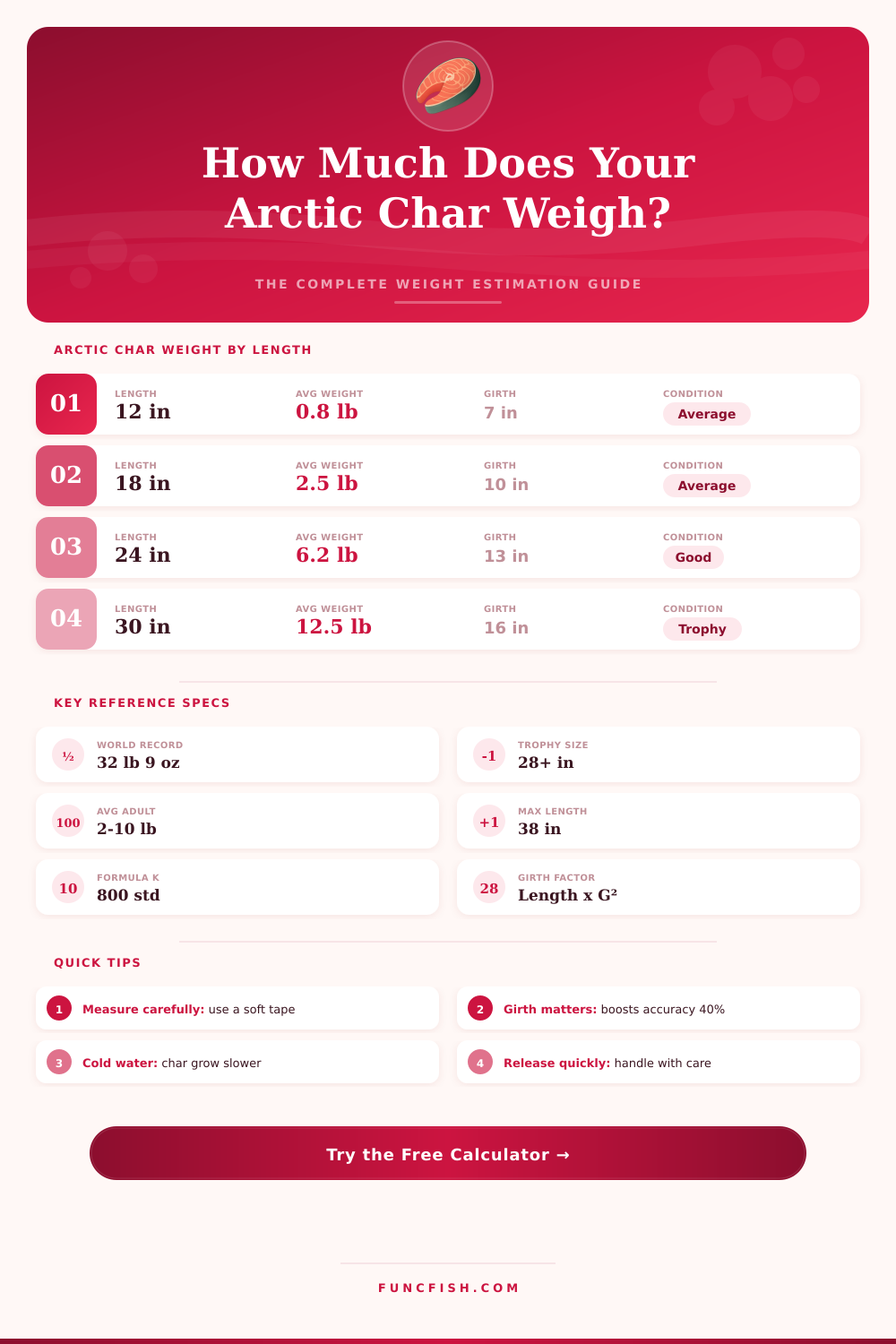
| Length (in) | Length (cm) | Est. Weight (lb) | Est. Weight (kg) | Avg Girth (in) | Size Class |
|---|---|---|---|---|---|
| 10 | 25.4 | 0.46 | 0.21 | 5.5 | Juvenile |
| 12 | 30.5 | 0.80 | 0.36 | 7.0 | Small |
| 14 | 35.6 | 1.25 | 0.57 | 8.0 | Small |
| 16 | 40.6 | 1.90 | 0.86 | 9.0 | Average |
| 18 | 45.7 | 2.53 | 1.15 | 10.0 | Average |
| 20 | 50.8 | 3.44 | 1.56 | 11.0 | Average |
| 22 | 55.9 | 4.57 | 2.07 | 12.0 | Good |
| 24 | 61.0 | 6.24 | 2.83 | 13.0 | Good |
| 26 | 66.0 | 7.90 | 3.58 | 14.0 | Large |
| 28 | 71.1 | 10.08 | 4.57 | 15.0 | Trophy |
| 30 | 76.2 | 12.50 | 5.67 | 16.0 | Trophy |
| 32 | 81.3 | 15.36 | 6.97 | 17.0 | Record Class |
| Formula | Best For | K Divisor | Accuracy |
|---|---|---|---|
| Standard (L x G² / 800) | Lake & River Char | 800 | ±10% |
| Length-Only (L³ / 2700) | No girth available | 2700 | ±20% |
| Anderson Char Formula | Northern lake char | 860 | ±8% |
| Fulton Condition Factor | Condition assessment | — | ±5% |
| Trophy Estimate | Large girth-heavy fish | 750 | ±12% |
| Sea-Run Adjusted | Anadromous char | 775 | ±9% |
| Population Type | Typical Length | Typical Weight | Growth Rate | Habitat |
|---|---|---|---|---|
| Landlocked Dwarf | 8–14 in (20–36 cm) | 0.3–1.2 lb (0.14–0.54 kg) | Slow | Deep cold lakes |
| Landlocked Standard | 14–26 in (36–66 cm) | 1–8 lb (0.45–3.6 kg) | Moderate | Lakes & rivers |
| Anadromous (Sea-Run) | 18–34 in (46–86 cm) | 3–20 lb (1.4–9 kg) | Fast | Arctic seas |
| River/Stream | 10–22 in (25–56 cm) | 0.5–5 lb (0.23–2.3 kg) | Moderate | Cold rivers |
| Trophy Lake | 26–38 in (66–97 cm) | 8–32 lb (3.6–14.5 kg) | Slow-Moderate | Deep arctic lakes |
Estimating a weight of an Arctic char is dificult. The length of the Arctic char dont provide an accurrate measurement of the weight of an Arctic char. People often attempt to estimate the weight of the Arctic char by measuring the length of an Arctic char.
However, the length of the Arctic char does not account for the volume of the Arctic char. It is possible for two Arctic char to have the same length but one Arctic char may have a larger girth compared to the other Arctic char that has a small girth. The girth of the Arctic char is necessary to measure the weight of the Arctic char because the girth of the Arctic char can provide an accurately indication of the volume of the Arctic char.
How to Estimate the Weight of an Arctic Char
In order to obtain the accurate weight of an Arctic char, you must measure the length and girth of the Arctic char. The life history of the Arctic char can influence the weight of the Arctic char. An anadromous Arctic char must spends time in the ocean to find food.
During this phase, the anadromous Arctic char often has a thicker body then an alpine Arctic char that lives in the mountain lakes with limited food for the Arctic char populations. The alpine Arctic char species are lean as they do not have much food in there habitat. In this case, the life history of the Arctic char should be chosen correctly when using the calculator as this impact the mathematics behind the weight of the Arctic char.
The spawning cycle of the Arctic char can impact the weight of the Arctic char. During the pre-spawn phase for female Arctic chars, they carry eggs which add to their weight. The male Arctic char can also lose weight during the spawning season as they use there fat reserves to care for the Arctic char young, thus leading to the male Arctic char with fewer fat reserves weighing less than a male Arctic char with more fat reserves.
You should adjust the spawning condition of the Arctic char in the calculator for the most accuratly result of the weight of the Arctic char. The environment in which they live and the food sources in the water can also influence the weight of the Arctic char. Arctic chars live in lakes with a variety of food sources which result in a heavy Arctic char.
In contrast, Arctic chars live in lakes with fewer food sources which results in a streamlined Arctic char that weighs less. The diet of the Arctic char influence its weight. The calculator accounts for this information as it will determine the diet of the Arctic char.
To obtain a good result from the calculator, high quality data must be entered. The fork length and girth of the Arctic char should be measured. The girth should be measured at the deepest part of the body of the Arctic char.
If you use a photo to estimate the weight of the Arctic char, the margin for error will be higher due to the lack of true dimensions in the photo. The confidence setting in the calculator can account for this error. This will widen the range of the weight of the Arctic char that is estimated using the calculator.
Researchers can use this data to track the weight of the Arctic char populations in specific lakes and determine if the food base in that lake is enough for the population of Arctic chars.