Assist Hook Length Calculator
Estimate finished assist cord length, cut length, hook landing zone, stagger distance, clearance, and foul risk for vertical jigging, slow pitch, shore jigging, and tuna-style metal jigs.
📌Assist rig presets
⚙Assist hook build settings
Measure from jig eye to the point where the assist loop starts.
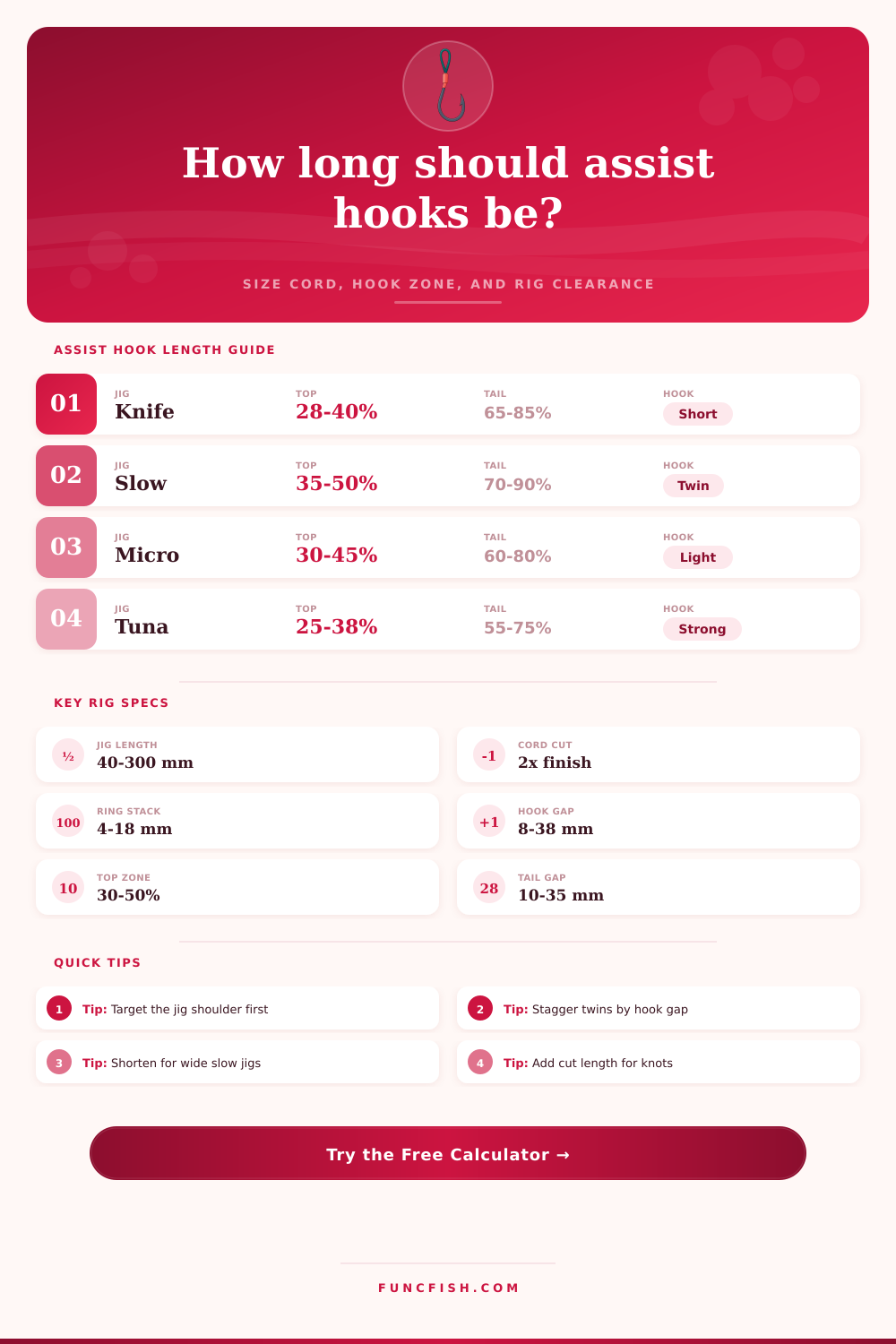
Top assists often land 30-50% down the jig; tail assists often land 65-90%.
A higher angle shortens vertical reach and increases swing clearance.
Include serving, knot tag, shrink tube overlap, or splice bury.
Assist hook length forecast
Calculation breakdown
📊Gear and species comparison grid
Slow Pitch Twin
Tuna Knife
Micro Shore
Madai Pair
📏Assist length target zones
| Jig or rig style | Top assist point zone | Tail assist point zone | Length logic | Watch-out |
|---|---|---|---|---|
| Long knife speed jig | 25-40% from nose | 55-78% from tail end | Keep the hook near the shoulder so it does not wrap the jig on fast pumps. | Too long can cross the centerline and foul on the fall. |
| Slow pitch wide jig | 35-52% from nose | 70-92% from nose | Wider flutter needs enough reach for side bites, but not so much the pair catches the belly. | Wide bodies need shorter cord or stiffer material. |
| Micro shore jig | 30-45% from nose | 60-82% from nose | Small hooks work best when the point lands just behind the weighted shoulder. | Oversized gap kills action and increases snagging. |
| Inchiku or madai | Rarely top only | 65-95% behind head | Hooks trail behind skirts or octopus tails; length follows skirt bite zone. | Very soft cord can tangle around skirt strands. |
| Heavy tuna jig | 22-38% from nose | 50-72% from nose | Short, strong single assists protect the ring stack under high drag. | Long twins can lever against each other under load. |
🧵Assist cord material reference
| Cord material | Typical diameter | Relative stiffness | Cut allowance behavior | Best use |
|---|---|---|---|---|
| Soft PE assist braid | 0.9-1.6 mm | Low | Needs serving or shrink tube to hold a repeatable length. | Slow pitch twins and reef jigs. |
| Stiff PE core cord | 1.1-2.0 mm | Medium | Keeps hooks off the jig better; add a little extra for bends. | Anti-foul top assists. |
| Kevlar braid | 1.0-2.2 mm | Medium-high | Low stretch and high heat resistance; knots can be bulky. | Heavy amberjack and tuna rigs. |
| Fluorocarbon core | 1.4-2.4 mm | High | Shortens effective swing and resists wrapping around the jig. | Sharp-toothed bycatch and clean water. |
| Wire core bite leader | 0.5-1.0 mm | Very high | Measure after crimping because bend radius changes finished length. | Kingfish, mackerel, and wahoo bite protection. |
| Hollow braid splice | 1.5-3.0 mm | Medium | Requires bury length; repeatable once marked before splicing. | Heavy drag rigs without bulky knots. |
🪝Hook gap and jig body matching
| Hook class | Approx gap | Common jig length | Common jig weight | Fit note |
|---|---|---|---|---|
| Size 8 to 4 micro | 8-11 mm | 40-80 mm | 5-30 g | Use short cord and a light ring stack so the hook point clears the shoulder. |
| 1/0 to 3/0 light jigging | 15-20 mm | 70-140 mm | 30-120 g | Good all-around range for shore and light boat jigs. |
| 5/0 slow pitch assist | 24-28 mm | 110-190 mm | 100-250 g | Match gap to jig width; wide jigs often prefer shorter cord. |
| 7/0 heavy assist | 30-34 mm | 150-240 mm | 180-400 g | Strong top assist for amberjack, tuna, and deep reef work. |
| 9/0 tuna assist | 36-40 mm | 190-320 mm | 250-600 g | Shorter single assist reduces leverage and keeps the point near the nose. |
🎣Species bite-zone comparison
| Target group | Typical bite on jig | Hook length tendency | Cord priority | Rigging note |
|---|---|---|---|---|
| Snapper and sea bream | Pecking at head or skirt | Moderate to long | Soft, light cord | Small twins help convert light nips without choking action. |
| Amberjack and yellowtail | Fast engulfing strike | Short to moderate | Abrasion and shock strength | Keep the hook close enough to avoid wrapping during speed pumps. |
| Tuna and bonito | Head-first slash | Short single or short twin | High drag strength | Heavy rings and short cord reduce leverage under boat-side pressure. |
| Grouper and reef fish | Crushing strike near bottom | Short anti-foul | Abrasion resistance | Shorten the assist if it catches rock, coral, or the jig belly. |
| Mackerel and kingfish | Tail nip or side slash | Moderate tail coverage | Bite protection | Wire core or sacrificial bite cord can save hooks from cutoffs. |
💡Rigging notes
Measure finished length under light tension: Assist cord shortens once knots, shrink tube, and hook eyes are seated. Mark the cord, pull the loop snug, then measure from the solid ring contact point to the hook eye.
Check the swing on the actual jig: Lay the hook along the jig and rotate it across both faces. If the point can reach past the opposite edge or catch the belly, shorten the cord or use a stiffer material.
So you have an inkling as too how far down on the shank you should put your hooks, right? Well, sorry, but geometry will gets you there, not wishing and hoping. If your hook’s a fraction-of-an-inch too long, every time you pump it wrap on your jighead. This fouls your line and never let a fish see it. Too short a hook means missing the strike altogether, the point won’t make it up to the shoulder. Fill your cooler by getting to know this landing zone better.
When you key in your hook size and jig length, the calc will give you completed assist length. That is distance from the hook eye to ring stack with the knots tied on. So what’s that? That is a good question. It takes into account waste when shrinking tube around the hook or serving it. If you were just cutting the line to the length you want, the hooks would be way up on the metal body. This would choke their action and make them prone to being fouled.
How to Get Your Hook Length Right
The other factor people miss are how the cord material affects the overall rig length. Braid drapes well, though soft PE braid can twist. Stiffer cores hold better based off jig face. The tool takes that into account when making its cut suggestion. You have to choose which best fits what you use because a light mono leader has a different looping structure than a heavier braid would. For shark protection, wire behaves different than fiber.
This is where you choose your rigging priority. If you want to prioritize anti-fouling, it shorten the reach so the hooks stays away from the belly of the jig when moving it vertically at faster speeds. The other factor that’s critical is hook gap size. A big nine-zero tuna hook has a much wider gape than a small size eight micro assist. So if you’re trying to get the point of each of these in the same relative position, you can’t use the same length cord on them. Because of their physical dimensions, the larger hook will go farther, so there is connection between hook class and typical jig weight/length.
That means that when using a hook with a big gap and a long cord it’s an issue in tight quarters like heavy cover or reef structure. You always want the hook to land in a location that fits how the species behaves. For example, tuna will slash at the head so you keep assists short with more of a nose assist to get maximum hookup ratio while retaining good fall action. Snapper and other fish like sea bream tend to nip at the tail or sometimes the skirt, so you need a longer reach to hit those lower bite area. Your choice of target tell the calculator what landing zone percentages should of be used. It shows you the right way to place your bait. This is because where that point lands affects how many bites you get based on your bait profile.
Before running it out there, test the swing on the deck. Rotate the jig with your fingers on the hooks. If they are touching the other side or cross the center line, then cut the cord down a bit. Often times just cutting it down a half-inch will save hours of knot picking off the bottom of a drop shot. You want it long enough where you have room to turn strikes but not so long that it tangles up the rig.
Figure it out and get the length correct and the fish will be finding you when it counts.