Bait Cost Per Trip Calculator
Estimate bait quantity, rounded containers, reusable leftovers, total bait spend, and each angler's share for a planned fishing trip.
📌Scenario presets
⚙Trip and bait settings
Bait trip estimate
Full breakdown
📋Bait usage reference grid
Nightcrawlers
Live Minnows
Shrimp
Soft Plastics
📊Trip planning tables
| Bait type | Typical container | Base use per rod hour | Best matched scenario |
|---|---|---|---|
| Soft plastics bag | 8-12 pieces | 0.8-1.6 pieces | Bass, kayak inshore, weed edges |
| Nightcrawlers | 12 worms | 1.5-2.4 worms | Trout, panfish, mixed bottom |
| Crickets | 50 crickets | 6-10 crickets | Panfish float rigs and kids trips |
| Live minnows | 24 minnows | 1.8-3.2 minnows | Walleye, perch, pike, slow trolling |
| Cut bait | 1 lb / 454 g | 2-5 oz / 57-142 g | Catfish, river rigs, heavy current |
| Shrimp or squid | 1 lb / 454 g | 2-6 oz / 57-170 g | Surf, pier, jetty, inshore bottom |
| Scenario | Bite pace factor | Loss factor | Suggested buffer |
|---|---|---|---|
| Clear trout drift | 0.85-1.05 | 1.00-1.12 | 10-15% |
| Bass plastics around cover | 0.95-1.25 | 1.08-1.25 | 15-20% |
| Panfish with kids | 1.25-1.55 | 1.05-1.18 | 20-30% |
| Catfish river bottom | 1.00-1.25 | 1.18-1.35 | 20-25% |
| Surf wash or pier crabs | 1.20-1.60 | 1.25-1.50 | 25-35% |
| Leftover type | Usually reusable | Calculator treatment | Planning note |
|---|---|---|---|
| Sealed soft plastics | 80-100% | High credit | Keep colors and scents separated |
| Healthy worms | 40-75% | Medium credit | Cool bedding preserves value |
| Live minnows | 20-65% | Low to medium credit | Aeration changes the result |
| Cut bait or shrimp | 0-50% | Low credit | Only count chilled unused bait |
| Prepared dough bait | 50-90% | Medium credit | Seal the lid before storage |
💡Planning checks
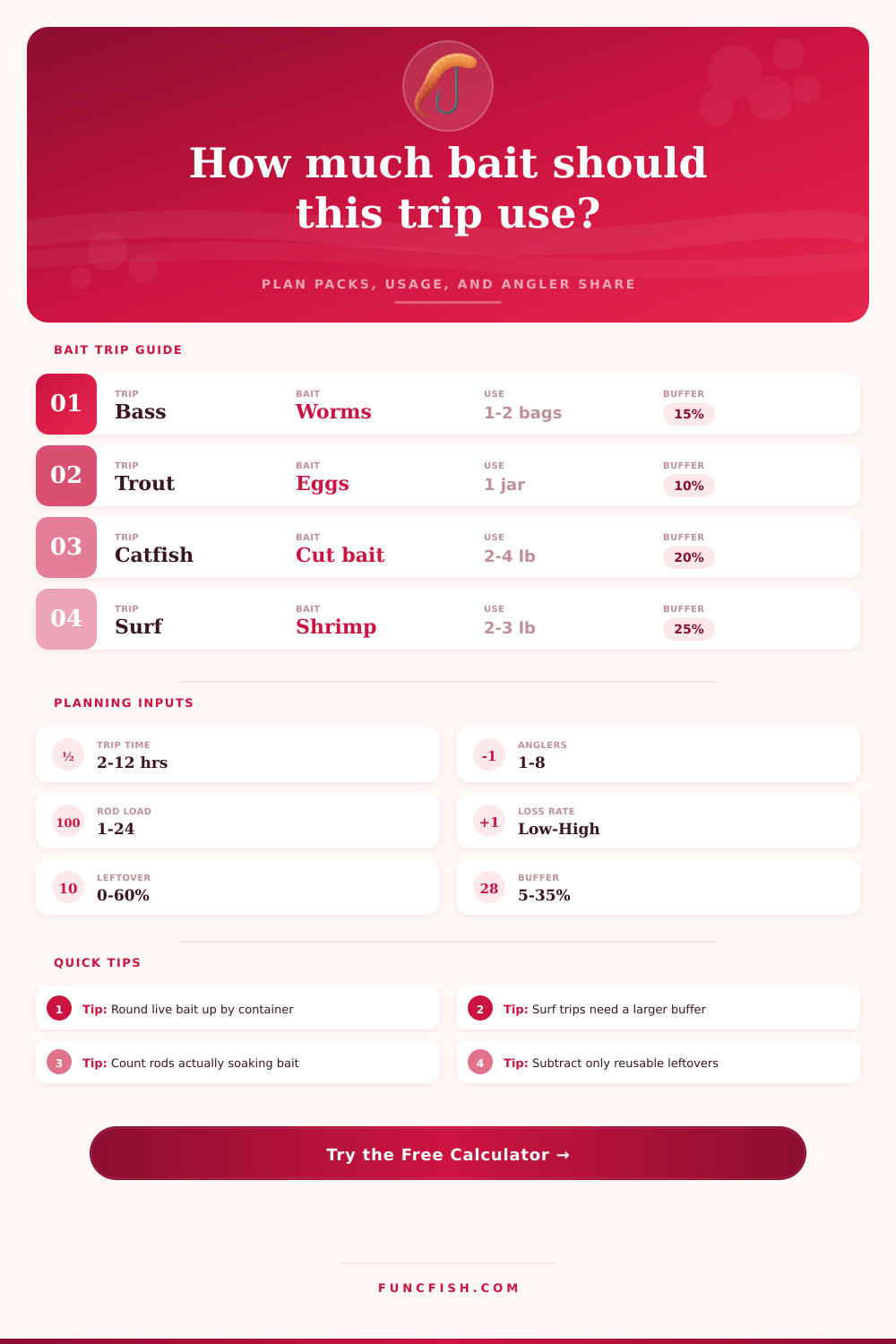
Tip: For live bait, round up to the seller's actual container size. A perfect decimal estimate rarely matches how bait is sold.
Tip: Count only bait that can truly be reused as leftover credit. Surf bait, spoiled bait, and opened scent baits often lose value quickly.
Planning a fishing trip requires you to calculate the specific amount of bait that you will needing for the trip. While you may know how many hours you will fish and how many fishing rods you will use, you might not know how many container of bait you will need to purchase. While you may be able to provide an estimate of the amount of bait that will be consume during your fishing trip, that estimate might not be accurate.
For instance, you might run out of bait during your trip, or you might buy too much bait for the trip, as the bait that you purchase will inevitablly go bad. Bait can behave in a variety of different ways during your fishing trip. For instance, live minnows lose there value quickly if they is removed from the aeration system, but soft plastics can sit in a bag for many week.
How much bait do you need for a fishing trip
Shrimp and “cut” bait can spoil quick, especially in warm weather, and they can also be easily lost during surf trips when waves or crabs strip the bait from the hooks. Additionally, the amount of bait that fish consume can vary great from one type of fishing spot to another. For instance, calm trout streams may consume very little bait, while a rocky pier may find that most of the bait becomes hooked on the rocks and is consumed by the fish at that location.
When many people goes fishing, they must share the cost of the bait that they purchase. However, people may have different opinions about what types of bait can be “reused” when they return from their fishing trip. For instance, one angler may believe that all of the bag of soft plastic bait can be reused, but another fisherman may only believe in the value of the worms that is stored in cool bedding.
The bait calculator allows for the percentage of reusable bait to be adjust. This way, the cost of the bait will factor in the survival of the bait after the fishing trip. The length of the fishing trip and the number of fishing rods that is used will impact the amount of bait that is consumed.
For instance, a four-hour fishing trip with three fishing rods will consume different amount of bait than a four hour fishing trip with six fishing rods that are fishing in a rough bottom of the lake. In these cases, more bait can become damaged and get hooked on the fish in rough environment. In these situations, it is a suggestion that people include a buffer for the bait that they purchase.
A buffer will ensure that there is enough bait for the fishing trip. The reference tables located on this page can help people decide how much bait to purchase based off the length of their fishing trip. The tables are not meant to replace the experience that a fisherman may have, but they can serve as a starting point for the bait purchase.
For instance, if the surf trips where the fisherman fishes tends to strip the shrimp at a faster rate than the reference tables indicate, the buffer can be increased. This will ensure that there is enough bait for the fish during that trip. People typically focus on the price of the bait that will be purchase.
However, many people dont consider the credit that they can recieve for the amount of bait that can be reused for another fishing trip. The bait that is reused must be stored proper and the type of bait should be able to survive until being use again for fishing. The calculator displays the credit from reusable bait as a separate line item so that the angler can decide if the effort of storing the bait will save enough money to be worth the effort.
For some fishing trips, the amount of credit from reusable bait will be significant. However, for trips that include surf or pier fishing locations, there will be little reusable bait so little credit will be provided. While it is true that calculating the amount of bait that will be consumed during a fishing trip will force an angler to think about the various variable of that fishing trip, people will begin to recognize how fast bait can be consumed at certain locations as compared to others.
These observations will help anglers to buy fewer container of bait than they otherwise would of had they relied upon estimation alone. When people go to the bait shop, they will feel more prepared if they have calculated the amount of bait that will be need. Additionally, the conversation between the fishermen and the person at the bait shop will be different if they know the amount of bait that is needed for the fishing trip.
While the calculation will not eliminate the uncertainty of fishing, it will eliminate the uncertainty regarding the amount of bait that is needed for purchase.