
Your initial decision probably centered on those fins… They’re big, bold forms that add drama to an otherwise compact body. New betta keepers take away that impression: “Oh, my finned-up fish looks really long.” Nope. They don’t. It’s one reason why knowing how big a betta actualy gets is relevant; it determines feeding routine and tank size.
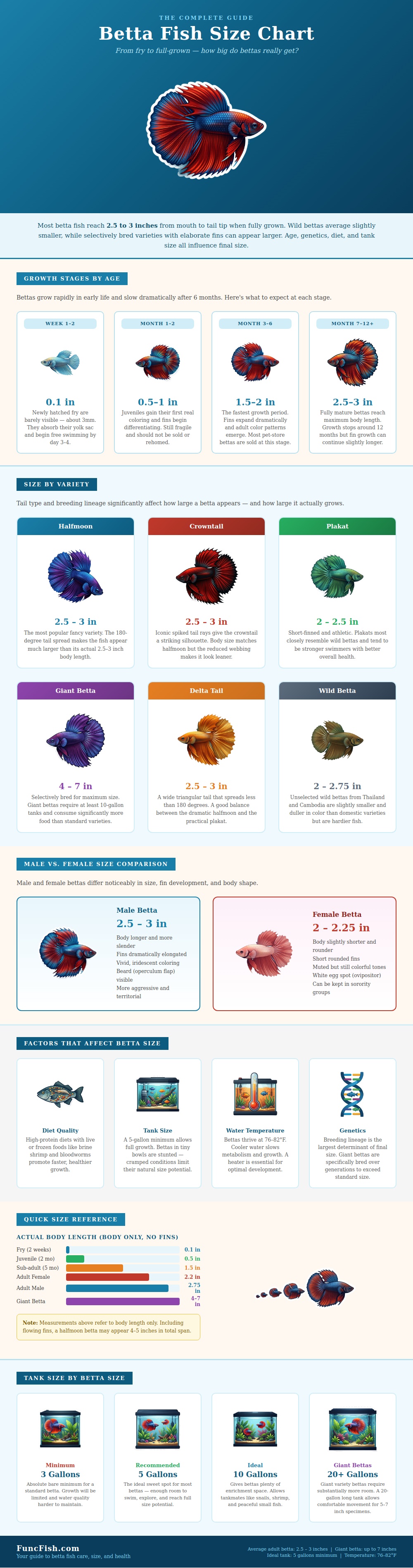
When full-grown, most bettas will be anywhere from 2½” to 3″ long. That’s total length, encompassing both the body plus the end of their tails. The body alone is even smaller. Why? So you’ll know what you’re getting into before buying supplies.
How Big Do Betta Fish Get?
This growth timeline illustrates what I mean about being patient. You’ll see fry starting out as almost invisible specks near surface sucking on their yolk sacs. After a few months, they become recognizable with adult coloration and fins. During this young stage, they’re delicate, and a lot of folks miss it simply because they want a “pretty” pet.
From three to six months, the real explosion occurs: Their fins grows large very fast. A lot of varieties achieve their characteristic grandeur here. At twelve months old, they slows down significantly. If you watch them every day, it’s a great way to manage your expectations of how quickly they go from tiny speck-to-adult. The graph above details it well.
Perceived size also has a lot to do with variety. A halfmoon betta has a wide tail that spreads out 180 degrees, masking its relatively small body length and giving it quite the wide visual footprint. Crowntails feature spiky rays that adds verticality rather than bulk. And plakats stay sleek and short-finned looking, so they appear smaller different than their actual size. Wild types land somewhere in-between, prioritizing hardiness over flash. Giants, on the other hand, are selectively bred individuals that can gets as large as seven inches long.
To give you an idea, that is huge for a betta fish. They should of be fed and kept in much larger spaces than normal varieties. Your whole care regimen will change depending off which of these you choose. A halfmoon may get worn out from battling strong current because those big fins aren’t made for gentle swimming. A plakat could take stronger flow and might even live in a well-curated community tank.
The gender distinction is also revealing. In general males are slenderer (longer), with flashy colors of bright iridescence (flashy color pattern that flares up). Females is typically shorter and rounder, and not quite so aggressive. Their body design requires different amount of space. The same area where a male feels right at home can make one female feel crowded out. Being mindful about such physical variation helps avoid injuries and extra stress. Not all bettas are created equal. You can’t just lump them together in an aquarium.
Fish are what they eat Nutrition is the primary factor. Healthy fish come from high protein diets consisting of frozen or live foods. Poor nutrition leads to stunted growth; many times, this can be traced back to improper feeding methods.
Tank size People don’t realize how important tank size is. To achieve stable water parameters, you need at least five gallons. This also provides enough space for natural movement. Small bowls trap waste and cause stress which stunts growth.
Temperature A functioning metabolism requires temperature between seventy-six and eighty-two degrees Fahrenheit. This helps keep digestive processes working properly.
Your fish’s potential is limited by their genetics; care dictates how closely you can reach that limit. Know yourself. What do you have? What’s best? If a standard betta, a 3g tank is about the lowest bar you can set and leaves little margin for error. Most of us will agree that 5 gallons are the sweet spot, offering plenty of room to decorate and stay stable. 10+ gallons begins to allow for other peaceful tankmates (shrimp, snails). For giants, twenty plus gallons is simply the necessary size to allow them to swim around comfortabley.
Make sure to match the fish to the container. Don’t go the other direction. Feed appropriately and start with good water. Let the fish grow naturaly. The outcome is a colorful companion who takes up exactly the amount of space they’re meant to fill in nature.