⚓ Bilge Pump GPH Calculator
Calculate the required pump flow rate for your boat — imperial & metric supported
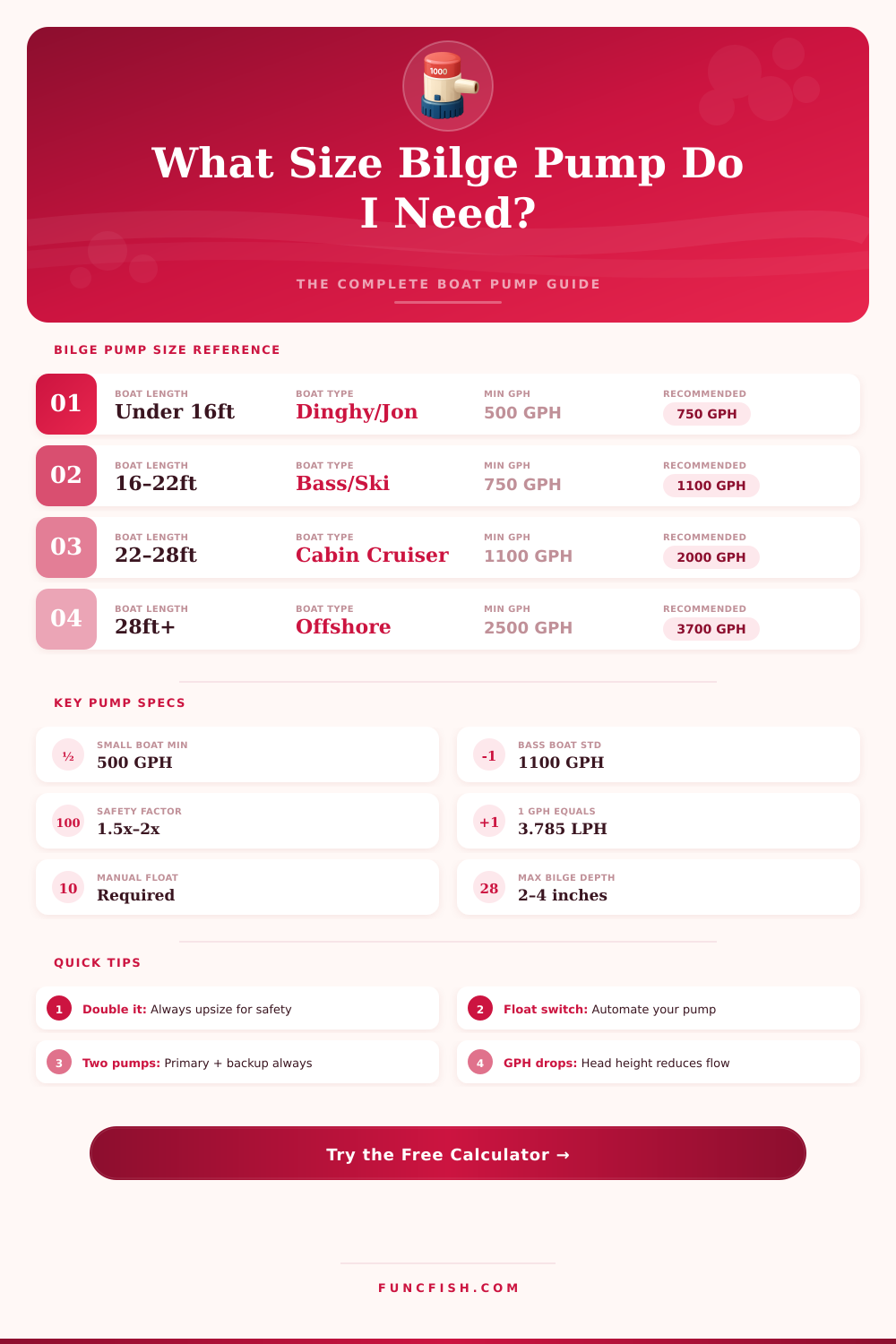
| Boat Length | Boat Length (m) | Minimum GPH | Recommended GPH | LPH Equivalent |
|---|---|---|---|---|
| Under 16 ft | Under 4.9 m | 500 | 750 | 2,839 |
| 16 – 20 ft | 4.9 – 6.1 m | 750 | 1,100 | 4,164 |
| 20 – 24 ft | 6.1 – 7.3 m | 1,100 | 1,500 | 5,678 |
| 24 – 28 ft | 7.3 – 8.5 m | 1,500 | 2,000 | 7,571 |
| 28 – 34 ft | 8.5 – 10.4 m | 2,000 | 2,500 | 9,464 |
| 34 – 40 ft | 10.4 – 12.2 m | 2,500 | 3,700 | 14,007 |
| 40 ft+ | 12.2 m+ | 3,700 | 5,000+ | 18,927+ |
| Head Height (ft) | Head Height (m) | Approx. GPH Loss | Effective Multiplier | Note |
|---|---|---|---|---|
| 0.5 ft | 0.15 m | ~5% | 0.95x | Minimal loss |
| 1.0 ft | 0.30 m | ~10% | 0.90x | Typical small boat |
| 1.5 ft | 0.46 m | ~15% | 0.85x | Standard runabout |
| 2.0 ft | 0.61 m | ~20% | 0.80x | Common cabin |
| 3.0 ft | 0.91 m | ~28% | 0.72x | Deep keel boat |
| 4.0 ft | 1.22 m | ~35% | 0.65x | Sailboat / offshore |
| 6.0 ft | 1.83 m | ~50% | 0.50x | High discharge |
| Boat Type | Typical GPH | Safety Factor | Recommended Mode | Bilge Volume Est. |
|---|---|---|---|---|
| Jon / Dinghy | 500 – 750 | 1.25x | Manual | 2 – 5 gal |
| Bass Boat | 750 – 1,100 | 1.5x | Auto Float | 5 – 15 gal |
| Ski / Runabout | 1,100 – 1,500 | 1.5x | Auto Float | 10 – 20 gal |
| Center Console | 1,500 – 2,000 | 1.5x – 2x | Auto / Dual | 15 – 30 gal |
| Cabin Cruiser | 2,000 – 2,500 | 2.0x | Dual Pump | 25 – 50 gal |
| Pontoon | 750 – 1,100 | 1.25x | Auto Float | 5 – 15 gal |
| Sailboat | 1,500 – 2,500 | 2.0x | Dual Pump | 20 – 60 gal |
| Offshore / Sport | 2,500 – 5,000+ | 2.0x – 2.5x | Dual Pump | 50 – 150 gal |
Sizing a bilge pumps correctly is a necessary task for boat owner. Ensuring that a bilge pump is size correctly will ensure that water is removed from the bilge faster than water enter the bilge. Many factors plays into the proper selection of a bilge pump.
Bilge pumps dont always perform according to the pump box specification. Several factors reduces the effectiveness of bilge pumps, including vertical lift, hose friction, and plumbing bend. The capacity of a bilge to fill with water depend on the hull design of the boat.
How to Choose the Right Bilge Pump
The hull design will determine the amount of water the bilge can hold. For instance, jon boats have wide bilges relative to the length of the boat while bass boats has narrow bilges. The amount of water in the bilge come from rain and leaks into the bilge.
Water also enter the bilge when the boat is on the water due to waves. Bilge pumps must remove all of the water currently in the bilge and remove water that enter the bilge while the bilge pump is running. If the bilge pump cannot remove water from the bilge at the same rate that water enters the bilge, the bilge will overflow.
The Gallons Per Hour (GPH) that is rated for bilge pumps is the amount of water the bilge pump can move. However, the actual GPH that bilge pumps deliver to the bilge area is less than the rated GPH. One of the factors that will reduce the GPH of the bilge pump is the vertical lift that the bilge pump must work against due to the force of gravity.
The second factor that can reduce the GPH of the bilge pump is the friction of the hoses connect to the bilge pump. Every inch of hose that is connected to the bilge pump increase the friction of the system. Additionally, any bend in the hose will also increase the friction in the system.
Therefore, the bilge pump that is rated to move 1100 GPH may only be able to move 700 GPH once installed in the boat. Another consideration for bilge pump selection is the inflow of water into the bilge. The inflow of water will differ according to the environment in which the boat operate.
For instance, a boat in a lake will experience a lower inflow of water than a boat that is in a coastal inlet. Additionally, boats that experience leaks will have a steady inflow of water. However, boats that are expose to rain will experience an inflow of water that come in sudden surges.
Therefore, it is necessary to provide a reserve capacity in the bilge pump so that it can handle these sudden inflows of water into the bilge. In addition to providing a bilge pump with sufficient capacity to handle inflows into the bilge, you should also install a backup bilge pump. The backup bilge pump should be sized to handle the overflow of water that the primary bilge pump cannot manage.
Another specification to consider when purchasing a bilge pump is the size of the hose that is used to move water out of the bilge. If the hose that is used has a small internal diameter, there will be a significant amount of friction in the system that will reduce the GPH of the bilge pump. Bilges that discharge their contents on land (internally) may only require a three-quarter inch internal diameter hose.
However, boats that discharge their bilges into the ocean may require a hose with a one and an eighth inch internal diameter to avoid excessive friction. Using a hose with a large internal diameter will reduce the friction in the system more effective than increasing the size of the bilge pump impeller. Finally, the placement of the bilge pump and the connections to the bilge’s electrical system are two final specification to consider.
Placing the bilge pump at the lowest point in the bilge will allow water to easily be drawn into the bilge pump. Additionally, you should place the bilge pump away from any debris that may enter into the pump and cause it to clog. Another consideration is the electrical system that will power the bilge pump.
The bilge pump will require thick wire to carry the electrical current to the bilge pump. Additionally, you should install fuses in the electrical system to protect the electrical system from the electrical draw of the bilge pump when it is working against a resistance in the bilge. A bilge pump alarm can also be installed into the bilge.
Installing a bilge pump alarm will alert the boat owner before the water level in the bilge reach the electrical components of the boat. Finally, the bilge pump should be tested while the boat is in motion to ensure that it operates within the specifications of the pump. Depending on the angle of the boat or the vibration that the boat experience, the bilge pump may not operate the same when the boat is in motion as it does when the boat is stationary.