
It’s tropical, you’re standing on the deck of a sportfishing boat; the rod arcs downward and you feel the bend. It’s a big fish, it’s moving fast, but this isn’t the time to be thinking about biology and conservation. At that point all you want to know is: How big is it? And that answer separates the experienced angler from the lucky amateur.
How do we estimate size of a blue marlin before he comes out of the water? It takes a little bit of science and a lot of art. Believe it or not, it matters more then you think. It’ll dictate whether or not your crew continues their push or decides to take a breather. It’ll establish the mood for the rest of the hour of fishing. More importantly, it could save you from embarrassing yourself if you happen to be involved in a tournament and, suddenly, scale actually reads.
How to Guess the Size of a Blue Marlin
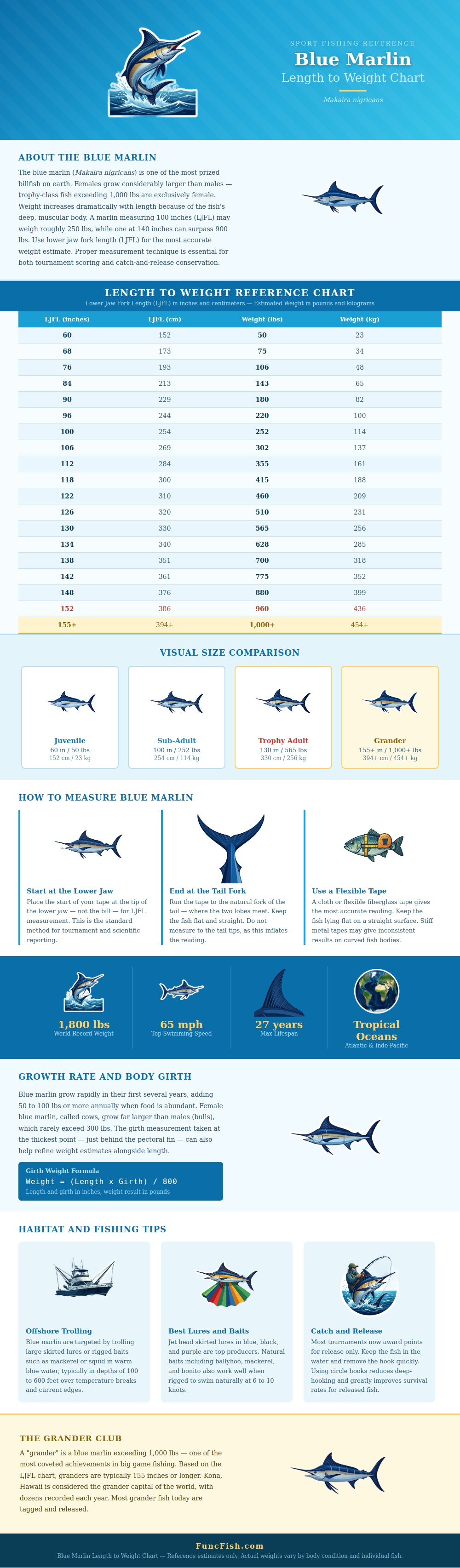
So, the chart ties weight to length. There’s just one small thing that throws even seasoned captains for a loop: how do you get your correct measurement? Well, according to infographic, this is Lower Jaw Fork Length (or LJFL). This measurement begins at the tip of the lower jaw and runs to the end of the fork of the tail. It is not measured from the tip of the bill to the end of tail.
Because the bill can be anywhere from 6-12 inches long depending on who you ask. It is long and skinny like an exclamation point. It may be shorter and fatter. A few marlin are even shaped like a banana. Measure it from the bill, and you’re dead wrong. That is why they created the standard. They wanted to remove the variable of that spear-like appendage and focus strictly on size of its body.
So yes, it’s mostly psychological. And we want it to be bigger than it is. So we grasp for as much length as we can. But restraint leads to accuracy. Now take length and then examine how it progresses. Imagine starting out with a six-foot juvenile that weighs about fifty pounds. Not bad. You can handle that on most tackle and it’s pretty hefty in your hands.
But weight doesn’t scale linearly. It compounds. Length doesn’t necessarily equal size. As the fish grows in length, it gain exponentially in width. By the time you see one reach ten feet it’s a two-hundred pound plus monster. So that ten footer isn’t just a foot bigger than a nine footer. It’s hundreds of pounds heavier.
This exponential growth rate is what makes marlin so dangerous to tackle. What easily overpowers an eight footer will snap like a twig under a ten footer if the drag isn’t set correctly. The graph above shows the steep rise. Each successive inch adds much more than previous one.
This is The Blue Marlin Foundation. Knowing the numbers prepares your tackle. If you estimate by sight that the fish is in trophy class of 1000 or more pounds, then you must respect its power. Granders are basically all female and very seldom do you find a male above 300 pounds. Females grow bigger and heavier because they feed longer and have more body weight to burn off while fighting. So when you witness a marlin coming up with that characteristic deep heavy bodied profile you just know she is a cow. She will roll sideways and make long runs. She will challenge each knot in your leader. You can adjust your drag beforehand knowing roughly how many pounds she weighs based on what she look like from the surface.
Size also has much to do with habitat. Blue marlin live in tropical oceans around the world. They inhabit the tropical Pacific from Hawaii, and the North Atlantic from the Azores to South America. But that doesn’t mean they reach equal sizes everywhere. The ones who do are those inhabiting warmer currents and rich bait concentrations. For example, a ninety-inch marlin caught off Costa Rica might be larger than a ninety-inch marlin caught in colder transitional waters. It’s not just about length but body condition. You can fine tune your guess by looking at the girth measurement taken behind the pectoral fin. If the fish appears especially strong then give it some extra weight in your mental equation. On the flipside, if the water is chilly and there isn’t a lot of bait around, this fish may be leaner than the chart indicates.
At the end of the day, how big your blue marlin is has less to do with getting your name on a wall or sharing it on social media and more to do with knowing the creature that swam beneath your boat. It is an apex predator that can reach speeds of up to sixty-five miles an hour and potentially live for dozens of years. The chance of catching one, let alone correctly guessing its size as it fights, is rare. Whether you land them or release them, respecting the fish honors the work they’ve done to survive long enough to get under your bow.
Start with the bottom jaw. End where it forks. Believe the numbers. Then set them free, knowing exactly what you have faced out in the deep blue.