🛥 Boat Battery Size Calculator
Calculate the correct amp-hour capacity & CCA rating for your marine battery
Enter the amp draw and hours used per day for each load:
| Motor Thrust | Typical Amps (Full) | Amps at 50% | Recommended Ah (8hr) |
|---|---|---|---|
| 30 lbs (134 N) | 30A | 12A | 100 Ah |
| 40 lbs (178 N) | 42A | 18A | 140 Ah |
| 55 lbs (245 N) | 52A | 22A | 180 Ah |
| 70 lbs (311 N) | 72A | 30A | 220 Ah |
| 80 lbs (356 N) | 82A | 36A | 260 Ah |
| 101 lbs (449 N) | 101A | 46A | 320 Ah |
| Engine Size | Min CCA (Warm) | Min CCA (Cold) | Group Size |
|---|---|---|---|
| Under 50 HP | 250 CCA | 350 CCA | Group 24 |
| 50–100 HP | 350 CCA | 500 CCA | Group 27 |
| 100–150 HP | 500 CCA | 700 CCA | Group 31 |
| 150–200 HP | 650 CCA | 900 CCA | Group 31 / 4D |
| 200–300 HP | 800 CCA | 1100 CCA | Group 4D / 8D |
| 300+ HP (twin) | 1000 CCA | 1400 CCA | Group 8D (x2) |
| Boat Type | Typical Ah Needed | Recommended Type | Weight (Approx) |
|---|---|---|---|
| Jon Boat / Kayak | 50–100 Ah | AGM or Lithium | 13–30 lbs / 6–14 kg |
| Bass Boat | 100–200 Ah | AGM Deep Cycle | 50–65 lbs / 23–29 kg |
| Center Console | 150–250 Ah | Dual Purpose AGM | 60–75 lbs / 27–34 kg |
| Pontoon Boat | 100–200 Ah | Flooded or AGM | 50–70 lbs / 23–32 kg |
| Offshore Fishing | 200–400 Ah | AGM or Lithium | 65–130 lbs / 29–59 kg |
| Sailboat (aux) | 200–600 Ah | Lithium or AGM | 55–200 lbs / 25–91 kg |
| Houseboat | 400–1000 Ah | Lithium Bank | 150–500 lbs / 68–227 kg |
Choosing the right battery for your boat is not something easy, that takes more steps than one would imagine. The Size of batteries are marked by group number that simply shows the outer measures. For instance, group 24 has around 10,5 inches of length, 6,2 inches of width and almost 8,9 inches of height.
Passing to group 31 for Boat Battery, one finds something much bigger, close to 12,8 inches long, 6,8 wide and 9,3 high. That extra space turns right away into bigger ability to keep energy. Boat Battery of group 24 stays a good and handy choice for your boat, but here is the spot: group 31 does last more long and so many folks choose it picking the big option.
How to Choose the Right Boat Battery
When one takes a Boat Battery of group 25, there is no doubt about what one gets. The Size of that group is the same at all makers. Builders of boats count on all those exact measures, when they design the spots for batteries during the build.
So staying at the same group Size keeps evrything simple and routine.
Limits of space create real troubles, when one chooses Size of battery for his boat. One wants enough reserves of energy, but small ships simply do not have place for the heavy bits. Plan a long journey?
One will have too enclose bigger batteries anyway. Choices like group 24, 27 or 29 each offer different ratings of amp-hours. Mostly, fitting the biggest battery that the place allows is the wisest step, because it gives more backup ability.
Big batteries give higher rating of amp-hours and last around more time, that is the basic math. The downside? More weight and higher price.
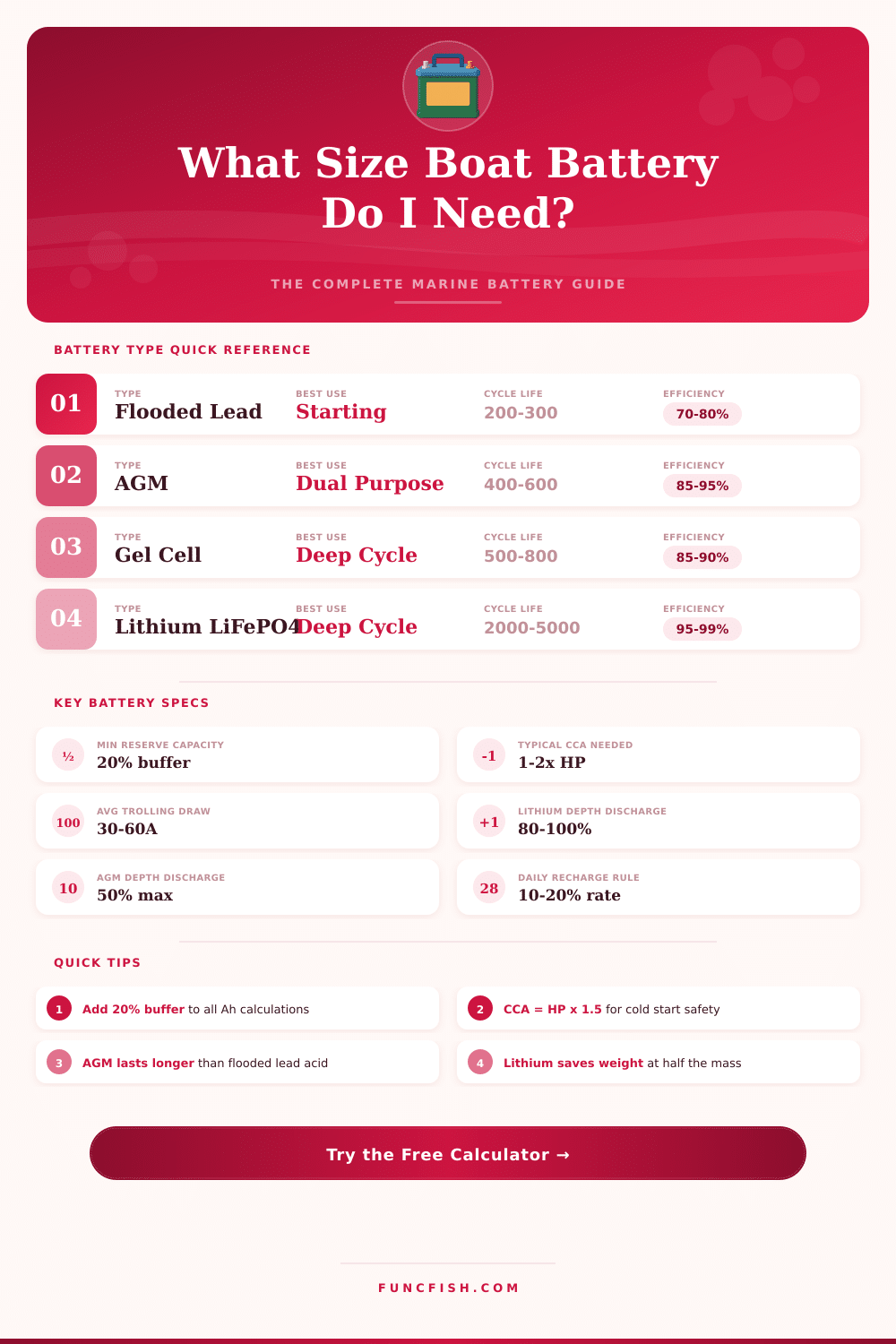
Boat Battery of 12 V with 125 Ah can in theory put out 125 amps during one full hour. Boats for fishing usually use systems of 12 V between 80 and 120 Ah, while the bigger brothers maybe need 24 V or 48 V setups instead. Lithium batteries last around a decade and weigh almost 50 to 70 percent less than lead-acid options.
They also cut the Size that one would need in half, quite useful, when thespace is tight.
Using double systems of batteries in a boat makes a real change. One of them must be a Boat Battery for starting, kept only for the engine, keep it separate, so that it never drains. The second is a deep cycle battery, that handles the extra devices: lights, fish finders, radios, everything like that.
For starting batteries, most plan around 300 to 500 CCA based on the Size of the engine. Useful is having three or four times your daily use in the whole capacity of batteries. So if your daily use is 120 Ah, you plan between 360 and 480 Ah in total.
The total needs of voltage matter a lot. Using a television or radios? Deep cycle is the right way.
Trolling motors need at least 75 Ah to work well, but 100 Ah works better for all-day fishing. An engine of 36 volts does need three batteries of 12 V connected in series. Counting from watt-hours and dividing by voltage, one finds the right rating of Ah for your trolling motor.