Boat Dock Line Size Calculator
Estimate dock line diameter, line length, working margin, and setup class from boat size, tide, wind, cleat spacing, material, and safety factor.
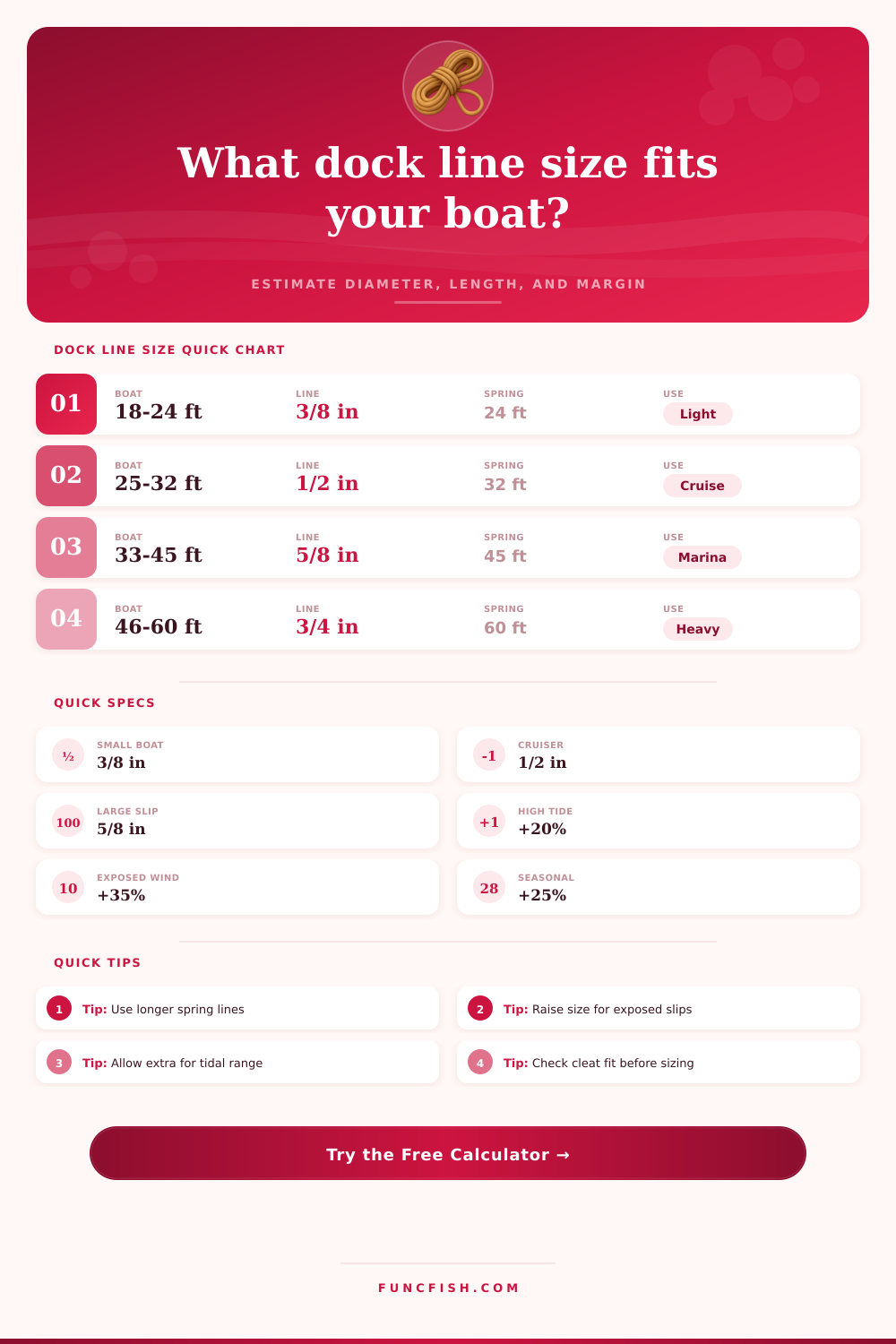
| Nominal Diameter | Metric Diameter | Baseline Break Load | Typical Boat Range |
|---|---|---|---|
| 3/8 in | 10 mm | 3,700 lb / 1,678 kg | 18-24 ft light boats |
| 1/2 in | 12 mm | 5,850 lb / 2,653 kg | 25-32 ft cruisers |
| 5/8 in | 16 mm | 9,350 lb / 4,241 kg | 33-45 ft slips |
| 3/4 in | 20 mm | 13,000 lb / 5,897 kg | 46-60 ft heavy berths |
| 7/8 in | 22 mm | 18,500 lb / 8,391 kg | Large exposed moorings |
| 1 in | 25 mm | 24,000 lb / 10,886 kg | Very heavy dock loads |
| Exposure Setting | Load Multiplier | Best Fit | Calculator Effect |
|---|---|---|---|
| Protected basin | 0.85 | Light wind and short fetch | Allows smaller demand load |
| Typical marina | 1.00 | Normal slips and fairways | Uses baseline demand load |
| Open fetch | 1.35 | Outer dock or open channel | Raises load and line size |
| High exposure | 1.70 | Holding setup with heavy wind | Requires stronger margin |
| Mooring Duration | Multiplier | Line Length Bias | Setup Class Signal |
|---|---|---|---|
| Short stop | 0.90 | Compact bow and stern leads | Day dock |
| Overnight or weekend | 1.05 | Extra slack and spring control | Overnight |
| Seasonal berth | 1.25 | Longer springs and tide allowance | Seasonal |
| Extended unattended | 1.45 | Highest length and margin bias | Heavy duty |
| Line Position | Length Rule | Main Role | Tide Note |
|---|---|---|---|
| Bow line | 0.65-0.85 x boat length | Holds bow near dock | Add slack for vertical change |
| Stern line | 0.65-0.85 x boat length | Holds stern near dock | Match lead angle to cleat height |
| Spring line | 1.00-1.50 x boat length | Controls fore-aft motion | Longer springs handle tide better |
| Breast line | Shortest practical lead | Controls side motion | Avoid over-tight vertical leads |
Selecting the correct dock lines is an important task insofar as the dock lines must be able to manage the force that are applied to the boat. The dock lines may appear to be the apropiate size when the boat is moored into the dock with the water relatively calm. However, those same dock lines may fail to provide enough force to manage the boat if the water becomes more disturbed or if the tide within the slip change.
The dock lines must be sized to ensure that they dont allow the boat to hit the dock if they stretch too much, yet they should not be too tightly to the boat such that the cleats upon which the dock lines are attached experience shock load. Thus, some balance must be found between these two situations. In order to size the dock lines apropiately, the dock line calculator requires several different inputs.
How to Choose the Right Dock Lines
The length of the boat and the displacement of the boat are two of the necessary inputs into the calculator. Additionally, the amount of exposure that the boat has to the wind is a necessary input. The tidal range and the spacing of the boats cleats are also important parameters for the calculator.
Finally, the length of time that the boat will be moored to the dock is also an important input to the calculator. Each of these factors will help the calculator to more appropriately size the dock lines for the boat. In addition to these various inputs, the choice of the material of the dock lines is also a critical factor in determining how the dock lines will perform when attached to the boat.
For instance, nylon dock lines will absorb some of the shock that the boat encounters in waves, while dock lines made of polyester will allow for more of the load to be placed upon the cleats that are attached to the boat. The calculator outputs the required diameter of the dock lines based off this information; dock lines that absorb some of the load will have a smaller required diameter than those that do not. An additional input within the calculator that allows for the selection of the dock lines is the safety factor; this adjustment will allow for the boat owner to choose how conservative the sizing of the dock lines should be.
Another method for determining the size of the dock lines is to refer to the dock lines that are attached to the boats of neighbors. This method, however, is not necessarily accurate in all situations. For instance, the neighbor’s boat may be heavier than the owners boat, the neighbors slip may be more exposed to the elements than the slip in which the owners boat is moored, or the tidal range within the owners slip may be more extreme than that within the neighbors slip.
Thus, the load upon the dock lines in these situations may be greater for the owners boat and dock line setup. Finally, within the calculator, there are recommendations for the length of the dock lines. For instance, bow lines and stern lines must have enough length to allow the boat to move vertically, as well as avoid setting the cleats of the boat at an excessively steep angle to the dock.
Furthermore, spring lines need to have some extra length to allow for the lines to stretch as the boat may move, which help the boat to return to its original resting position. Each of these length recommendations are built into the calculator; each dock line will have an appropriate length based upon the parameters that are entered into the tool. Another common mistake in mooring boats to docks is to assume that each of the dock lines has the same function.
For instance, breast lines will hold the boat closer to the dock, so they may be of a relatively shorter length than other dock lines. However, breast lines are not used to absorb some of the movement of the dock lines that are used to allow the boat to return to its resting position. Thus, attempting to use one dock line for two different tasks will lead to strain upon the dock line or boat cleats.
The calculator outputs information that helps separate these two tasks so that the dock lines can be appropriately sized for the intended function of each line. Another important consideration for dock lines is the protection of the dock lines from chafing against the dock. Dock lines that are provided with chafe guards will not fail due to chafing against the dock; however, many boat owners either add chafe guards to dock lines or reroute the dock lines to avoid chafing.
Each of these modifications will help to extend the life of dock lines more than adding dock lines of increased diameter. The tables that are provided within the calculator allow for the boat owner to review the calculations made by the calculator in comparison to typical recommendations for boat dock lines. These tables are not strict rules to which dock lines must adhere.
Rather, the tables help to show to what extent the majority of boats are moored within the docks. Should a boat owner find that the size of their dock lines is outside of these recommendations, they should review each of the parameters that they entered into the calculator. The reason for the dock lines having a different size than these recommendations will be related to one of the parameters that they entered when using the calculator.
Finally, the task of choosing dock lines is not one in which there is a single perfect answer. However, there is a balance that must be found between the forces that is exerted upon the boat while moored to the dock; the calculator helps to remove most of the guesswork that must be performed in this task. Thus, the boat owner must still make a decision as to what the appropriate balance of dock line strength should of be in relation to the boat and its mooring situation.