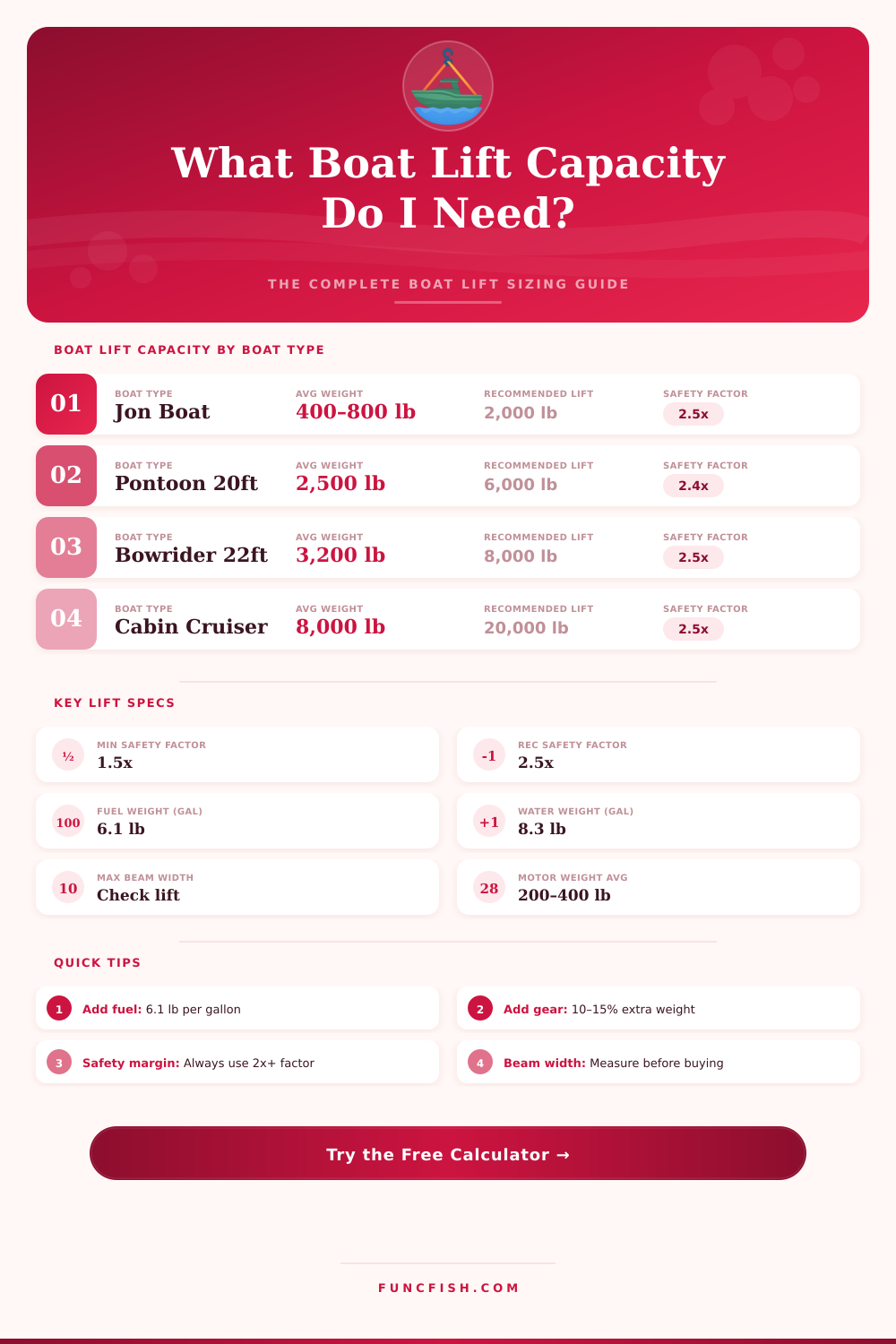
⛴️ Boat Lift Capacity Calculator
Find the correct boat lift size for your vessel — includes safety factor, fuel, gear & motor weight
| Boat Type | Typical Dry Weight | Loaded Weight Estimate | Recommended Lift (2.5x) | Lift Type Suggestion |
|---|---|---|---|---|
| Jon Boat 10–14ft | 300–700 lb (136–318 kg) | 600–1,200 lb | 2,000 lb | Hydraulic / PWC |
| Bass Boat 16–20ft | 1,000–1,800 lb (454–816 kg) | 1,800–3,000 lb | 6,000 lb | Hydraulic / 4-Post |
| Aluminum Fishing 14–18ft | 500–1,200 lb (227–544 kg) | 1,000–2,000 lb | 4,000 lb | Hydraulic |
| Pontoon 18–22ft | 1,800–3,000 lb (816–1,361 kg) | 3,000–5,000 lb | 8,000 lb | 4-Post Freestanding |
| Pontoon 24–28ft | 3,000–4,500 lb (1,361–2,041 kg) | 5,000–7,000 lb | 14,000 lb | 4-Post / Hi-Tide |
| Bowrider 20–24ft | 2,500–4,000 lb (1,134–1,814 kg) | 4,000–6,000 lb | 10,000 lb | 4-Post Freestanding |
| Center Console 20–26ft | 2,000–4,500 lb (907–2,041 kg) | 3,500–7,000 lb | 12,000 lb | 4-Post / Vertical |
| Cabin Cruiser 26–32ft | 6,000–12,000 lb (2,722–5,443 kg) | 8,000–16,000 lb | 20,000–40,000 lb | Vertical / Marine Railway |
| Sailboat 22–30ft | 4,000–10,000 lb (1,814–4,536 kg) | 5,000–12,000 lb | 15,000–30,000 lb | Vertical / Piling |
| PWC / Jet Ski | 700–1,000 lb (318–454 kg) | 900–1,400 lb | 2,000 lb | PWC Lift |
| Lift Type | Capacity Range | Best For | Key Feature | Water Depth Needed |
|---|---|---|---|---|
| Hydraulic / Cantilever | 1,500–10,000 lb (680–4,536 kg) | Small–medium boats | Simple, reliable mechanism | 2–4 ft (0.6–1.2 m) |
| 4-Post Freestanding | 4,000–20,000 lb (1,814–9,072 kg) | Medium–large boats | Stable in all conditions | 3–6 ft (0.9–1.8 m) |
| Vertical (Elevator) | 10,000–60,000 lb (4,536–27,216 kg) | Large boats & deep water | Works in deep/tidal water | 5–15 ft (1.5–4.6 m) |
| PWC / Jet Ski Lift | 1,000–2,500 lb (454–1,134 kg) | PWC / personal watercraft | Compact & low cost | 2–3 ft (0.6–0.9 m) |
| Floating Boat Lift | 3,000–20,000 lb (1,361–9,072 kg) | Fluctuating water levels | Adjusts with water level | Any depth |
| Piling-Mounted | 2,000–15,000 lb (907–6,804 kg) | Dock-installed setups | Fixed to existing pilings | 3–8 ft (0.9–2.4 m) |
| Pipe Frame Lift | 1,500–6,000 lb (680–2,722 kg) | Shallow water / small boats | Low cost, manual option | 1.5–3 ft (0.5–0.9 m) |
| Hi-Tide / Cradle | 5,000–25,000 lb (2,268–11,340 kg) | Large pontoons & cruisers | Wide beam support cradle | 4–8 ft (1.2–2.4 m) |
| Water Condition | Min Safety Factor | Rec. Safety Factor | Example Locations | Notes |
|---|---|---|---|---|
| Calm Lake / Protected | 1.5x | 2.0x | Private lakes, coves | Low wave action |
| Moderate (light chop) | 2.0x | 2.5x | Large lakes, inland bays | Occasional boat wakes |
| Rough / Tidal | 2.5x | 3.0x | Rivers, tidal creeks | Dynamic loading from current |
| Saltwater / Coastal | 3.0x | 3.5x | Ocean, sounds, ICW | Corrosion + surge loads |
| Component | Imperial | Metric | Notes |
|---|---|---|---|
| Gasoline (fuel) | 6.1 lb/gal | 0.73 kg/L | Standard gasoline density |
| Diesel fuel | 7.1 lb/gal | 0.85 kg/L | Heavier than gasoline |
| Fresh water | 8.34 lb/gal | 1.0 kg/L | Ballast / livewell |
| Salt water | 8.56 lb/gal | 1.025 kg/L | Slightly denser than fresh |
| Small outboard (2–10 HP) | 25–80 lb | 11–36 kg | Portable motors |
| Mid outboard (15–60 HP) | 80–250 lb | 36–113 kg | Common fishing motors |
| Large outboard (75–200 HP) | 250–450 lb | 113–204 kg | Bowrider / CC motors |
| V8 Inboard / Sterndrive | 600–900 lb | 272–408 kg | Cabin cruisers |
| Average adult passenger | 175 lb | 79 kg | ABYC standard estimate |
| Typical gear load (small boat) | 50–150 lb | 23–68 kg | Tackle, rods, life jackets |
| Typical gear load (large boat) | 200–600 lb | 91–272 kg | Electronics, anchors, etc. |
| Anchor + rode (small boat) | 20–50 lb | 9–23 kg | Danforth + nylon rode |
Boat lifts come in all sizes (genuinely), the range is huge. In the bottom limit, you find models for only thousand pounds while others fit to bear until two hundred thousand pounds. More than you believe, matter to choose the apt weight skill.
Here is how to estimate what lift you genuinely require. Start with the dry weight of your boat, later add the capacity of the fuel tanks multiplied by six. Add another 500 pounds for gears, coolers and everything else that piles up.
How to Choose the Right Boat Lift
Like this you receive the real working load that the lift must last, not only the basic weight. The dry weight normally includes the body, occasionally with the advised engine. The real full weight comes when you consider fuel, boxes, water in livewells and bilges, extra items and folks up.
Here the key spot: the lift requires more skill than you genuinely nede. I found that 20 percent safety margin feels well, and if your total weights fall between two sizes, choose the stronger. Assume the calculation reaches 3,500 pounds; with margin it becomes around 4,200 pounds for your target.
Be smart to oversize if you plan to alter to bigger boat later. Such situation happens commonly (for instance some with 10),000-pound boat intends 12,000-pound lift and see that it is too confined.
The weight distribution matter likewise as the total weight, according to me. Four-piling lift for 10,000 pounds shares the burden equally, so 2,500 pounds each pile. According to that, the center of gravity of the boat recline exactly above the piles.
But if the weight divides because of some cause, you require stronger lift for stay safe.
Lift sizing depend on matching with your own boat. Weight and beam must answer well. You can exchange bunks, yes, but do not add skill nor alter beam.
Is also effect called compounding, that doubles the lift, although it halves the haste.
Well know about some concrete variants. Aluminum hydraulic lifts of 4,500 pounds answer for seasons on lakes and bear boats of 22 until 24 feet. ShoreStation bid hydraulics of 4,000 until 15,000 pounds with aluminum frames, wireless drives and sensor up.
Floating lifts is other opportunity, they have 14,000 and 20,000 pound capacity. Some goes to heavy extremes; one model reaches 54,000 pounds. 30K lifts bear until 30,000 pounds, while 40K go until 40,000.
Surpass the rated skill do not value the danger. Maybe are a bit of wiggle room over the limit, but not a lot. Those maximum figures are the real measure for safely lifting your boat without overloadingthe machine.