⚓ Boat Motor Size Calculator
Find the perfect horsepower for your boat based on weight, length, hull type & intended use
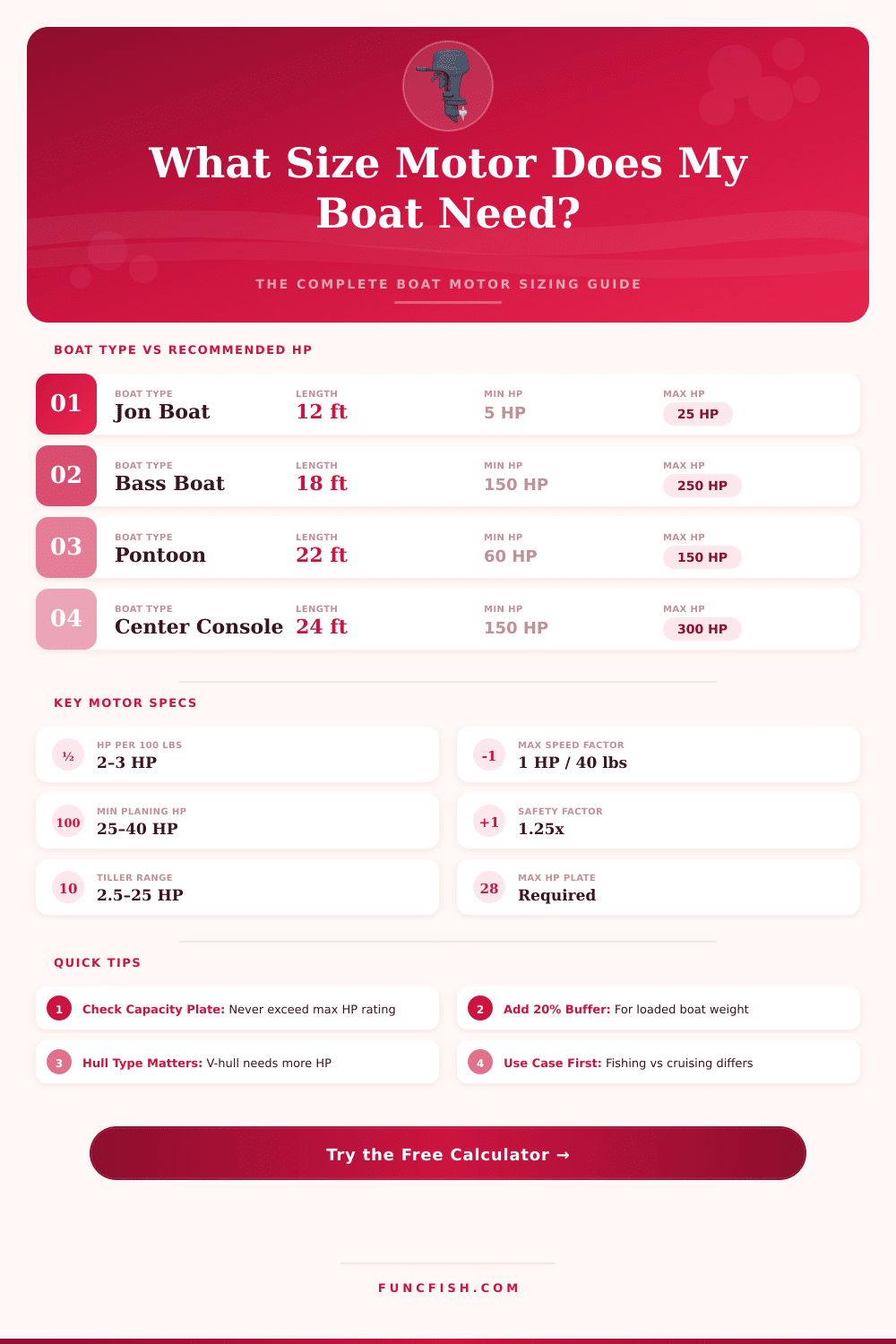
| Boat Type | Typical Length | Typical Weight | Min HP | Rec. HP | Max HP | Motor Type |
|---|---|---|---|---|---|---|
| Jon Boat (small) | 10–12 ft | 200–400 lb | 5 | 15–25 | 25 | Tiller Outboard |
| Jon Boat (medium) | 14–16 ft | 400–700 lb | 15 | 30–50 | 60 | Tiller Outboard |
| Jon Boat (large) | 18–20 ft | 700–1200 lb | 40 | 60–90 | 115 | Remote Outboard |
| Bass Boat | 16–21 ft | 1200–2000 lb | 90 | 150–200 | 250 | Remote Outboard |
| Pontoon (small) | 18–20 ft | 1500–2500 lb | 40 | 60–90 | 115 | Outboard |
| Pontoon (large) | 22–28 ft | 2500–4500 lb | 90 | 115–175 | 250 | Single/Twin Out. |
| Center Console | 18–26 ft | 2000–5000 lb | 115 | 150–300 | 350+ | Single/Twin Out. |
| Dinghy / Inflatable | 8–12 ft | 100–400 lb | 2.5 | 6–15 | 25 | Tiller Outboard |
| Kayak / Canoe | 10–14 ft | 50–150 lb | 0.5 | 1–3 | 5 | Trolling Motor |
| Offshore / Deep-V | 24–35 ft | 4000–12000 lb | 200 | 300–600 | 1000+ | Twin/Triple Out. |
| Hull Type | HP Multiplier | Notes |
|---|---|---|
| Flat Bottom | 1.0x | Easiest to plane, lowest HP |
| V-Hull (Moderate) | 1.15x | Good all-around performance |
| Deep-V Hull | 1.25x | Best rough water, needs more HP |
| Pontoon / Tri-toon | 1.2x | Wide beam, high drag |
| Inflatable / RIB | 0.9x | Light, efficient, less HP needed |
| Use Type | HP Adjust | Reason |
|---|---|---|
| Fishing / Trolling | +0% | Baseline; moderate speed |
| Leisure / Cruising | +10% | Comfortable cruise speed |
| Water Sports / Towing | +25% | Wakeboarding, skiing drag |
| Offshore / Open Water | +30% | Safety margin in rough seas |
| Horsepower (HP) | Kilowatts (kW) | Typical Application | Boat Size Range |
|---|---|---|---|
| 2.5 HP | 1.9 kW | Kayak, canoe, dinghy | 8–11 ft |
| 6 HP | 4.5 kW | Small inflatable, tender | 10–13 ft |
| 15 HP | 11.2 kW | Small jon boat | 12–14 ft |
| 25 HP | 18.6 kW | Jon boat, small aluminum | 14–16 ft |
| 40 HP | 29.8 kW | Small pontoon, aluminum | 16–18 ft |
| 60 HP | 44.7 kW | Mid pontoon, walleye boat | 18–20 ft |
| 90 HP | 67.1 kW | Bass boat entry, pontoon | 18–21 ft |
| 115 HP | 85.8 kW | Bass boat, center console | 17–21 ft |
| 150 HP | 111.9 kW | Bass boat, CC, offshore | 18–24 ft |
| 200 HP | 149.1 kW | Center console, offshore | 20–26 ft |
| 250 HP | 186.4 kW | High-perf bass, offshore | 21–28 ft |
| 300 HP | 223.7 kW | Large offshore, twin rig | 24–32 ft |
| 350 HP | 261.0 kW | Offshore, large CC | 26–35 ft |
| Boat Weight (loaded) | Min Thrust (lbs) | Rec. Thrust | Voltage | HP Equiv. |
|---|---|---|---|---|
| Up to 1,000 lb (454 kg) | 30 lbs | 45 lbs | 12V | ~0.5 HP |
| 1,000–1,500 lb (680 kg) | 45 lbs | 55 lbs | 12V | ~0.7 HP |
| 1,500–2,000 lb (907 kg) | 55 lbs | 70 lbs | 24V | ~1.0 HP |
| 2,000–2,500 lb (1134 kg) | 70 lbs | 80 lbs | 24V | ~1.2 HP |
| 2,500–3,000 lb (1361 kg) | 80 lbs | 101 lbs | 36V | ~1.5 HP |
| 3,000+ lb (1361+ kg) | 101 lbs | 112+ lbs | 36V | ~1.7+ HP |
Choosing the right Size of Boat Motor for a boat seems easy, but actually requires care. The decision depends on the model of the boat, its specs, limits of the maker, the way one will use it, and the conditions of the water in the region. Good choice of Boat Motor makes the time on the water more fun and without problems.
Every boat with power comes with a plate from the maker about capacity. It points the maximum horsepower that one allows. Following it is important.
How to Choose the Right Boat Motor Size
Installing a Boat Motor that is too strong for the boat can create danger. Here is a good example: a 1436 Jon-boat works well with an 8 hp Boat Motor but it handles up to 15 hp. Putting 25 hp on the same boat would be truly dangerous.
Also a four-stroke engine weighs more than a matching two-stroke, and although weight is not officially limited, it still matters a lot.
For Jon-boats widely a 6 hp Boat Motor is enough to move one under 6,000 pounds at good pace. A 9.9 hp engine works for Jon-boats under 12,000 pounds. That explains why the 9.9 hp is a popular choice, because it fits the most many Sizes of Jon-boats, from 10 feet to 14 feet and even a bit bigger, if teh weight stays inside the limits.
Pontoon boats form a totally different case. Choices of horsepower go from 9.9 to 600. For mid-Size pontoon engines one uses around 50 to 150 hp.
The design of pontoons truly improved, and Boat Motors now reach speeds that one never saw before four that kind of boat. 90 hp on a 24-foot pontoon can reach around 20 miles each hour on a calm day. Even so changing to 115 hp on a three-pontoon seems much better, because it uses less fuel and handles games like tubing easily.
Here is a simple way to count the Size of engine. First add up the full loaded weight of the boat, that includes gas, engine, folks, gear, anchor and everything else. Split that number by 30, and the result points the horsepower that one needs to reach 30 miles each hour.
For instance, a boat with total loaded weight of 895 pounds would need around a 30 hp engine.
Insurance forms another spot that one must think about. Before boosting the engine, it is good to check the rules of the insurance company about limits of horsepower. Bigger horsepower usually brings a higher fee.
The whole Size of the ship, including the horsepower, can even change the type of policy involved.
Even little engines have their role. 7.5 hp is the minimum to start a boat from rest, but 15 hp engines do not weigh much more and give more force. Little engines that can not reach planing speed burn more fuel for the distance traveled.
Common advice is to buy the strongest engine that the capacity plate allows. Boats with maximum horsepower commonly use less fuel at cruising pace, because the engines turn at lower RPM. They alsosell more easily later.