⛵ Boat Speed Calculator
Calculate boat speed in MPH, knots & KPH — hull speed, engine power, and condition adjustments
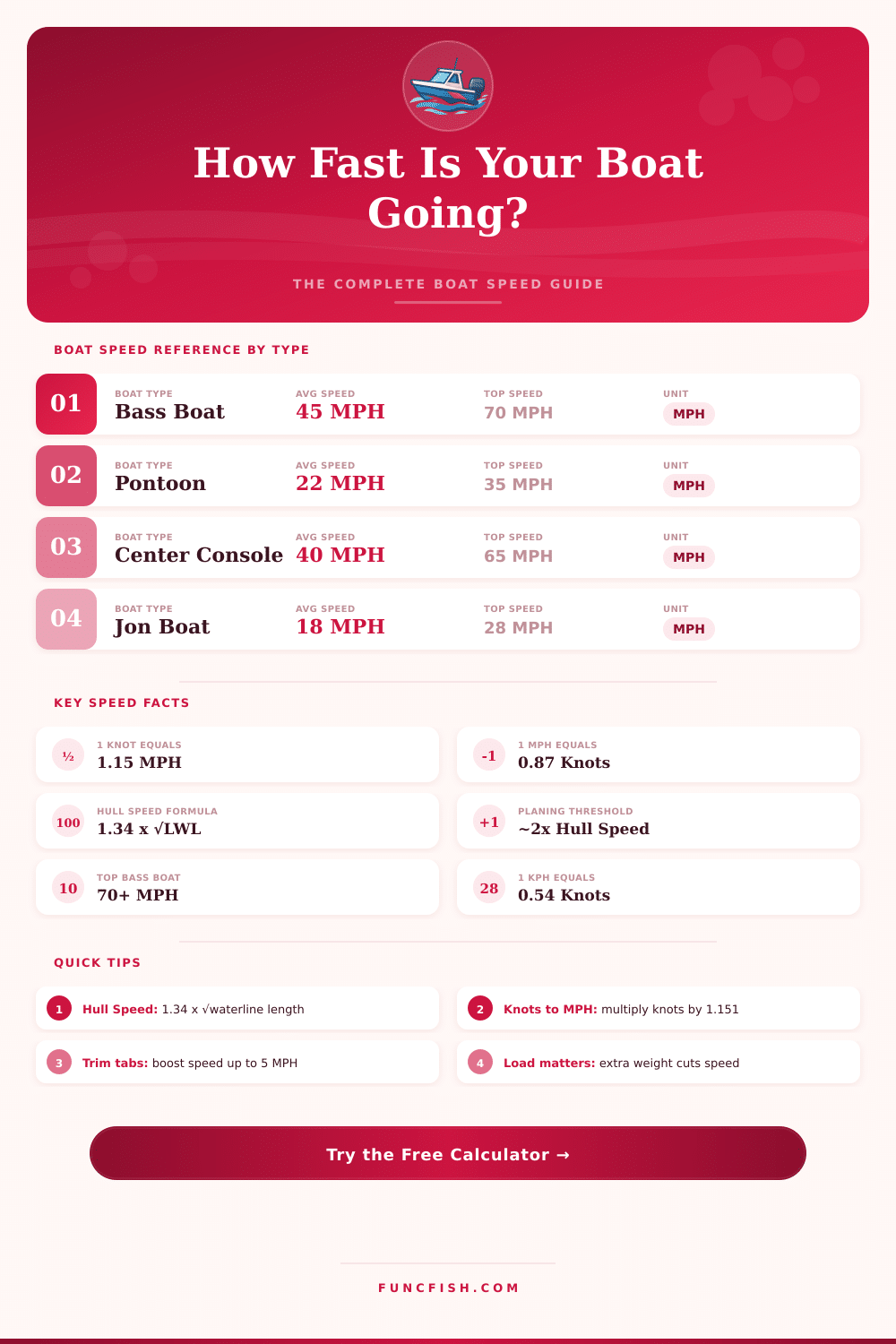
| Boat Type | Avg Speed (MPH) | Top Speed (MPH) | Avg Speed (Knots) | Avg Speed (KPH) |
|---|---|---|---|---|
| Bass Boat | 45 | 70 | 39.1 | 72.4 |
| Pontoon Boat | 22 | 35 | 19.1 | 35.4 |
| Center Console | 40 | 65 | 34.8 | 64.4 |
| Jon Boat | 18 | 28 | 15.6 | 29.0 |
| Walleye Boat | 40 | 60 | 34.8 | 64.4 |
| Offshore Cruiser | 30 | 50 | 26.1 | 48.3 |
| Jet Ski / PWC | 55 | 70 | 47.8 | 88.5 |
| Kayak | 3.5 | 5 | 3.0 | 5.6 |
| Sailboat | 7 | 12 | 6.1 | 11.3 |
| MPH | Knots | KPH | m/s |
|---|---|---|---|
| 5 | 4.34 | 8.05 | 2.24 |
| 10 | 8.69 | 16.09 | 4.47 |
| 20 | 17.38 | 32.19 | 8.94 |
| 30 | 26.07 | 48.28 | 13.41 |
| 40 | 34.76 | 64.37 | 17.88 |
| 50 | 43.45 | 80.47 | 22.35 |
| 60 | 52.14 | 96.56 | 26.82 |
| 70 | 60.83 | 112.65 | 31.29 |
| Hull Material | Speed Factor | Weight Impact | Best Use |
|---|---|---|---|
| Fiberglass | 1.00 (baseline) | Medium | All-around, sport fishing |
| Aluminum | 0.95 | Light | Lakes, rivers, fishing |
| Carbon Composite | 1.08 | Very Light | Racing, performance |
| Wood / Plywood | 0.90 | Heavy | Classic, inland water |
| Inflatable / Hypalon | 0.88 | Very Light | Dinghies, tenders |
| Steel | 0.82 | Very Heavy | Offshore, commercial |
| Kevlar | 1.10 | Lightest | High performance |
| Rotomolded Plastic | 0.86 | Medium | Kayaks, canoes |
| Conditions | Speed Reduction | Wave Height | Recommended Action |
|---|---|---|---|
| Calm / Flat | 0% | 0–0.5 ft | Full speed OK |
| Light Chop | 5–10% | 0.5–1 ft | Slight throttle back |
| Choppy | 15–20% | 1–2 ft | Reduce speed, watch trim |
| Rough | 25–35% | 2–4 ft | Significant slowdown needed |
| Very Rough | 40–60% | 4+ ft | Seek shelter if possible |
Boat speed varies depending on the kind you talk about. Average sailboat sails at 5-7 knots in good winds. Up wind it must tack, which slows progress.
Sailboats can keep that speed as long as the wind, crew and provisions last The pleasure boats usually reach 35-40 mph. It does not sound crazy fast, but on water it feels much more fast.
Boat Speeds and Safety
Motorboats designed for high speed and called cigarette boats because of their narrow shape or simply go-fast boats, reach 90 mph easily above calm waters. Speedboats for enthusiasts commonly surpass 100 mph. Offshore powerboats cross 100 knots, or around 115 mph, and are famuos because of their strength in heavy conditions.
They have reinforced hulls and strong engines, so you choose them for racing runs.
The fastest boat on water was Spirit of Australia with 317 mph. This wooden speedboat used Westinghouse J34 jet engines, like planes and fighter jets. Unlimited hydro boats with turbine engines probably are the fastest in race, reaching more than 260 mph during a quartre mile.
They however are not useful for other uses than racing.
There is a rule for hull speed. Maximum speed in knots is 1.34 times the square root of the length at the waterline in feet. It depends on the waves that the hull creates in water.
Each hull has its hull speed proportionate to its length. For real high speed on water, you must raise it out of the water as much as possible. The secret for a fast boat is to make it a plane.
Water becomes awfully hard above 30 mph. Hitting another boat at such speeds is no game.
To use a boat safely, the most important thing to recall is that every ship must go at a speed that gives time and distance to avoid collisions. Unlike on roads with clear limits, on water there are often no marks. Many places require slow speeds to 10 km/h in 30 metres of coast.
Remember obstacles like rocks, tree stumps or shallow areas. You must consider stoppingdistance and turning of the boat.