Boat Winch Capacity Calculator
Estimate trailer winch capacity, ramp pull load, safety margin, and strap tension from loaded boat weight, ramp slope, roller or bunk friction, trailer setup, strap angle, safety factor, load condition, selected winch rating, and units.
📌Named boat winch presets
⚙Boat weight, ramp, trailer, strap, and winch inputs
Model: the calculator estimates ramp pull as boat weight times ramp slope force plus support friction, adjusts for loading condition and trailer alignment, then converts pull into strap tension based on strap angle. The required capacity card applies your safety factor.
Boat winch capacity results
Calculation breakdown
🛠Trailer support friction data grid
Wet Roller Trailer
Slick Wet Bunks
Plain Carpet Bunks
Dry Rough Bunks
📊Boat and trailer winch comparison grid
Manual Single-Speed Strap
Works best when the boat is light, the ramp is moderate, and the hull is still mostly floating.
Manual Two-Speed Strap
Better mechanical range for heavier fishing rigs, tandem trailers, or occasional low-water pulls.
Electric Straight-Line
Useful for repeat retrieves where strap angle, battery condition, and drum layer are controlled.
Double-Line Block Setup
Reduces line load at the winch but halves line speed and requires a rated anchor point.
📋Reference tables for ramp and winch estimating
| Ramp angle | Approx grade | Slope force only | What it means |
|---|---|---|---|
| 4° | 7.0% | 7% of boat weight | Gentle ramp, friction may dominate |
| 7° | 12.3% | 12% of boat weight | Common protected-water ramp range |
| 10° | 17.6% | 17% of boat weight | Moderate ramp where strap angle matters |
| 13° | 23.1% | 22% of boat weight | Steep retrieve, more reserve is sensible |
| 16° | 28.7% | 28% of boat weight | Very steep for heavy bunk trailers |
| Support type | Coefficient used | Typical condition | Capacity note |
|---|---|---|---|
| Wet rollers | 0.04 to 0.06 | Rolling support, aligned keel | Lowest steady pull for small boats |
| Wet slick bunks | 0.07 to 0.11 | Clean carpet or slick covers | Good normal retrieve assumption |
| Plain carpet bunks | 0.14 to 0.18 | Common bunk trailer | Use loaded weight and safety factor |
| Dry rough bunks | 0.22 to 0.30 | Low water, dry carpet, grit | First pull can be much higher |
| Mud or sand contact | 0.32 to 0.40 | Sticky ramp or hull drag | Plan extra reserve and inspect setup |
| Load condition | Multiplier | Use when | Result effect |
|---|---|---|---|
| Mostly floating | 0.65 | Boat is floated forward to bow stop | Lower ramp pull than full hull weight |
| Wet normal retrieve | 1.00 | Usual ramp loading with wet supports | Baseline for most trailer estimates |
| Dry or low water pull | 1.25 | Boat is partly dragged over dry bunks | Raises capacity requirement |
| Wind or current angle | 1.18 | Side force or poor alignment at ramp | Adds steering and side-load demand |
| Stuck first pull | 1.55 | Hull must break free before rolling | Highest short-duration load estimate |
| Boat and trailer class | Loaded weight | Common winch range | Trailer setup note |
|---|---|---|---|
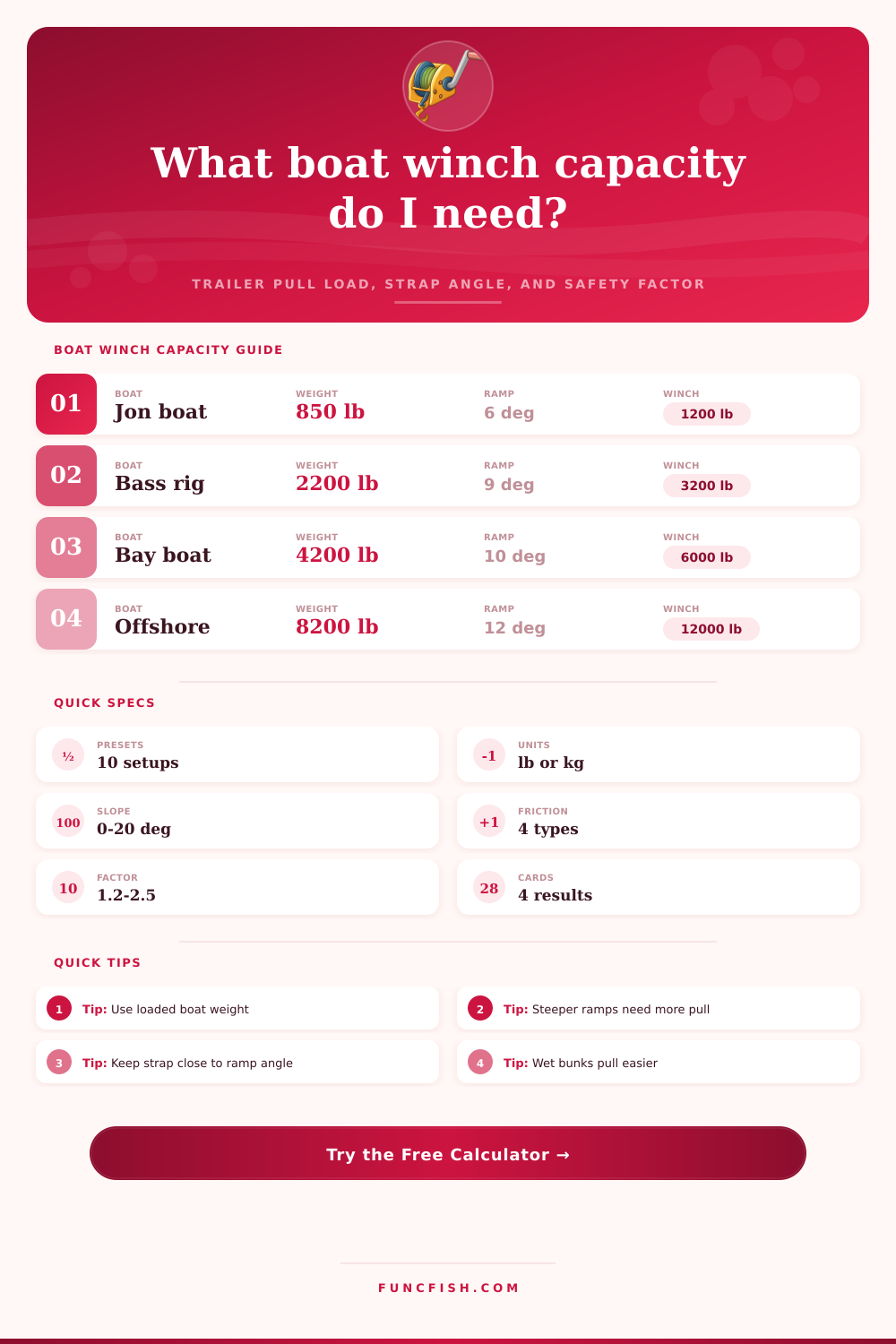
| Jon boat or kayak skiff | 400 to 1500 lb | 900 to 1800 lb | Rollers or light bunks keep pull low |
| Bass or walleye rig | 1600 to 3500 lb | 2500 to 4500 lb | Bunk friction can exceed slope force |
| Bay or center console | 3500 to 6500 lb | 5000 to 8000 lb | Tandem alignment and strap angle matter |
| Pontoon or fishing cat | 3000 to 9000 lb | 5000 to 10000 lb | Cradle geometry can add side drag |
| Offshore trailer boat | 7000 to 16000 lb | 9000 to 18000 lb | Check bow eye, post, strap, and anchor ratings |
These values are estimating aids for trailer loading. For structural ratings, always compare with the boat, trailer, bow eye, strap, cable, hook, and winch documentation.
💡Boat winch capacity tips
Fuel, batteries, kicker motors, anchors, tackle, coolers, bait tanks, water, and a wet hull can move the capacity result more than a small change in ramp angle.
A strap pulling high above the ramp direction needs extra tension for the same boat movement. Keep the bow eye, winch post, and roller geometry aligned before trusting a narrow safety margin.
Choosing a winch for a boat trailer requires consider many different variables. When choosing the winch, it is important to consider each of these variables and how they affects the winch capacity. The weight of the boat is one consideration, but the ramp angle and the trailer supports is also variables to consider.
Choosing a winch based only on the boat weight can lead to the winch failing to handle the boat when the ramp angle or trailer supports is adversely to the chosen winch. When pulling a boat using a winch, the winch must overcome several force. The weight of the boat that is present on a slope will contribute to the force that the winch must overcome.
How to Choose a Winch for Your Boat Trailer
Additionally, the winch must overcome the friction between the boat and the trailer support. The winch must also overcome the tension created by the angle of the winch strap. The winch must be strong enough to overcome each of these forces.
The calculator included in this article help to calculate the winch capacity that is required to pull a boat onto the trailer. You calculate the winch capacity by entering the weight of the boat, the angle of the trailer ramp, and the trailer setup into the calculator. The calculator can separate the slope force from the friction force.
Additionally, the calculator can adjust the total force according to the load and the trailer setup, and it can convert the forces into the tension of the winch strap. Based off the determined tension of the winch strap, the calculator can apply a safety factor to recommend the winch capacity. The calculator does not just provide a recommended winch capacity; it also calculates and provides the pull load at the boat and the strap tension.
The strap angle is an input into the calculator. The strap angle will change the tension that is required to pull the boat. If the winch strap is pulled at an angle, the tension in the strap will increase due to the angle of the strap.
Therefore, the angle of the strap will also increase the winch capacity that is required for the trailer. The trailer setup will also impact the load on the winch. A trailer with a post that is centered on a tandem axle trailer will create more drag on the trailer than a tilt trailer.
This drag will force the winch to work harder to pull the boat onto the trailer. A trailer with a double-line block will reduce the load on the winch but will also change the speed at which the winch will pull the boat onto the trailer. These different trailer setups will change the total load on the winch, so you should consider the winch when purchasing the trailer.
Friction can also impact the winch capacity. Friction between the boat and the trailer supports will create an opposing force to the winch. The type of trailer supports will impact the amount of friction between the trailer and the boat.
For example, wet rollers will create less friction between the trailer and the boat than dry bunks will. Dry bunks will require more winch capacity than trailers with wet rollers. You can select the type of trailer supports in the calculator so that the friction coefficient is entered in a way that reflects the actual type of trailer supports installed on the trailer.
The load on the trailer will also impact the winch. The force required to pull a boat that is floating in the water will require less force than a boat that is resting on dry supports. Additionally, wind and current will require extra force to be exerted by the winch.
These loads will impact the total force that the winch has to overcome. While these variables will not change the winch capacity that is specified for the winch, they will change the amount of winch capacity that is used when pulling the boat. The reference tables will include more information on each of the variables.
One table will include information on how the slope force changes with the ramp angle. Another table will include information on the ranges of friction between the trailer supports. Another table will include multipliers for different load conditions.
These tables will allow individuals to understand why two boats of the same weight could require different winch ratings. The winch specifications will change with the ramp angle and the type of trailer supports for the boat. In addition to the winch calculations, there are some additional factors to consider.
For instance, the layer on the winch drum will change the pull of the winch. Additionally, the condition of the battery will change the performance of an electric winch. Another factor to consider is the stretch of the winch strap.
The winch calculations indicated the winch capacity that should of been used for the trailer. However, if the winch is working too hard on the ramp, the safety factor should be increased to provide for the actual conditions of the ramp. In selecting the winch, it is essential that the winch has a reserve capacity beyond the force that must be exerted to pull the boat.
Using a winch that is of the correct size for the boat will make it feel effortlessness to pull the boat on the trailer. Additionally, the winch will have extra capacity to overcome the ramp angle or dry trailer supports. Having extra capacity for the winch will ensure that the winch does not fail when trying to pull the boat on the trailer.