Boilie Rolling Yield Calculator
Estimate how many boilies a carp bait batch should roll after eggs, liquids, trim loss, drying loss, diameter, and rolling board capacity are included.
📌Batch presets
⚙Rolling batch settings
Rolling yield forecast
Full calculation breakdown
🧪Mix behavior grid
Fishmeal
Birdfood
Milk Protein
Cork Dust
📏Diameter yield reference
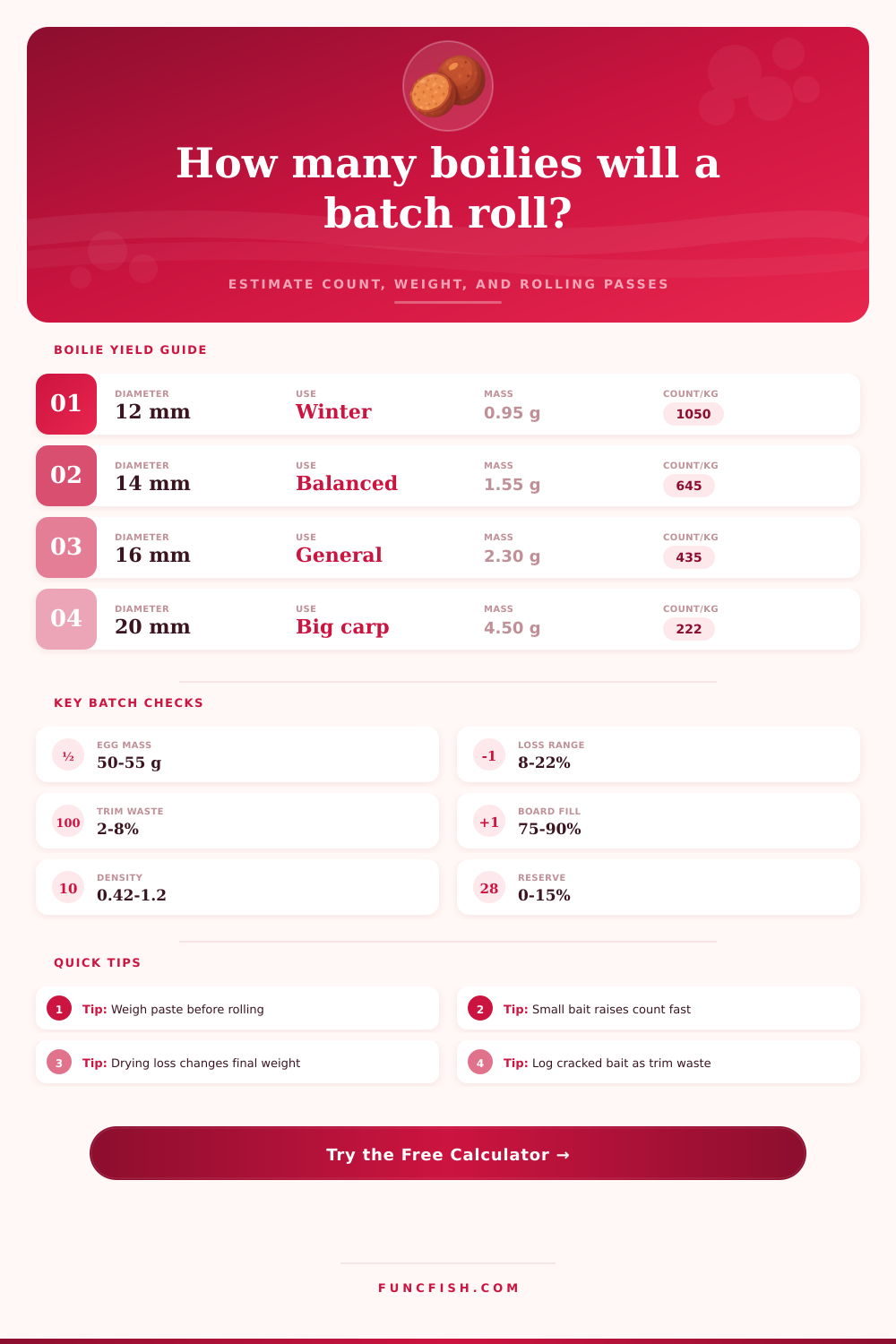
| Finished diameter | Approx bait mass at 1.08 g/ml | Boilies per finished kilogram | Typical carp bait role |
|---|---|---|---|
| 10 mm / 0.39 in | 0.57 g each | About 1768 | Cold water feed or particle-style boilies |
| 12 mm / 0.47 in | 0.98 g each | About 1023 | Winter, pressured carp, mixed-size feed |
| 14 mm / 0.55 in | 1.55 g each | About 644 | General carp fishing and balanced feeding |
| 16 mm / 0.63 in | 2.32 g each | About 431 | Standard session boilies and catapult feed |
| 18 mm / 0.71 in | 3.30 g each | About 303 | Selective feeding where nuisance fish are present |
| 20 mm / 0.79 in | 4.52 g each | About 221 | Big-fish baiting, river carp, longer drying |
| 24 mm / 0.94 in | 7.82 g each | About 128 | Large hookbaits or very selective loose feed |
🧮Rolling board pass guide
| Board setup | Small bait capacity | Standard bait capacity | Large bait capacity |
|---|---|---|---|
| 8 grooves x 30 cm | 175-210 at 10-12 mm | 105-130 at 16 mm | 70-85 at 20 mm |
| 10 grooves x 40 cm | 290-350 at 10-12 mm | 175-210 at 16 mm | 115-140 at 20 mm |
| 12 grooves x 45 cm | 390-470 at 10-12 mm | 235-285 at 16 mm | 155-185 at 20 mm |
| 16 grooves x 50 cm | 580-700 at 10-12 mm | 350-420 at 16 mm | 230-280 at 20 mm |
📊Loss allowance table
| Process point | Typical allowance | What raises it | Calculation effect |
|---|---|---|---|
| Rolling trim | 2-5% | Dry paste, split sausages, overfilled table | Reduces wet mass before count |
| Cracked boilies | 1-4% | Hard rolling, sharp edges, brittle mix | Moves bait from fishable to scrap |
| Boiling loss | 4-9% | Long boil, soluble attractors, open texture | Lowers finished mass |
| Drying loss | 5-16% | Air-drying, warm room, small diameters | Lowers packed bait weight |
| Hookbait reserve | 0-15% | Dedicated rig baits or testing batches | Reduces loose-feed count |
🔍Batch comparison grid
Small winter feed
12 mm creates a high count from the same paste mass, but board passes climb quickly because each sausage is cut into more bait.
Balanced session bait
14-16 mm gives a practical yield for most carp sessions and keeps rolling time moderate on a 10-12 groove table.
Selective big bait
18-20 mm cuts the bait count sharply, so finished weight is the better planning number than individual boilies.
Buoyant hookbait
Pop-up mix weighs less per ball, so count rises even when the paste batch looks smaller before drying.
💡Practical yield notes
Weigh the paste before sausage rolling. If the paste feels dry enough to crack at the table edge, increase trim loss before trusting the final boilie count.
Separate hookbaits from loose feed. A 5-10% reserve keeps rig baits consistent and prevents the main feed count from looking larger than it really is.
It’s the all-too-common baiting heartbreak. You stand in the kitchen with a bowl of damp paste that look like it should be feeding a small army, then discover a couple of hours later that you’ve made barely enough boilies for your next session. We measure the success of our mixes based off how they feel on the table, not how much actualy makes it into the bucket; that loss is the difference between weight of the wet paste and finished dry bait. This calculator sits above waiting to bridge that gap and do so with real numbers not hopeful estimates.
Firstly, understand that eggs aren’t free calories. They’re liquid, and they is quite heavy. When you take ten eggs and crack them into a kilogram of dry mix, you’re introducing approximately five hundred grams of moisture and protein to the bait. All that goes on hold right up to the point where the boil happens but then it’s shrink time as the starch gels and all that water evaporates. As the bait does that it gets harder. And if you’ve got your drying loss set on your tool to be fifteen percent, that means you’re chucking one sixth of your end product back up into the air.
How to Plan Your Boilie Making
Now most folks make that mistake by purchasing a kilo of meal and expecting a kilo of boilies. Unless you cook them under water in a pressure cooker, you won’t ever get that. But what about size? A twenty millimeter river bomb is four times as heavy than a twelve millimeter winter boilie. Four times! That’s not a linear but an exponential increase in volume. So although it only require very little mass of paste per ball, the number of balls you can gets into a single bag soars if you’re rolling the small stuff. But then again, rolling such small bait take forever on the table and you’ll be running more board passes to process the same amount of mix. The tool has a table that lays this all out with diameters as the reference so you can see why most folks agree a sixteen millimeter session bait seem to hit the sweet spot. It balances speed and yield.
The other silent killer is trim loss. We like to think that only those bits we drop on the floor after cutting our sausage count toward the loss. But that’s not true; we also lose those little pieces that tear or break off in the boiling process. These scraps accumulate quickly, so the trim percentage field on the calculator allow you to include this. If your sausage mix is dry, it will crack more; leading to greater loss. Adding just a bit more water to the paste can reduces loss, but will slow down drying times and could cause swelling problems. So there’s always the tug-of-war between efficiency and texture here. Log your cracked bait under “waste” so at least the final tally is based on reality versus some sort of idealized scenario where everything comes through perfectly intact.
Bottom bait is typically denser than water and sinks to the bottom. You can make them less dense by adding Cork Dust. Alternatively, you can use a very airy Birdfood mixture. This makes the same sized bait less dense and lighter for the same number of baits. You’ll have more baits out of a given amount of paste mass but they won’t last as long on the bottom because they may be eaten by bream before the carp ever see them. If you want the bait to float and present your hook, then that’s one density number. If you want the bait to hold its shape, well, then that’s another number and the tool does all the math for you.
Last but not least, consider your board size. While we won’t get too deep into the science of it all right now, having a big ol’ professional table vs. Using a little rolling board with eight grooves means you will cut and turn the same amount of material many more times than your buddy who uses the big table. This is what the passes calculation reveals to you; it translates an abstract sense of exhaustion into a concrete amount of repetitions. For instance, knowing that you’ll need to do forty full runs through the groove could of helped you decide whether to roll now or save it for later when your energy levels are higher.
Evaporation is partly predictable and partly not; you can’t control it but you can roll boilies. Measure what you have going in and account for the losses that are coming out, as you go. Stop guessing at how many baits you’ll end up with. You want to be coming off the line with some bait left over. Not an empty bucket and a sinking feeling. That’s the discipline that turns a messy kitchen project into a consistent supply chain for the next swim.