🐟 Bowfin Weight Calculator
Estimate bowfin weight from length & girth measurements — imperial & metric results
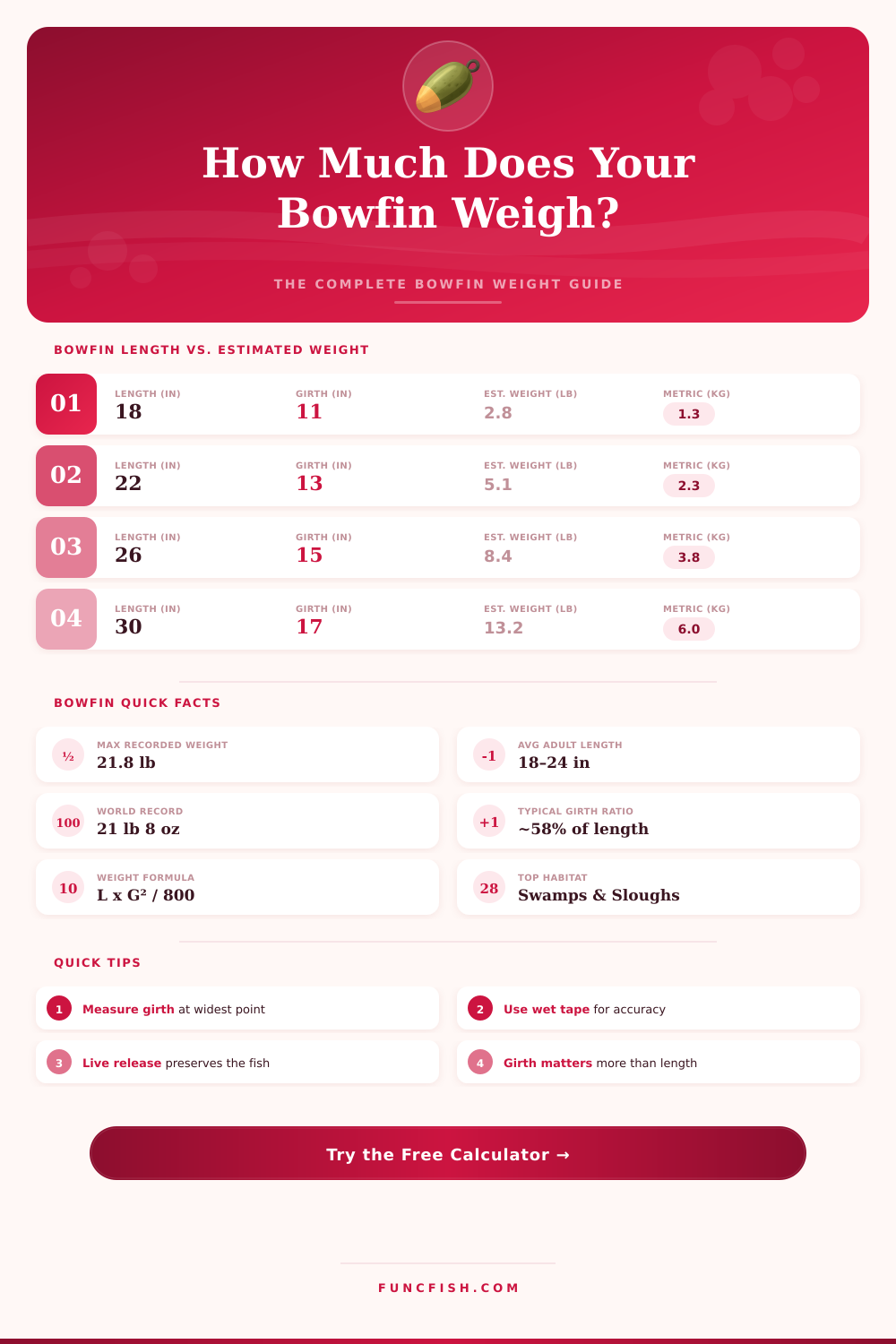
| Length (in) | Length (cm) | Est. Girth (in) | Est. Weight (lb) | Est. Weight (kg) | Size Class |
|---|---|---|---|---|---|
| 14 | 35.6 | 8.1 | 1.1 | 0.50 | Sub-Adult |
| 16 | 40.6 | 9.3 | 1.7 | 0.77 | Sub-Adult |
| 18 | 45.7 | 10.4 | 2.5 | 1.13 | Adult |
| 20 | 50.8 | 11.6 | 3.4 | 1.54 | Adult |
| 22 | 55.9 | 12.8 | 4.5 | 2.04 | Adult |
| 24 | 61.0 | 13.9 | 5.8 | 2.63 | Quality |
| 26 | 66.0 | 15.1 | 7.4 | 3.36 | Quality |
| 28 | 71.1 | 16.2 | 9.4 | 4.26 | Trophy |
| 30 | 76.2 | 17.4 | 11.6 | 5.26 | Trophy |
| 32 | 81.3 | 18.6 | 14.2 | 6.44 | Trophy+ |
| 34 | 86.4 | 19.7 | 16.5 | 7.48 | Near-Record |
| Habitat Type | Avg Length (in) | Avg Weight (lb) | Max Typical (lb) | Notes |
|---|---|---|---|---|
| Swamp / Wetland | 16–22 | 2–4 | 8 | Dense cover, slower growth |
| Lake / Reservoir | 20–28 | 4–9 | 18 | Best growth rates, open water |
| River / Stream | 18–26 | 3–7 | 14 | Current-adapted, leaner |
| Backwater / Slough | 18–25 | 3–7 | 14 | Productive, warm shallow water |
| Canal / Drainage | 14–20 | 1.5–4 | 7 | Typically smaller specimens |
| Formula | Equation | Divisor | Best Use | Accuracy Note |
|---|---|---|---|---|
| Standard | L x G² / 800 | 800 | General bowfin | Most widely used |
| Girth-Heavy | L x G² / 750 | 750 | Chunky / fat fish | Slightly overestimates lean fish |
| IGFA Trophy | L x G² / 900 | 900 | Conservative estimate | Often used for record claims |
| Conservative | L x G² / 850 | 850 | Average-condition fish | Good middle ground |
| Length-Only | 0.000137 x L³ | N/A | No girth available | Less accurate without girth |
| Cylindrical | π x (G/2π)² x L x 0.047 | N/A | Scientific model | Assumes uniform cylinder |
| Bowfin Size | Weight Range | Rod Power | Line Weight | Leader |
|---|---|---|---|---|
| Small (< 18 in) | < 2.5 lb / 1.1 kg | Medium | 10–15 lb mono | 15 lb wire/fluoro |
| Average (18–22 in) | 2.5–5 lb / 1.1–2.3 kg | Med-Heavy | 15–20 lb mono | 20 lb wire/fluoro |
| Quality (22–26 in) | 5–8 lb / 2.3–3.6 kg | Heavy | 20–30 lb braid | 30 lb wire |
| Trophy (26–30 in) | 8–12 lb / 3.6–5.4 kg | Heavy | 30–50 lb braid | 40 lb wire |
| Giant (30+ in) | 12+ lb / 5.4+ kg | X-Heavy | 50+ lb braid | 60 lb wire |
The weight of a bowfin is not always easy determined by measuring the length of the bowfin. People often attempt to estimate the weight of a bowfin by measuring the length of the fish. However, two bowfin of the same length can have a differently weight.
The girth of a bowfin determine the mass of the fish. To calculate the weight of a bowfin, you must measure its girth, spesifically the girth of a belly of the fish. The girth of the belly of a bowfin is the most important measurement for estimating the weight of a bowfin.
How to Estimate the Weight of a Bowfin
The shape of a bowfin may also play a role in calculating the weight of a bowfin. For example, the side of a bass is more compressed than that of a bowfin. Additionally, the width of the head and depth of the chest of a bowfin play a role in the weight of that fish.
An older bowfin may have a broader head and deep chest than a younger bowfin. These measurement must be included in a calculator that calculate the weight of the bowfin to determine whether that individual bowfin is lean or heavy-bodied. The habitat in which a bowfin live can also impact the physical build of the fish.
For example, bowfin that live in a swamp may have a thicker middle portion of their body than those that live in a river. River bowfin must have a more streamlined body to navigate the water efficient. Additionally, due to there feeding habits, lake bowfin may have more body weight than those that live in a river.
The weight of a bowfin can vary with the season in which the fish is captured. For example, a female bowfin may have more weight during late winter and spring due to the roe that she is carrying in her body. This round belly is filled with roe and add to the weight of the female bowfin.
After the spawning season, a bowfin may be leaner in body weight due to the roe in their bellies. You should of accounted for these conditions in estimating the weight of a bowfin. Additional considerations to determine the weight of a bowfin involves the precision with which you take the measurements.
For example, using a flexible tape to measure the girth of the fish is more accurate than taking a photograph of the fish. Because the angle of the photograph may make a thin bowfin look thick or a thick bowfin look thin, using a photograph of the fish is inaccurate. Therefore, using a confidence level with the estimated weight of the bowfin will provide a range of the weight of the fish, which is more important then a single number for describing the weight of the fish.
The weight of the bowfin will significantly increase with the size of the bowfin. As the girth and length of a bowfin increase, the weight of that fish will also dramatic increase. This is due to the fact that a bowfin that is much heavier will have more girth, which indicates that the weight of that fish will increase with the increase of it’s girth.
By measuring the girth and length of the bowfin, an individual can gain an understanding of the health and age of the bowfin populations.