🛥 Planing Boat Speed Calculator
Calculate hull speed, planing threshold, power-to-weight ratio, and top speed estimate for your boat
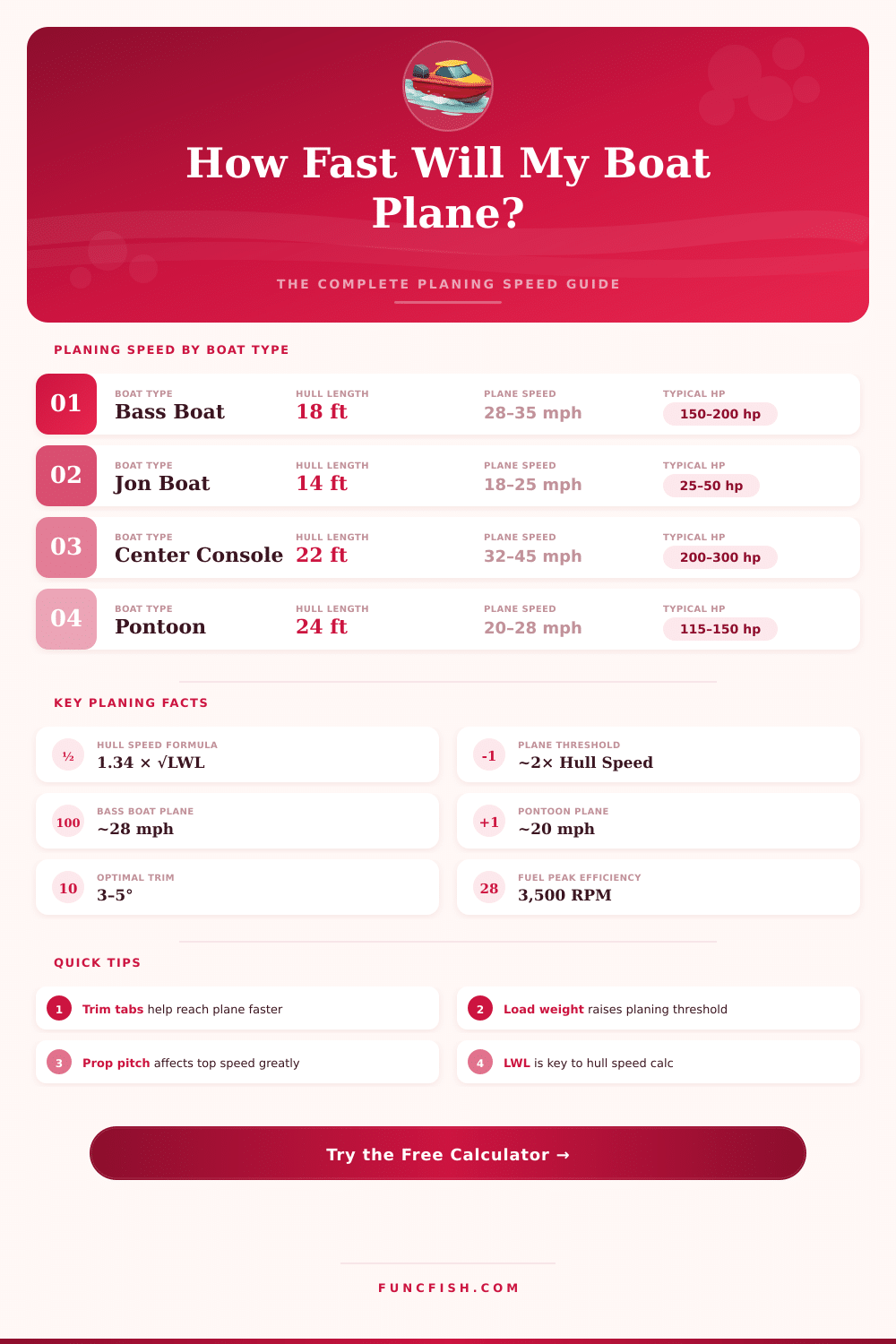
| Boat Type | Typical Length | Hull Speed | Plane Threshold | Top Speed Est. | Typical HP |
|---|---|---|---|---|---|
| Bass Boat | 17–21 ft | 5.5–6.2 mph | 11–13 mph | 60–75 mph | 150–250 hp |
| Jon Boat | 12–16 ft | 4.8–5.4 mph | 9–11 mph | 30–45 mph | 25–75 hp |
| Center Console | 18–30 ft | 5.7–7.4 mph | 12–15 mph | 45–70 mph | 150–400 hp |
| Pontoon | 20–28 ft | 6.0–7.1 mph | 12–14 mph | 20–35 mph | 115–300 hp |
| Ski / Wake Boat | 19–24 ft | 5.9–6.6 mph | 12–14 mph | 40–55 mph | 300–450 hp |
| Flats Boat | 15–18 ft | 5.2–5.7 mph | 10–12 mph | 45–65 mph | 90–150 hp |
| Offshore Sport | 24–35 ft | 6.6–8.0 mph | 13–16 mph | 50–80 mph | 300–800 hp |
| Inflatable RIB | 10–16 ft | 4.2–5.4 mph | 8–11 mph | 30–50 mph | 25–115 hp |
| Material | Weight Factor | Drag Factor | Durability | Speed Benefit |
|---|---|---|---|---|
| Fiberglass | 1.00 (baseline) | Medium | High | Baseline |
| Aluminum | 0.85 (–15%) | Medium-High | Very High | +2–4 mph |
| Carbon Composite | 0.60 (–40%) | Very Low | Medium | +6–10 mph |
| Inflatable / Hypalon | 0.50 (–50%) | Low | Medium | +5–8 mph |
| Wood / Plywood | 1.15 (+15%) | Medium-High | Low | –2–4 mph |
| Steel | 1.50 (+50%) | High | Very High | –8–15 mph |
| Kevlar / Aramid | 0.70 (–30%) | Low | High | +4–7 mph |
| Foam Core FG | 0.90 (–10%) | Low-Medium | High | +1–3 mph |
| Prop Pitch (in) | Speed Range (mph) | Best Use | RPM Range | km/h Equiv. |
|---|---|---|---|---|
| 10–12 in | 15–25 mph | Heavy loads, towing | 4,000–5,000 | 24–40 km/h |
| 13–15 in | 22–35 mph | General fishing, slow cruise | 4,500–5,500 | 35–56 km/h |
| 16–18 in | 30–45 mph | Moderate speed cruising | 4,800–5,800 | 48–72 km/h |
| 19–21 in | 40–55 mph | Performance fishing boats | 5,000–6,000 | 64–89 km/h |
| 22–25 in | 50–65 mph | High-performance bass/sport | 5,200–6,200 | 80–105 km/h |
| 26–30+ in | 60–80+ mph | Race / ultra-performance | 5,500–6,500 | 97–129 km/h |
When a boat planes, it reaches a speed where hydrodynamic forces help it rise above the water, which reduces drag while it boosts and maneuvers better The planing speed is the minimum speed a boat needs to make lift. Powerboats that drive under that speed work as displacement hulls because they do not make lift.
A boat planes when enough power pushes the hull above the water. Different boats reach planing mode at various speeds. While they boost, they rise from the water.
How Boats Plane and What Affects Planing Speed
Less hull in water means less resistance, so a planing boat can reach even bigger speds. Builders commonly design hulls that fit 40 to 60 knots.
Both the weight and the shape of the hull affect the planing speed. Long and thin boats with shallow draft and flat bottoms help to rise more easily on the plane. A longer and slim boat stays on step at lower speeds because of better lift and direct push, and it has a high top speed because of less surface tension.
Broader boats are stable, while long ones run better in waves.
Almost all commercial powerboats weigh too much for their bottom area, so they cannot easily pass from displacement to planing speed. They require a big trim angle for enough lift, which requires much power to beat the drag of that angle. Such boats feel hole well only at very low or very high speeds.
The planing speed changes according to boat, and also according to load, engine size, prop, trim and load balance. Some boats rise on plane around 20 mph with three-blade props. The slowest planing speed of a 30-foot RIB was around 14 knots, while other boats planed between 16 and 20 knots.
It would be good to plane under 20 mph. Trim tabs can help a lot, slowing the minimum planing speed by around 4 mph, keeping the bow in waves and making the boat much better in blows.
During the move from displacement to planing, the power needed is first huge, when the boat is pulled from the water, but later it drops, when it is up and away. One boat with a 225 engine jumps upward at half throttle, but a 24-foot Sea Ray requires three-quarters throttle to rise on plane. Once on plane, little throttle suffices, one boat stays here at 2500 RPM after passing the hump.
The best way to find the right planing speed is to test in various conditions, for instance in rough or calm waters. Also reading the manuals of boat and engine for specific tips about planing speed helps a lot to learn how theboat handles.